Jig fishing has grown from a niche bottom technique into a staple of both fresh and salt water, because a lead or tungsten head turns an ordinary hook into a lure that can be cast, counted down, and worked back with control. The hook inside that head does the quiet work, yet it is usually the part anglers consider last. A good head on the wrong eye angle still misses fish, and a premium head poured onto light wire still opens under a good fish in cover.
Jig hooks are fishing hooks with the eye bent away from the shank so a weighted head can be molded onto them, which keeps the bait horizontal or upright and gives the hookset a straight pull toward the point. The angled eye sits above the head’s center of gravity, and that geometry stops a jig from rolling onto its side at rest or on the fall. Understand eye angle, bend shape, wire gauge, and size numbering, and you can predict how a hook will behave before you tie it on.
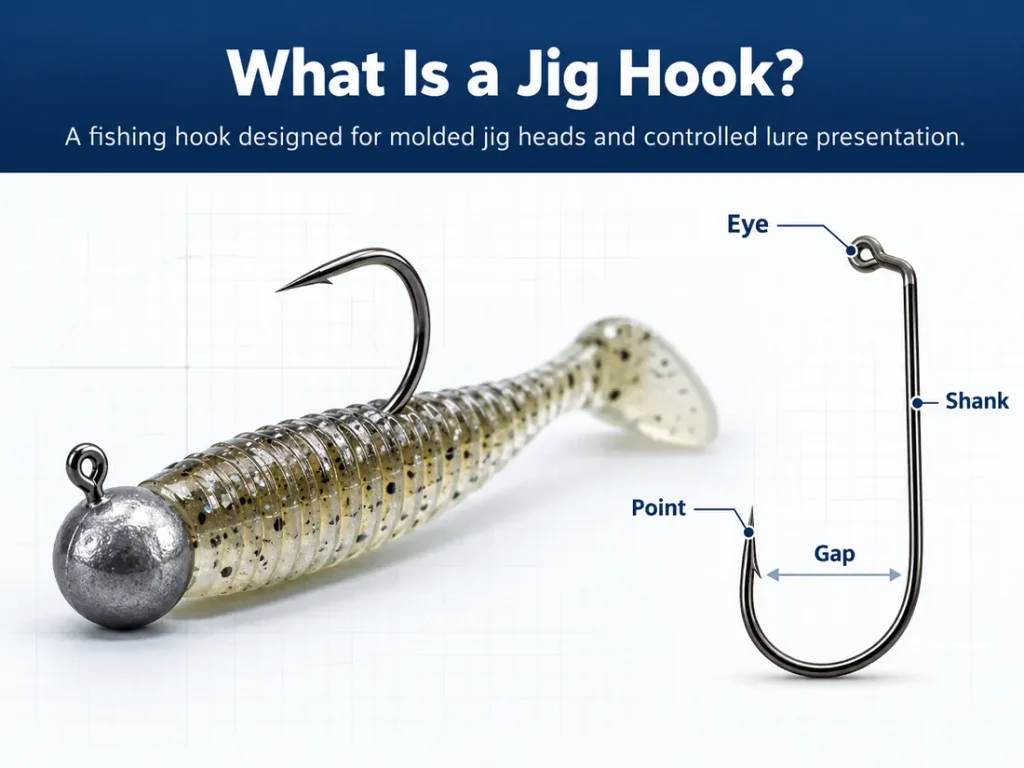
The differences are easier to see once the parts are named.
What Makes a Hook a Jig Hook?
A jig hook is defined by three features working together: an eye bent roughly 60 or 90 degrees off the shank, a shank long enough to carry a poured head plus a plastic or hair dressing, and a bend that stays stable when the line pulls from above. Remove any one and the hook still catches fish, but it stops behaving like a jig hook.
A jig is fished on a tight line most of the time. The head is what a fish reacts to on the fall, and the hook must stay strikeable while the bait sits, hops, or drags. A straight eye lets a bait hang differently on every touchdown, so the eye is bent to fix the relationship between line, weight, and point.
The Anatomy of a Jig Hook
| Component | Function | Failure when mismatched |
| Eye | Line tie, bent 60 or 90 degrees | Rough or open eye wears leader; wrong angle ruins resting attitude |
| Shank | Carries head, keeper, plastic | Too short crowds the bait; too long adds leverage |
| Gap | Distance from point to shank | Too narrow lets plastic fill it, so the point never reaches flesh |
| Point | Penetration and retention | A rolled point skips off hard jaws |
| Barb | Holds once through | Too tall tears tissue and slows release |
| Wire | Strength and penetration effort | Light wire bends on structure; heavy wire will not drive home on light tackle |
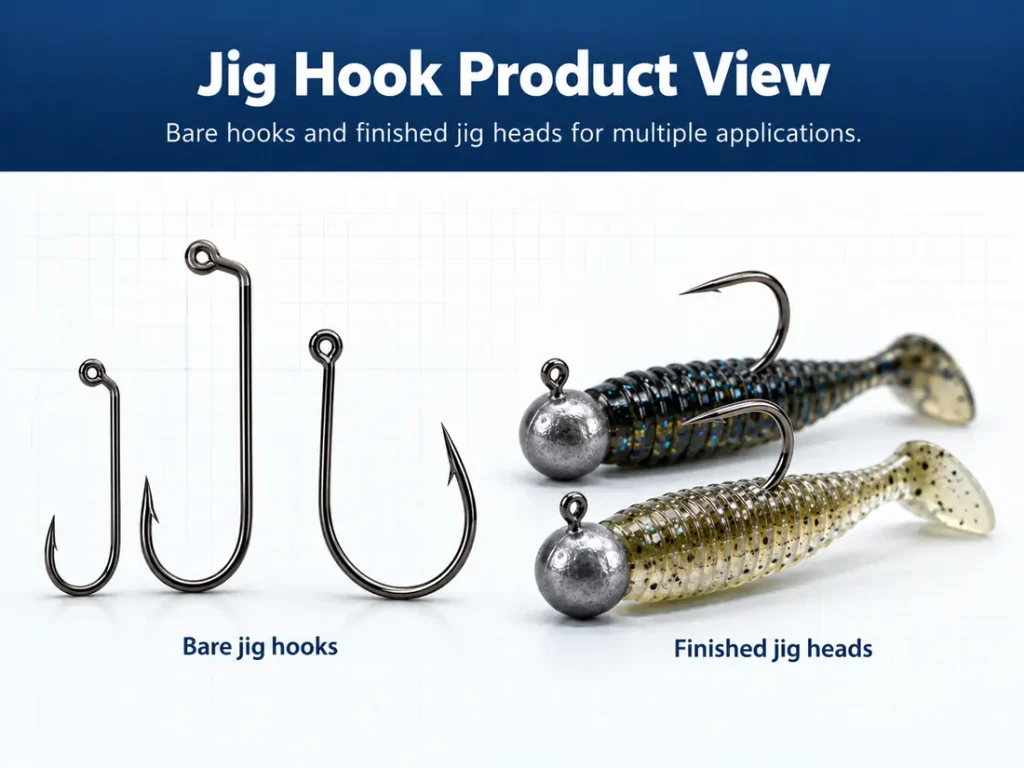
Heads are poured onto the shank, so Jig Hooks are sold either bare for custom pouring or already molded onto a finished head. Bare hooks are the flexible buy: the same hook becomes a ball, football, or stand-up head depending on the mold.
How Jig Hooks Differ From Standard J-Hooks
| Feature | Standard J-hook | Jig hook |
| Eye | Inline, or turned slightly | 60 or 90 degrees off the shank, sometimes flat |
| Shank | Sized to the bait | Long enough for a head plus bait room |
| Wire | Light to medium | Often 2X to 4X heavy |
| Typical use | Worms, live and cut bait, bobber rigs | Jig heads, swim jigs, bucktails, soft-plastic jigs |
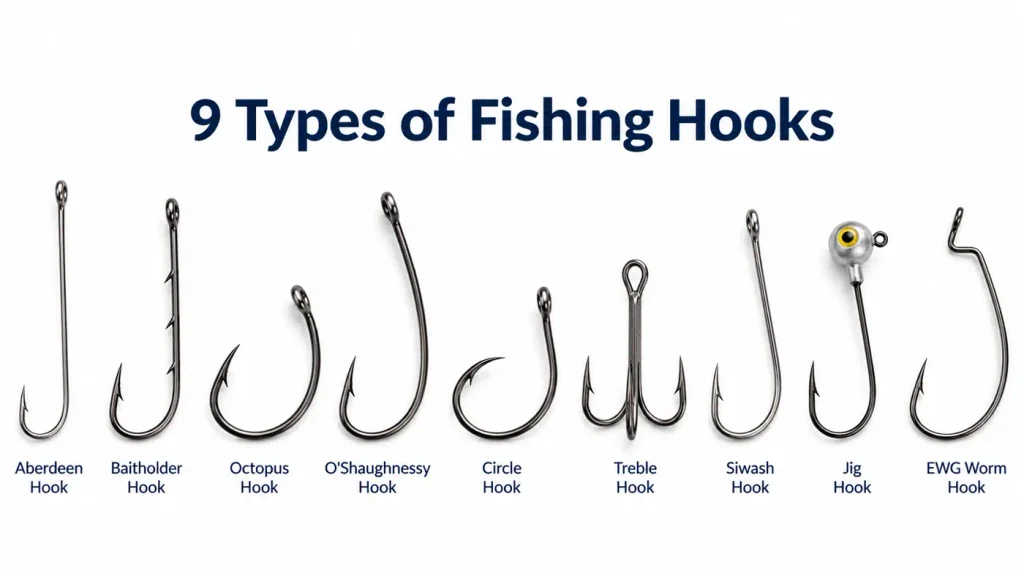
The two look alike and behave nothing alike: a J-hook suits bait that supplies its own weight, a jig hook suits a lure carrying weight at the front.
The Main Jig Hook Types and What Each One Does
Jig hooks are best sorted by four independent variables rather than by product name: eye angle, bend shape, wire gauge, and finish. Two hooks with the same size number can fish completely differently, which is why a catalog listing that gives only a size tells you almost nothing.
This matters when substituting patterns: a 3/0 in one family may carry a wider gap, a shorter shank, and heavier wire than a 3/0 in another.
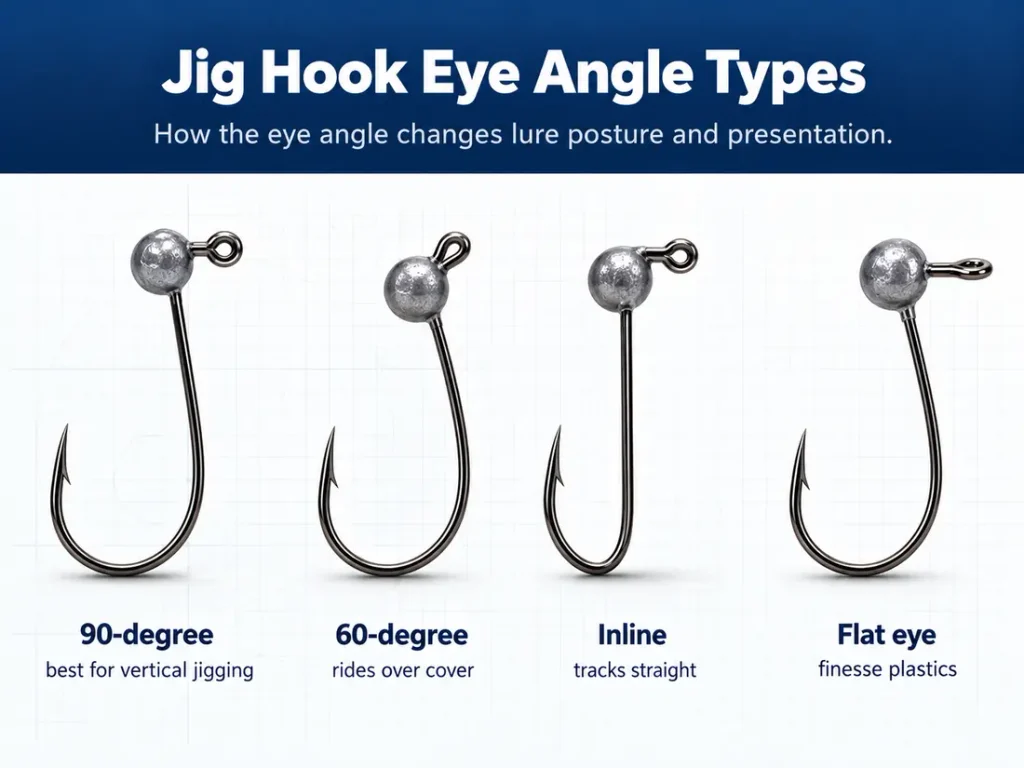
Eye Angle: 60-Degree, 90-Degree, and Inline
| Eye angle | How it sits | Best for | Trade-off |
| 90-degree | Horizontal, point below the tie | Vertical jigging, dragging bottom, pilings | Less weedless than 60 degrees |
| 60-degree | Nose down, rides over cover | Swimming jigs, casting plastics, weed edges | Rolls on its side on hard flat bottom |
| Inline | Axial pull, tracks straight | Swim jigs, spinnerbaits, metal jigs | Less stable for vertical work |
| Flat eye | Laid against the head | Finesse and shaky-head plastics | Poor for deep bottom contact |
A 90-degree hook is not stronger or better; it is aimed at a different presentation. Where rock and weed are split evenly, a 60-degree hook and a careful retrieve beat changing hooks every hundred yards.
Bend Shape: Round Bend, Wide Gap, and Sickle
- Round bend. Even curve from shank to point, spreading pressure and keeping a natural profile. The most forgiving shape for mixed presentations.
- Wide Gap Hooks. Extra distance between point and shank lets a craw, creature bait, or thick swimbait pass without crowding the point. Use them whenever a bulky bait fills a standard gap once rigged.
- Sickle bend. The angled curve holds plastics on the shank and lifts the point clear of the body, which suits finesse and shaky-head heads.
- Long shank. Leaves room for a bucktail collar or long narrow plastic, and speeds dehooking on deep-taken fish.
Gap is not the same as size. A wide-gap 3/0 and a round-bend 3/0 are nominally identical and fish nothing alike, so compare the gap against the thickest part of the bait.
Wire: Light, Standard, Heavy, and Extra-Heavy
Wire is quoted as a multiple of a maker’s baseline diameter, written 2X, 3X, or 4X. The figure is relative to that maker’s standard, not an absolute measurement, so check drawings rather than labels.
| Wire class | Strength | Penetration | Where it belongs |
| Light | Bends before it breaks | Easiest, even on light rods | Finesse, panfish, clear pressured water |
| Standard | Moderate | Balanced | All-purpose freshwater jig fishing |
| 2X | High | Needs a firm sweep | Bass in wood and grass, walleye in current |
| 3X to 4X | Very high | Needs a stout rod | Heavy cover, big fish, saltwater vertical work |
The trade-off cuts both ways. Heavy wire survives structure but needs more force to drive through a hard jaw, so it punishes light rods and lazy hooksets. Light wire penetrates almost effortlessly and bends free from a snag, but straightens on a good fish in cover.
Finish, Forging, and Barbless Options
Black nickel cuts glare and holds up in fresh water; tin and plated finishes are the usual saltwater choice; coated finishes add corrosion protection at the cost of a duller point transition. Forging compresses the bend and eye area, adding strength without more wire diameter.
Barbless deserves its own line. Official guidance on NOAA Fisheries catch and release best practices recommends barbless or crimped-barb hooks because they shorten handling time and ease release, and some fisheries now require them. A barbless jig hook holds well on a tight line and loses little on a properly loaded rod.
What Are Jig Hooks Used For?
Jig hooks are used wherever a weighted head has to hold a bait in a controlled attitude: vertical jigging over deep structure, casting and swimming plastics through the water column, flipping and pitching into cover, and dressing hair or feather jigs for everything from panfish to offshore bottom fishing.
Vertical Jigging and Bottom Contact
Straight-down work depends on a 90-degree eye so the bait hangs level and the point stays presented while the jig sits still. Offshore and deep vertical work leans on Jigging Hooks built with heavy wire and a reinforced eye, because the load is constant and fish are hooked close to structure. In fresh water the same geometry serves walleye over hard bottom and ice fishing, where a motionless level bait often triggers the strike.
Casting and Swimming Soft Plastics
Casting and retrieving demands a hook that rides over cover instead of into it, which is why 60-degree and inline patterns dominate. The bait must track straight at speed, and the shank needs enough length to stop a paddle tail bunching at the bend. Heavy wire is often wrong in open water, where light wire penetrates more easily at long range.
Flipping, Pitching, and Finesse Presentations
Short-range work inverts the priorities. The hook must survive a violent hookset and a fish burying itself in wood, so heavy wire and a forged bend are standard. At the finesse end, a light-wire hook with a sickle or round bend lets a pressured fish take the bait without feeling weight, and a fine point does the work with almost no rod input.
Freshwater and Saltwater Applications
Salt adds corrosion and load. Saltwater jig hooks usually use heavier wire, a marine-grade finish such as tin, and a larger size for the same bait, because saltwater fish have harder mouths and more pulling power. Inshore plastics typically land between 1/0 and 4/0, while offshore vertical jigging and heavy bucktails push into 5/0 to 8/0 on 3X or 4X wire.
How Jig Hook Sizes Work
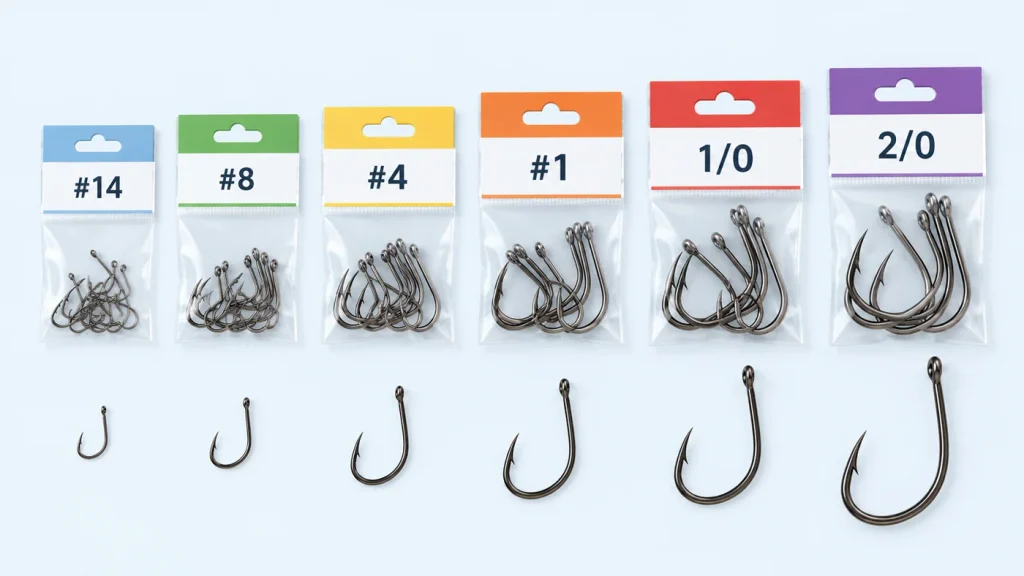
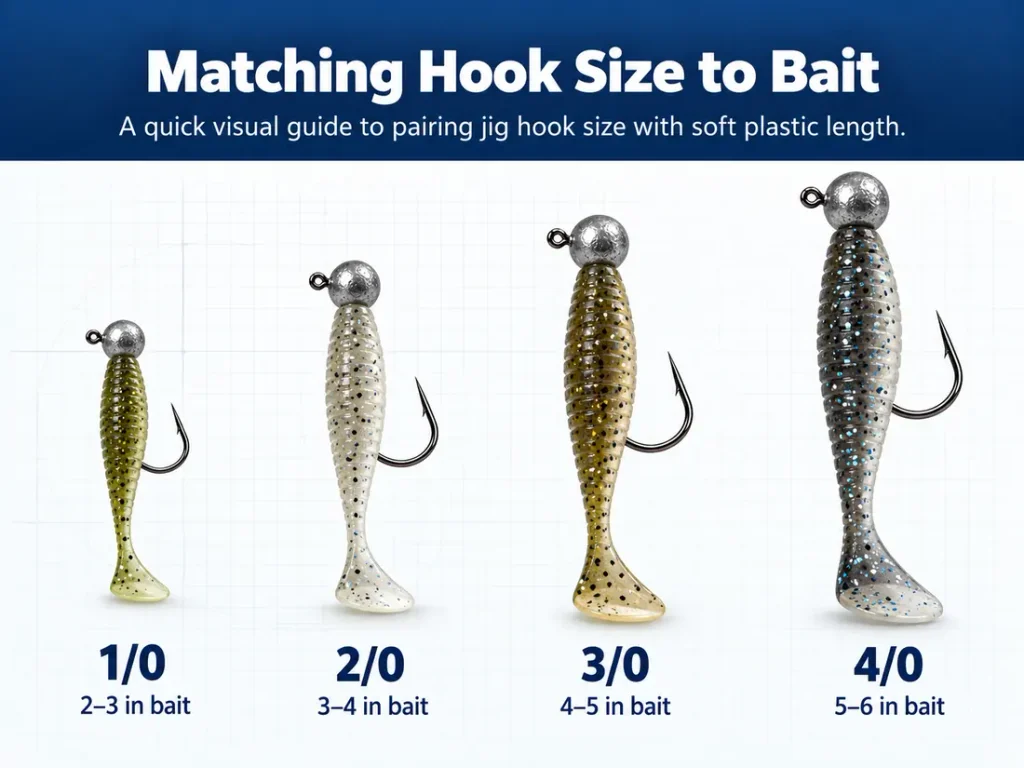
Jig hook sizes follow the general hook convention: whole numbers from 1 down to 8 or smaller get physically smaller as the number rises, while aught sizes such as 1/0, 2/0, and 3/0 get larger as the number rises. The numbering is not standardized between manufacturers, so a size number is a starting point for comparison, not a specification.
A Fishing Hook Size Chart translates nominal numbers into actual gap, shank, and throat measurements, and it is the only reliable way to compare hooks from different production runs.
| Hook size | Bait length | Common targets | Wire |
| 6 to 2 | 1.5 to 2.5 in | Panfish, crappie, perch | Light |
| 1 to 1/0 | 2 to 3 in | Trout, walleye, finesse plastics | Light to standard |
| 1/0 to 2/0 | 3 to 4 in | Bass, walleye, inshore salt | Standard to 2X |
| 2/0 to 3/0 | 4 to 5 in | Largemouth, smallmouth, pike | 2X to 3X |
| 3/0 to 5/0 | 5 to 7 in | Big bass, pike, musky, inshore | 3X |
| 5/0 to 8/0 | 6 in and up | Offshore bottom fish, large bucktails | 3X to 4X |
How to Choose a Jig Hook
Choose the bait first, then the gap, then the wire, then the size, and check the point last. That order prevents the most common mistake in jig selection, which is picking a hook that suits the target fish but not the plastic that has to pass through its gap.
Match the Gap to the Bait
Rig the plastic and look at it side on. If the body fills the gap, the point will never reach flesh, however hard the hookset. Move up a size or switch to a wide-gap pattern. Soft plastics compress and tolerate a tighter gap; hard, salted, or ribbed baits do not.
Match the Wire to Cover and Fish Size
Ask what the hook must survive, not what it must catch. Open water on light line calls for lighter wire, because penetration at distance is the limit. Wood, rock, and matted vegetation call for 2X and up, because a straightened hook ends the fight at once.
Match the Weight and Size to Depth and Current
| Head weight | Depth and conditions | Typical use |
| 1/32 to 1/16 oz | Under 3 ft, calm water | Finesse plastics, pressured or cold fish |
| 1/8 oz | 3 to 10 ft | The all-purpose pond and small river weight |
| 3/16 to 1/4 oz | 10 to 20 ft, wind, fast descent | Deeper banks, current seams, covering water |
| 3/8 to 1/2 oz | 20 to 33 ft, moderate to strong current | Deep ledges, pilings, river channels |
| 3/4 oz and up | Deep water, heavy current, rocky coast | Offshore bottom work, large bucktails |
Use the lightest head that still reaches bottom and stays in contact. Too heavy drops past the strike zone before a fish reacts; too light lets current sweep it off the structure.
Check the Point Before You Buy
Point geometry decides the one contact that matters. A needle point slices in with minimal resistance and is fastest through a soft mouth, but the fine tip rolls against rock. A cutting point opens tough jaws and holds its edge longer, at the cost of a harder drive. Drag a new point across a thumbnail: it should bite without pressure. If it skids, it will skid on a fish.
A Default Setup for Beginners
One pattern fished well beats five fished badly. A 60-degree eye, standard or 2X wire, round bend, sizes 1/0 to 3/0, in black nickel or tin covers most freshwater soft-plastic jig fishing and stays serviceable in light salt. Add a wide-gap version for bulky craws, and a 90-degree hook only when vertical work enters the rotation.
What Bulk Buyers Should Specify
Volume buyers need the specification locked before production, because the differences that matter on the water are invisible in a catalog photo: wire diameter tolerance, temper, gap and throat dimensions, point angle, eye closure, finish thickness, and batch consistency.
| Specification | Why it must be fixed first |
| Wire diameter with tolerance | Sets strength and mold fit |
| Temper and hardness | Decides whether the hook bends back or snaps |
| Gap, throat, and shank | Defines bait compatibility and usable size |
| Point geometry and angle | Sets penetration force and dulling rate |
| Eye diameter and weld | Affects knot seating and abrasion |
| Finish and salt-spray hours | Decides service life in salt and shelf life |
| Straight-pull and bend tests | The only objective proof of what it survives |
Private-label and custom-head projects usually run through OEM Fishing Tackle Manufacturing rather than a stock catalog order, because head geometry, hook, and packaging must be approved together. Signing off a physical sample against a dimensional drawing remains the cheapest quality control available.
FAQ
The questions below cover what the sections above leave open: worm hooks, fishing without a head, and the knot.
Are jig hooks and worm hooks interchangeable?
Only when no head is being poured. A worm hook has an offset shank and an inline eye, so a plastic can be rigged weedless and pulled straight. A jig hook has an angled eye and no offset, so weightless it hangs at a different angle. Both catch fish in still water, but they are not drop-in substitutes.
Can you fish a jig hook without a jig head?
Yes. A bare jig hook works for weightless plastics, for tube baits where the body supplies bulk, and for hair or feather dressings swung through current. The angled eye still changes the resting attitude, so expect a slightly nose-down sit.
Do jig hooks need a special knot?
No. The eye takes the same knots as any hook, including the improved clinch and the Palomar, and a loop knot works when you want more freedom at the head. Do check the inside of the eye: a rough or gapped eye abrades light fluorocarbon over a long fight.