A tackle shop wall looks like a museum of small decisions: hundreds of wire shapes, under names that rarely explain themselves. Most of those ranges, including most of what is sold as Bait Hooks, are variations on a small number of geometries, and learning the geometries is faster than memorising a catalogue.
Many commonly used fishing hooks fall into nine recognizable patterns, none of them inventions so much as settled answers to the same trade-offs. Some are primarily designed for natural bait, others are commonly used with artificial lures, and several work well in both. Once you can read the features that separate them, the wall collapses into a short list.
What follows takes them one at a time, because the differences that matter are visible in your hand.
What Separates One Hook Pattern From Another
Most fishing hook patterns can be understood by comparing five key design features: wire thickness, gap width, shank length, eye angle, and point orientation. Additional features, such as shank barbs, bend shape and multiple points, distinguish certain specialist patterns, but the five carry most of the decision.
Start here rather than with names, because a name records where a hook came from, not what it will do. Two patterns can share four of the five features and differ only in where the eye points, which changes how the hook hangs and which knots seat on it. Those five are also the terms a standard hook anatomy reference uses, which is why patterns can be compared at all.
| Design feature | What it buys | What it costs |
| Thinner wire | Faster penetration and livelier bait | It bends before the line reaches its limit |
| Wider gap | Clearance for thick bait, and a bite that reaches further round the jaw | The same wire spans further, so it gives way sooner |
| Longer shank | Keeps teeth away from a light leader | More leverage for a fish to work the point loose |
| Eye turned up toward the point | A straight pull from a snell, point leading | Little gained once a head or clip replaces the knot |
| Eye set at a right angle to the shank | Pull runs down through a moulded head, not across it | It will not hang straight from a knot alone |
| Point aimed back toward the shank | Turns into the jaw corner under steady load | No room left for a hard strike |
Read that table as prices rather than advantages. A pattern that solves a problem in one row pays for it in another, and the nine survive because the price is worth paying somewhere.
Why Pattern Names Do Not Travel
The same geometry is sold under different names in different markets, and a term that means a short-shanked bait hook in one catalogue can describe something closer to a long-shanked saltwater pattern in another. A name is therefore a starting point and never a specification: compare gap, overall length and wire diameter on a sample, and treat the name as the label on the box rather than a description of the contents.
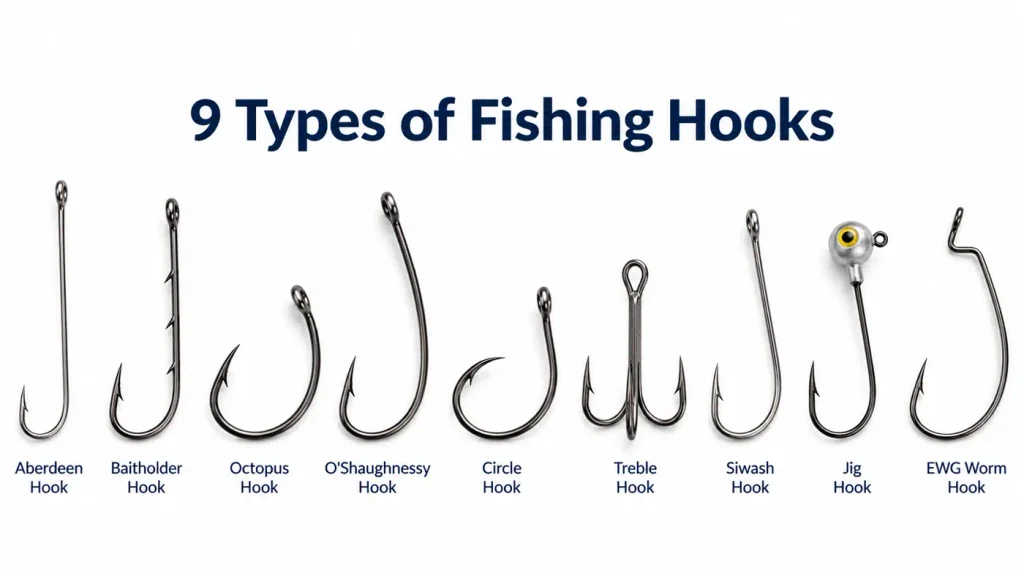
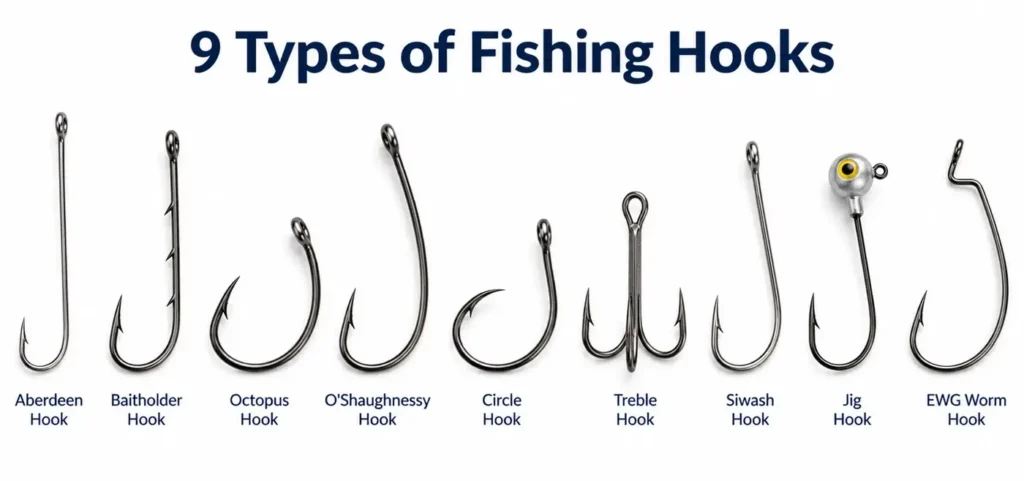
9 Types of Fishing Hooks and How to Use Each One
The nine group themselves in a way that helps reading but is not a rule. Five are mostly used with natural bait: Aberdeen, baitholder, octopus, O’Shaughnessy and circle. Four are mostly used to arm a lure: treble, siwash, jig and extra-wide-gap worm. Several cross over, so the group marks where a pattern starts, not what it may do.
Aberdeen Hook
A light wire, a wide round bend and a long shank, usually with a ringed or spade eye. How to use: small live bait or a worm on light line, with a smooth lift rather than a snapped strike, because the wire straightens under a hard pull. Best for: small live baits, worms and light tackle, and snaggy water where a light wire can be eased out rather than broken off; a visibly deformed hook should be replaced rather than reused, since bent wire does not return to full strength. When to avoid: loads the wire was not built for, such as a locked drag in heavy current or a hard strike into a big fish, though gentler flow can still suit it.
Baitholder Hook
A long shank carrying two or three barbed notches on its back, with a straight or slightly offset point. How to use: thread a worm or a soft strip up the shank so the notches bite into it, then leave the bend and the point clear. Best for: still water and worm or strip bait, on float and ledger rigs where bait must survive a cast and some nibbling. When to avoid: thin bait that the notches shred, and fisheries where every fish is going back.
Octopus Hook
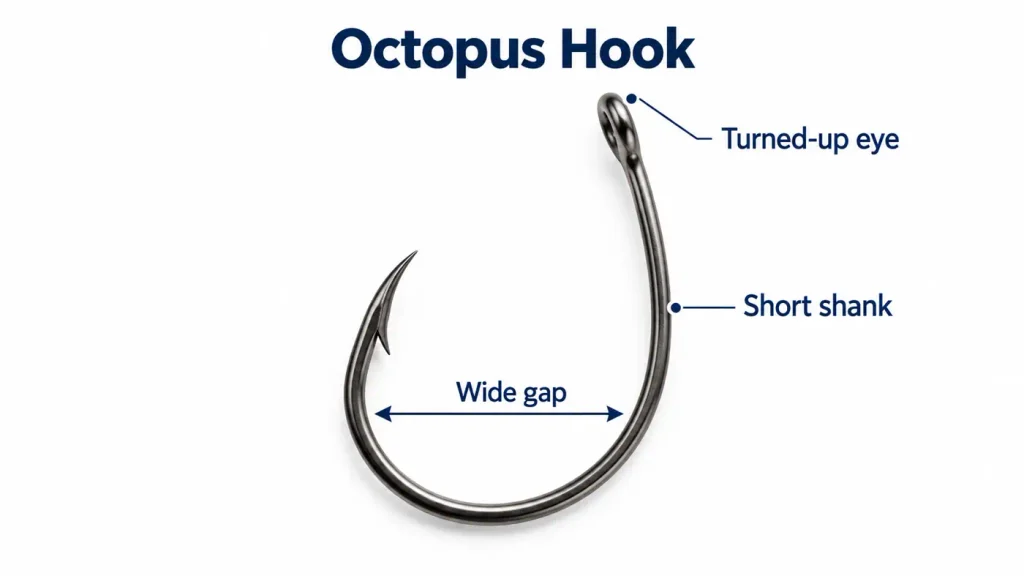
Octopus Hooks are built on a short shank, a wide gap and an eye turned up toward the point, with the point angled slightly out of the shank’s line. How to use: tie direct or snell the eye, and keep the bait short enough that the bend stays exposed. Best for: live and cut bait over structure, and boat work in current where the gap must clear a chunk of bait. When to avoid: very small mouths, and long baits that need a shank to lie along.
O’Shaughnessy Hook
O’Shaughnessy hooks commonly combine forged construction with a versatile bend and a point that runs close to parallel with the shank, while shank length and wire strength vary by model, so a long shank is a common form rather than a fixed feature. How to use: pair it with a heavier leader and a firmer bait, and drive it with a steady sweep rather than a snap. Best for: salt water, trolling and live bait for hard-mouthed fish. When to avoid: fine presentations, because the heavier wire makes a small bait behave unnaturally.
Circle Hook
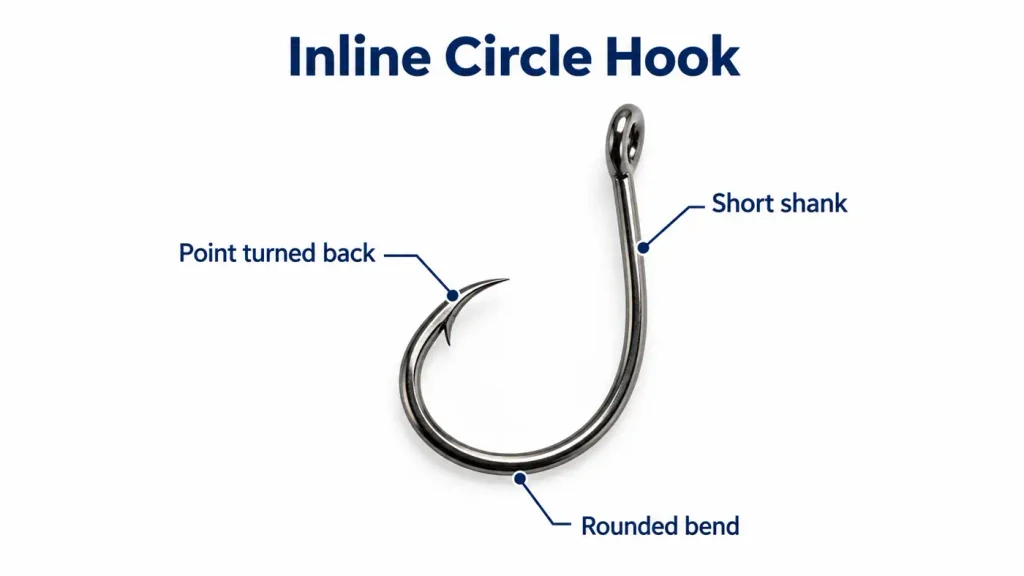
A point turned back toward the shank, a bend that closes into a near circle or oval, and a shank that is usually short. How to use: let the fish load the line and do not strike; lift the rod and reel steadily until weight comes on, and the geometry turns the point into the jaw corner on its own. That is the design brief behind Circle Hooks, and why a hard strike works against you. Best for: bait fishing where the fish are going back, and current heavy enough that a fish hooks itself against the drag. A review of longline gear studies found these hooks lodge in the mouth or jaw more often than straight-shank patterns; inline versions keep the point in line with the shank, offset versions angle it to one side, and non-offset hooks are the usual choice for release work and are required in some regulated fisheries, so check the local rules. When to avoid: lure fishing, and any bite that must be driven home through a bony mouth in the first second.
Treble Hook
Three points on one shank and one eye, with two of them hanging free. How to use: hang it from a split ring so the points swing clear of the body, and check they hang below the lure rather than against it. Best for: hard lures and spoons in open water, and as a stinger on long soft baits. When to avoid: weed, wood and shallow structure, and any trip where the fish are being released.
Siwash Hook
A single hook with a short shank, a long point and a straight eye, often an open eye closed onto the lure. How to use: open the eye, seat it on the ring, close it with pliers until the gap is shut, then check it still pivots freely. Best for: replacing a treble on a spoon or spinner where one point and an easier release beat three points. When to avoid: lures that depend on multiple points to hold fish that swipe short.
Jig Hook
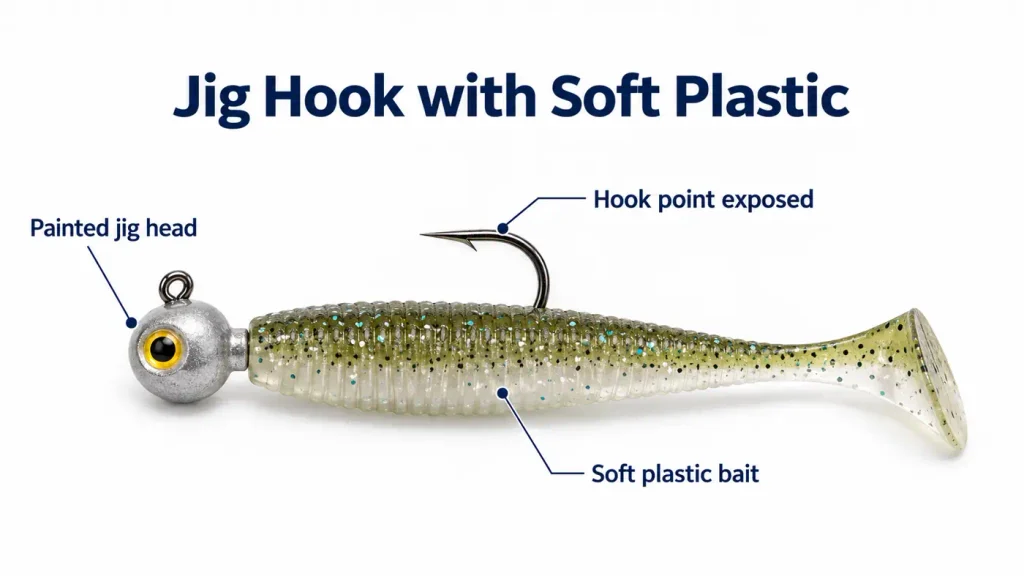
A hook with the eye bent out of the shank line, heavy forged wire, and a shank far shorter than the gap. How to use: pick a jig head whose weight and hook size match the soft plastic, thread the bait straight onto the hook so it sits square behind the head, leave the point exposed or rig it weedless in cover, then work it with controlled lifts, short hops or a steady swim. Best for: vertical work and bottom contact in current, where the pull runs in line through the head and the wide gap clears a bulky body. When to avoid: long bait presentations, and light-line work where heavy wire will not travel through a mouth easily.
The eye angle varies by design rather than being fixed: 60 and 90 degrees are common, and 30 degrees turns up on heads that hang closer to horizontal. Jig Hooks are usually supplied bare for that reason, with the head matched to the hook.
Extra-Wide-Gap (EWG) Worm Hook
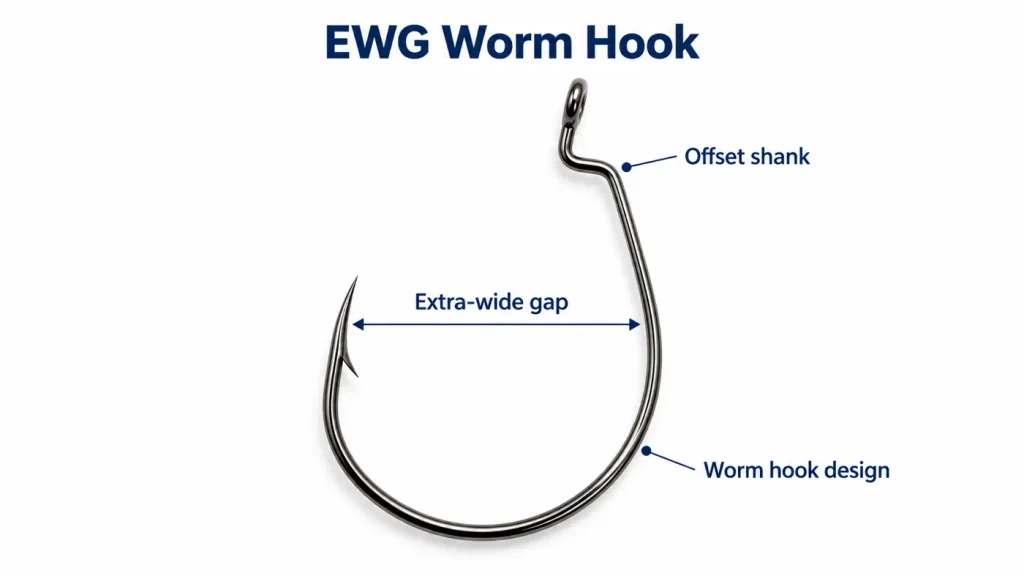
An extra-wide gap on a shank that steps near the eye, with the point inline or slightly offset and often a keeper for the plastic. How to use: enter the nose, bring the point out through the body, slide the bait up over the step, then bury the point in the plastic for weedless work or leave it proud. Best for: soft plastics in and around cover, where the extra gap gives the point room around a thick body. When to avoid: small baits, where the gap is wider than the bait and the point has nothing to cross.
How Water Conditions Affect Fishing Hook Choice
Water condition is one input rather than the answer. What the water does to the line and the bait narrows the pattern, then bait thickness, technique and the tension you can hold finish the choice, which is why two anglers in the same current can both be right.
Still water asks the hook to do the holding, because nothing else loads the line. Moving water loads it for you: a steady current drags line and bait, so a light wire that hangs well in a pond starts to plane and swing. Surf and wash are harder again, because the line slackens and snaps tight inside one wave, the cycle a self-seating point handles best.
| Water condition | What it does to the rig | Suitable hook patterns and why |
| Still water, soft presentations | Almost no load, so holding is mostly the hook’s job | Light-wire bait patterns such as Aberdeen may suit, with a gap that clears the bait |
| Steady river current | Continuous drag on line and bait | Octopus or jig patterns may suit, since a short shank resists planing |
| Surf and heavy wash | Line slackens and tightens within one wave | Circle hooks may suit where a fish can load the line, O’Shaughnessy where forged wire matters |
| Deep vertical work | Contact matters more than feel | Jig patterns, where an eye set out of the shank line keeps the pull through the head |
| Open water at trolling speed | Constant tension, no slack, hard mouths | O’Shaughnessy for bait, treble or siwash for lures, on the heaviest wire the fish tolerates |
The same water can justify two answers, and the bait settles it. A slow river with a whole dead bait wants an octopus hook’s wide gap; the same river with a soft plastic wants EWG clearance. Use water to remove half the list, then stop looking at water.
Which Type of Fishing Hook Is Best?
No pattern is best in the abstract. The best hook is the one left standing after four questions: what you are presenting, how you are working it, what the hook has to survive, and only then what size it should be.
- Determine the presentation, including how thick it is and whether the point has to be buried.
- Match the pattern to the technique: bait under a float, bait moving in current, plastic through cover, or a lure at speed.
- Check gap, wire strength and point design against the mouth you expect, since gap decides clearance and wire decides whether the point arrives.
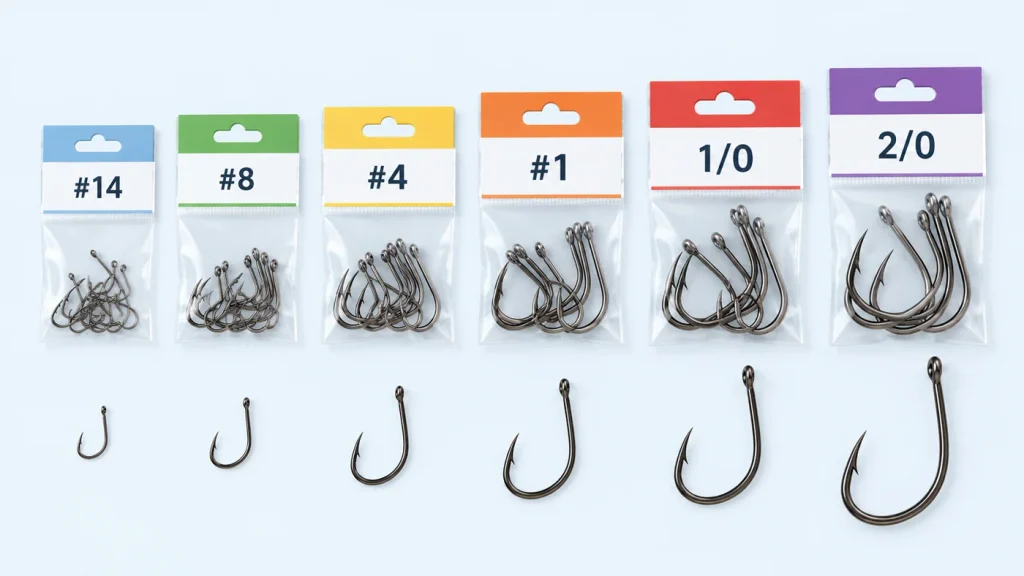
- Choose the size last, because the number is the last thing to settle, and the conversion belongs with the Fish Hook Size Guide.
A three-pattern set covers most seasons: a light-wire bait hook for small natural baits, an octopus or circle for bigger bait and moving water, and an EWG for plastics. Overturn that when the water changes the load rather than the presentation. Wire is usually the better place to start than size, but the trade runs both ways: heavier wire dulls a small bait and asks more of the strike, so the answer is the heaviest wire the bait still carries.
Frequently Asked Questions
Each question below turns on a distinction a pattern name does not make for you.
Can a Saltwater Hook Be Used in Freshwater?
Yes, and the label matters less than wire diameter, finish, size and the water the hook was built for. Saltwater ranges often carry heavier wire and a better finish, but plenty of freshwater patterns are forged from heavy wire too, and a light hook is not automatically wrong in salt. In fresh water a salt-rated hook is simply more hook than the job needs. Go the other way and the risk is real: a light freshwater hook left wet in salt air corrodes and can fail at the bend.
Does a Wider Gap Mean a Bigger Hook?
No. Gap is one dimension among several, and two hooks with the same number can differ visibly in gap. Gap decides whether the point clears the bait and reaches round the jaw, length decides how much bait the hook supports, and wire decides how much load it survives. Judge all three on a sample, not on the number.
What Is the Difference Between an Offset Point and a Wide Gap?
They are separate attributes and regularly confused. An offset point is bent out of the plane of the shank, which changes the angle at which the point meets flesh. An offset shank is a step near the eye that holds a soft bait in place. A wide gap is simply the distance from shank to point, and a hook can carry a wide gap with an inline point at the same time.