A bait comes back stripped to the shank, or the hook comes back bare. These failures rarely start at the knot. They happen where the bait meets the hook, because bait is a compressible mass competing for the space the point needs to travel.
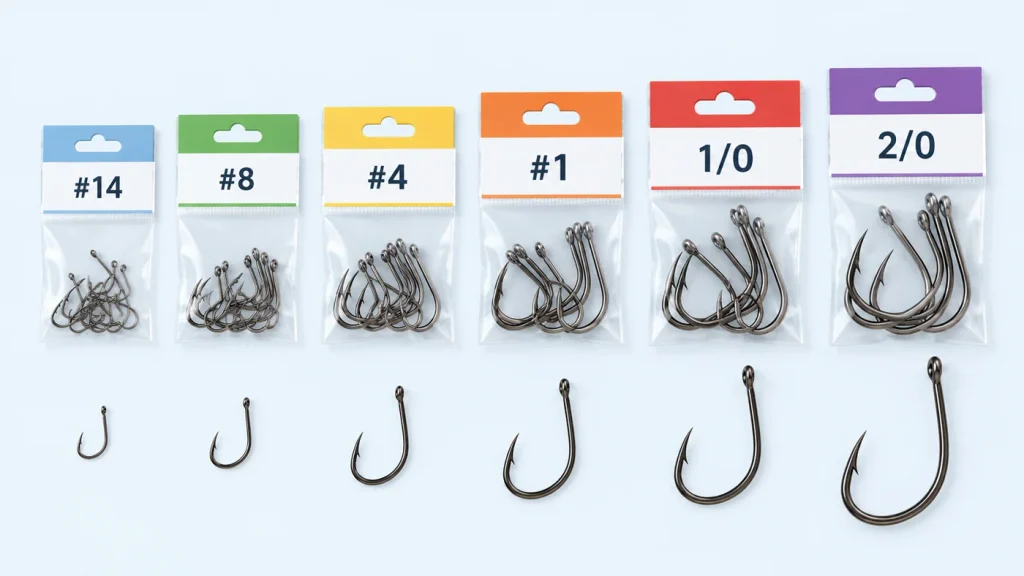
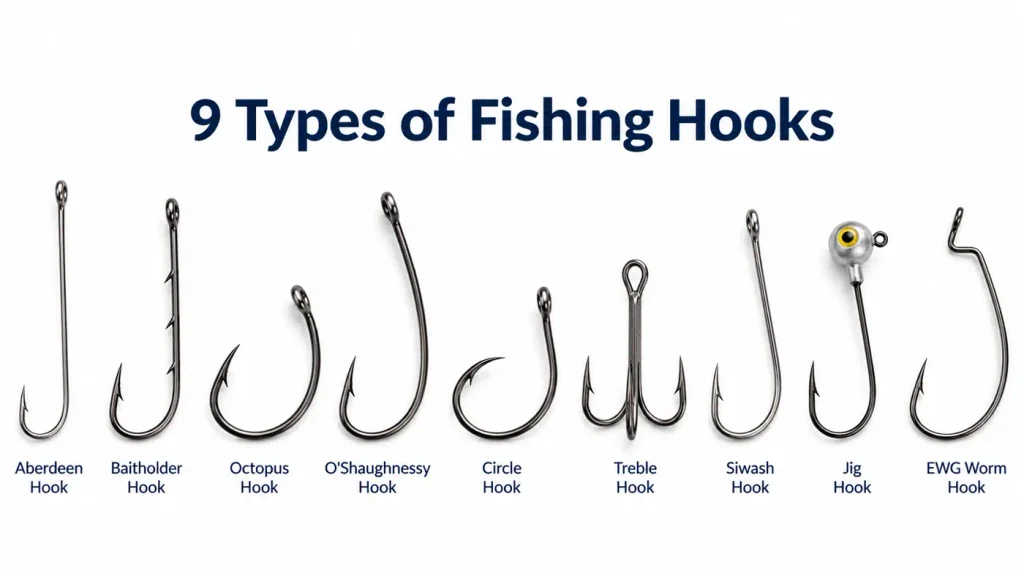
Tying a hook for bait means finishing two jobs: connecting the hook to the line, and fixing the bait to the hook so the point can still move. This guide covers the second. A properly baited hook lets the point exit the bait, leaves enough gape for the bait to be pushed aside on the strike, and keeps the bait attached through the cast. The baits below run from live worms and shrimp to cut strips, soft plastics and hard hookbaits, and the Bait Hooks range shows how differently those hooks are built.
The order below follows the bait rather than the knot.
What Makes a Properly Baited Hook Work?
A bait is rigged correctly when three things are true as a fish takes it: the point can leave the bait, the gape still has room for the jaw, and the bait is anchored firmly enough to survive the cast. Miss one and the rig fails in a way that looks like bad luck.
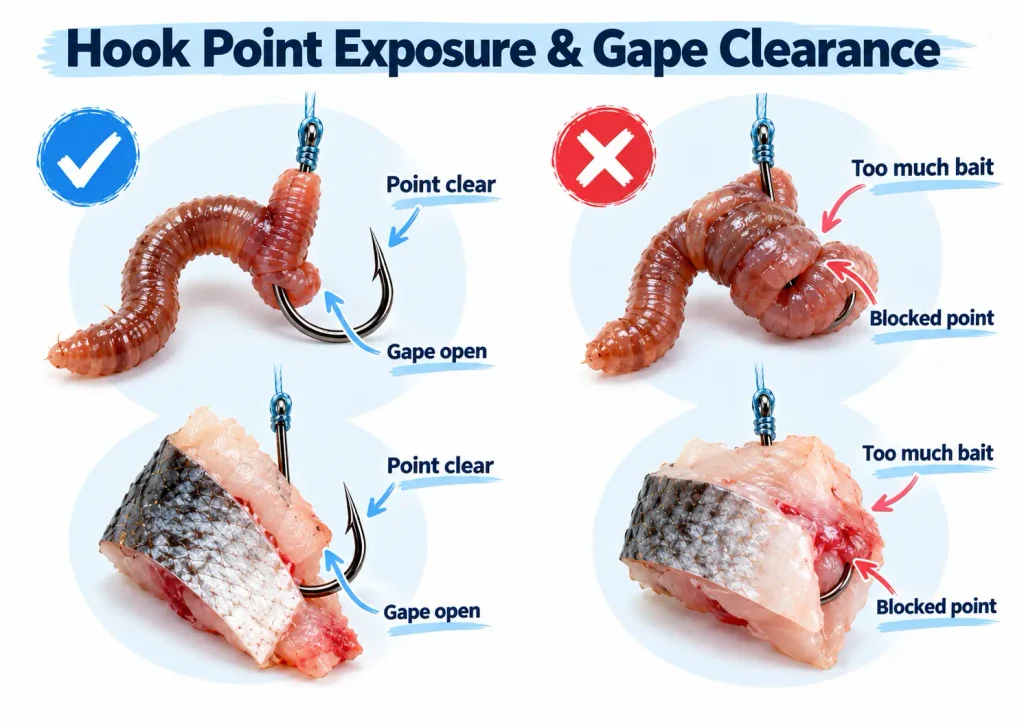
Bait occupies volume. A worm bunched over the bend or a fillet folded across the gap turns an open hook into a solid lump, and the point arrives with nothing to grab.
Hook Point Exposure and Gape Clearance
The gape is the open distance between the point and the shank, and bait decides how much of it stays usable. The same holds for the throat, the pocket below the bend, which bait can fill so completely that the hook cannot turn. Specialists writing about keeping the gap and throat clear of bait treat that pocket as a bucket that has to stay empty.
Point exposure is a separate question, and where blanket advice goes wrong. Some rigs need the point proud, others bury it on purpose: a Texas rig hides the point so the plastic can be dragged through cover, and the strike pulls the plastic down the shank to free it. What travels across bait types is a mechanical test. Hold the baited hook at eye level, pull the bait toward the bend the way a jaw would, and watch the point. If the bait slides aside and the point reaches open space, the rig will hook.
Keeping the Bait Secure Without Blocking the Point
Three variables control how firmly bait sits without smothering the hook: how much bait goes on, how many times the point passes through it, and where the bait sits on the shank. Extra passes add grip but compress the bait; bait pushed against the eye stays put, bait left over the bend masks the point. Before casting, check that the bait hangs straight, the point has a clear line of travel, and the bait does not rotate freely.
How to Put Live Bait on a Fishing Hook
Live bait is hooked for two purposes at once: to hold it on the hook and to keep it moving. Those goals pull against each other, because the firmest hold damages the bait and the gentlest hold loses it on the cast. The compromise is to pierce tough tissue, avoid vital organs and leave the fragile parts free.
Where the point enters matters more than how deep it goes. Most live bait has a tough anchor a few millimetres from a vulnerable zone.
Hooking Worms, Maggots, and Soft-Bodied Bait
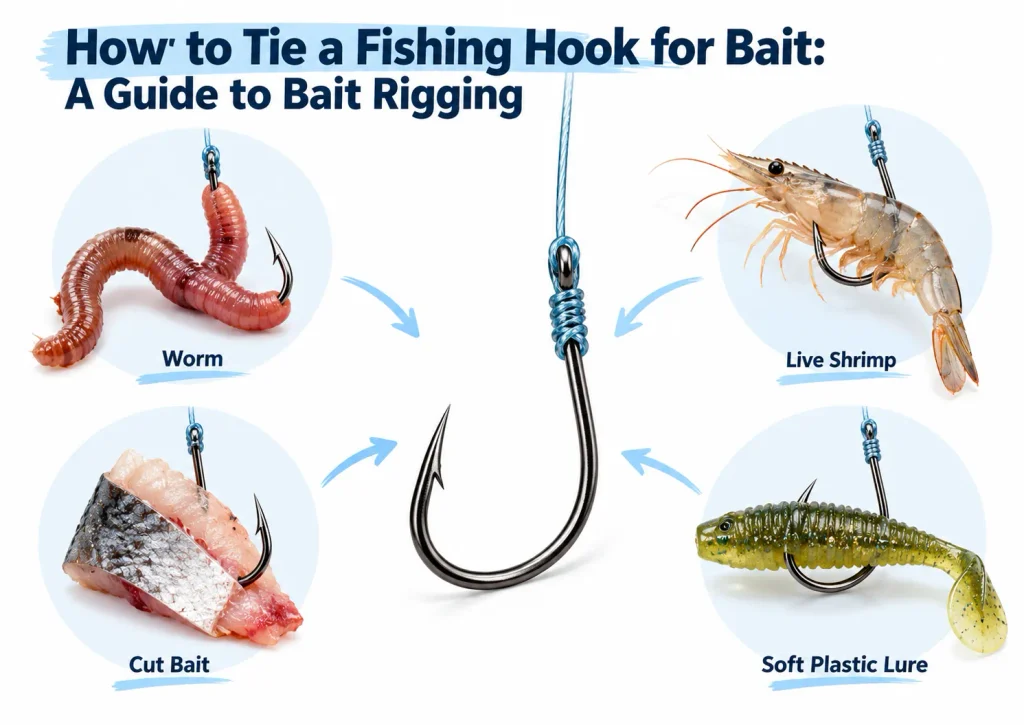
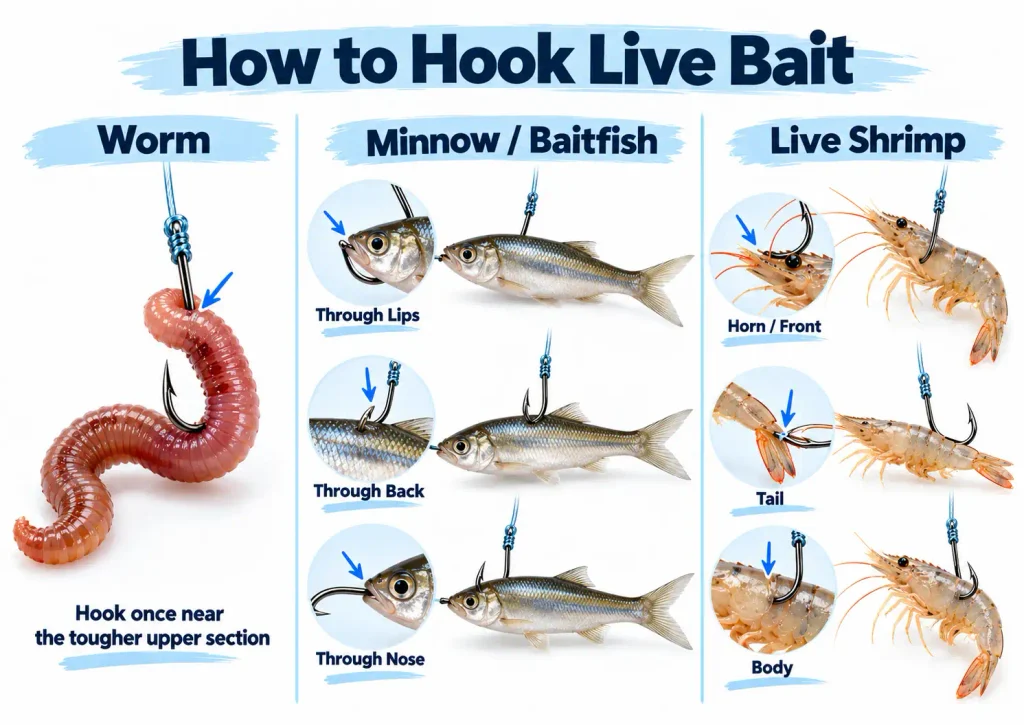
A nightcrawler has a thickened band near the head, and that band is the best anchor: one pass through it, with the rest of the worm free to writhe. Threading the worm up the shank holds better in current but kills it faster and blocks more of the shank. Small red worms take a single pass through the middle.
Maggots go on through the blunt end, just under the skin where the casing is toughest. Small hooks carry one or two, and piercing the body cavity turns a maggot into a husk within minutes.
Hooking Minnows and Live Baitfish
Minnows can be hooked in three places, and each position changes how the bait swims.
- Through both lips, entering under the chin and exiting between the nostrils. The bait faces into the current, but the lips tear on hard casts and after repeated strikes.
- Through the back, just forward of the dorsal fin and shallow enough to miss the spine. This is the most natural swimming position and the most forgiving on long casts.
- Through the nose with a bridle or a rubber band holding the bait, so the hook hangs outside it and the gape and throat stay free of flesh.
Avoid the spine on all three. A baitfish hooked through the backbone stops swimming and starts spinning, and an upright bait that kicks is worth three that hang sideways.
Hooking Live Shrimp
Shrimp are one of the most sensitive live baits: the vital nerve centre sits in a dark spot just behind the base of the horn, and a point through it kills them almost immediately.
Horn hooking enters under the chin behind the rostrum and exits through the shell forward of the dark spot, leaving the organs intact. The shrimp keeps kicking for a long time, which makes this the standard choice in calm water, but the tissue is thin and the cast has to be a smooth lob.
Tail hooking passes the point through the last or second-to-last tail fan segment, staying off the dark vein. It is the most durable option for long casts, and the weight-forward profile flies well, but the tail carries the load and the bait tires sooner.
Body hooking holds best in strong current and deteriorates fastest. Small, fine-wire hooks matched to bait size reduce the wound, which is the reasoning behind patterns such as the AYU Hooks built around small live baits.
| Hook Position | Best For | Bait Life | Cast Durability |
| Horn, forward of the dark spot | Calm water, light current, selective fish | Longest | Low, needs a smooth lob |
| Tail fan segment | Long casts, strong current, rough handling | Moderate | Highest |
| Body segment behind the head | Holding in heavy current | Shortest | High |
How to Hook Dead Bait and Cut Bait Securely
Dead bait does not need to stay alive, so every decision can favour staying attached. The priorities shift to cutting the bait to fit the hook, using the toughest tissue as the anchor, and controlling how much of the bait sits inside the gape.
Hooking Fish Chunks, Fillets, and Strips
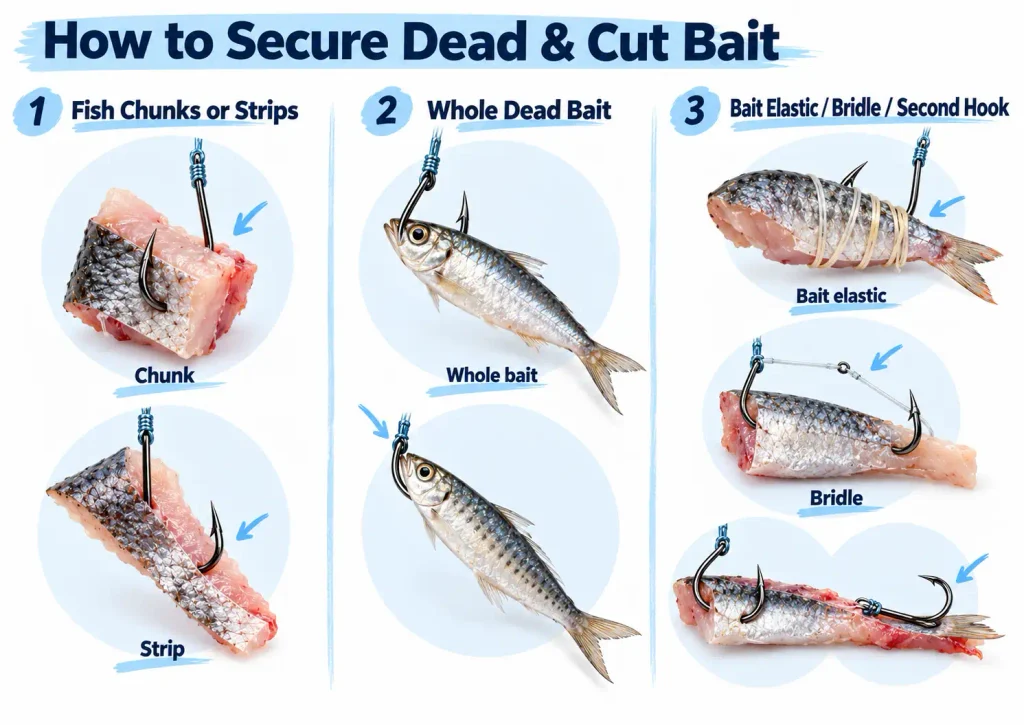
Cut the piece to roughly the size of the gape rather than the size of the hook, then pass the point through two corners on the same face so the bait hangs from a corner and flutters. A chunk threaded onto the shank like a sleeve sits tighter but masks more of the hook.
Fillets and strips hold best when the skin does the work. Enter through the flesh, run the point along the strip and exit through the skin near one end; a strip hooked only through flesh tears free on the first decent cast. Long strips can be folded once and pierced again to shorten the profile.
Securing Whole Dead Bait
Whole baitfish and squid are hooked through the head, through both lips or the bridge of the nose, so the bait trails behind the hook. A bait hooked mid-body tends to spin. For large baits, a bridle made from a rubber band or a short loop of line through the eye socket holds the bait behind the hook eye and leaves the gape untouched. Squid take a single pass through the tip of the mantle.
When Bait Elastic or a Second Hook Helps
Bait elastic earns its place with anything that tears: soft fillets, shellfish, worms, and baits that must survive repeated casts into surf. Wrap three to five turns around bait and shank under light tension, crossing diagonally so the wraps lock, and finish with the point clear. Elastic does not fix a wrong hook path, it only stops the bait sliding.
A second hook or stinger suits baits longer than the hook can control, such as whole squid. The trade-off is more points to foul a fish or an angler, and local rules often limit how many hooks a bait may carry. A wider gape carries a bigger bait without surrendering clearance, which is the role of a pattern such as Wide Gap Hooks on large cut baits.
How to Rig Soft Plastic Baits on Fishing Hooks
Soft plastics are the one bait type where the hook is meant to be hidden at rest. The rig works because the plastic slides down the shank when a fish bites, uncovering the point at the moment it is needed. Everything is judged by whether that release happens cleanly and whether the bait tracks straight.
Bad rigging shows two symptoms: the bait rolls on the retrieve, and the point never clears the plastic on the strike.
Texas Rig for Weedless Presentations
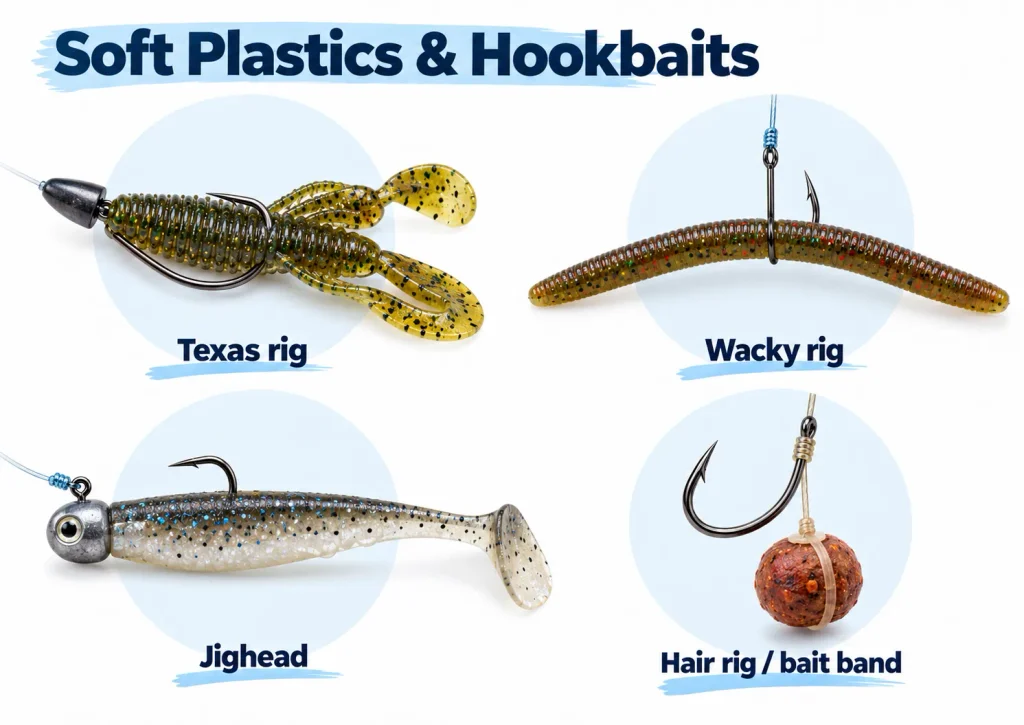
The point enters the nose, exits the top, slides to the bend and turns back into the body so it lies flush. The bait should sit straight with no kink at the entry hole. This is the rig for cover, and the buried point is deliberate. On the strike the plastic is pushed down the shank and the point is exposed against the jaw, so the hookset has to be firm enough to complete that travel.
Wacky Rig and Nose-Hooked Plastics
Wacky rigging passes the hook through the middle of the plastic, leaving both ends free to quiver as the bait falls. The point stays exposed, so hookups on a slow fall are high, but the bait is easy to lose in cover. An O-ring around the middle extends bait life. Nose hooking through the tip of the head achieves a similar slow fall.
Rigging Paddletails on Jigheads
A paddletail has one correct alignment: straight. Enter at the nose, exit through the top of the back, and check that the bait sits square to the jighead. A twisted bait swims in a corkscrew and the tail works against the head.
How to Secure Pellets and Boilies Without Piercing Them
Hard hookbaits cannot be pierced reliably. A pellet or a boiled bait pushed onto a hook either splits or slides off, so these baits are held rather than impaled: gripped by a band, or hung on a short hair below the bend. The hook carries the bait without passing through it, which leaves the point and gape untouched.
Hair and band rigs dominate hard-bait fishing.
Bait Bands Versus Hair Rigs
A band holds the bait by tension. A hair rig hangs the bait on a short loop below the bend, placing it where a fish taking the bait also takes the hook. The banded version of the knotless knot combines both, and the sequence below follows one published banded rig walkthrough.
- Thread the band onto the line and trap it inside an overhand loop.
- Tighten with a baiting needle passed through the loop rather than your fingers, leaving the smallest loop that holds the band without strangling it.
- Hold the band so its lower edge lines up with the bottom of the bend.
- Whip the line down the shank in tight even turns, as far as the start of the bend.
- Pass the line back through the eye and pull steadily so the wraps lock.
- Check that the band hangs in line with the point, and add thin silicone tubing on the shank if the hair needs trapping.
The band stretches around a pellet or boilie, or is pulled through a drilled bait with a needle so it grips from inside as it contracts. Drilled baits hold better than banded ones.
Keeping the Hook Point Clear
Because the bait hangs below the bend, the point is never covered. The check is whether the band or hair can swing back over the point during the cast; a band set level with the bottom of the bend stays clear, one set higher can fold across the gap.
Why Bait Falls Off or Blocks the Hook Point
Almost every bait failure has a visible cause before the cast. Reading the symptom backwards usually identifies the fault without re-rigging from scratch.
| Problem | Likely Cause | How to Fix It |
| Bait slides down to the bend | Too few pierces, nothing gripping the shank | Add a bait stop, use a shank with holding barbs, or take one more pass |
| Bait tears off on the cast | Soft flesh carrying the load, or a snapping cast | Anchor on skin or a tough segment, add elastic, lob rather than snap |
| Hook comes back bare after a take | Bait too soft or too small for the hook | Use a tougher bait, shorten it, or drop a hook size |
| Point never gets purchase | Bait covering the point or filling the gape | Reduce bait volume, reposition it, or move to a band or hair |
| Bait spins on the retrieve | Hook entered off-centre or exited to one side | Re-rig so the bait sits straight and check the exit point |
FAQ
These four questions come up most often once bait placement is clear.
Should You Tie the Hook Before Adding Bait?
Tie the hook on first. Bait makes the eye and tag end awkward to handle, and residue on the knot reduces the friction it needs to seat. The exception is a band or hair rig, where the line passes through the band before the knot is finished. The guide to tying hook to fishing line covers that connection.
How Do You Stop Bait From Sliding Down the Hook?
Use a hook with holding barbs on the shank, add a bait stop such as a grain of corn above the bait, or take the point through the bait twice. Bait elastic also works. The aim is to stop movement without compressing the bait into a lump that fills the gape.
Should the Hook Point Be Exposed When Using Bait?
Not always. A Texas rig buries the point on purpose, and circle hooks work with an inward-facing point that is never fully exposed. The test is mechanical: pull the bait toward the bend and see whether the point reaches open space. Agencies publishing guidance on non-offset circle hooks note the inward point still finds the jaw while bait stays clear of the gap.
Can You Use a Bait Band Without a Hair Rig?
Yes. A band can be stretched directly over hook and bait, gripping both, or threaded onto a short sleeve of silicone on the shank. The bait then sits against the hook rather than hanging below the bend. It suits pellets and small hard baits, though a hair rig keeps the gape emptier.