Most anglers who lose fish on bait blame the hook size or the fish. In practice, hook shape and reaction timing decide where the point lands, and that location decides whether a released fish survives. Deep hooking in the throat or gut is the strongest predictor of post-release death, which is why hook geometry now appears in fishing regulations.
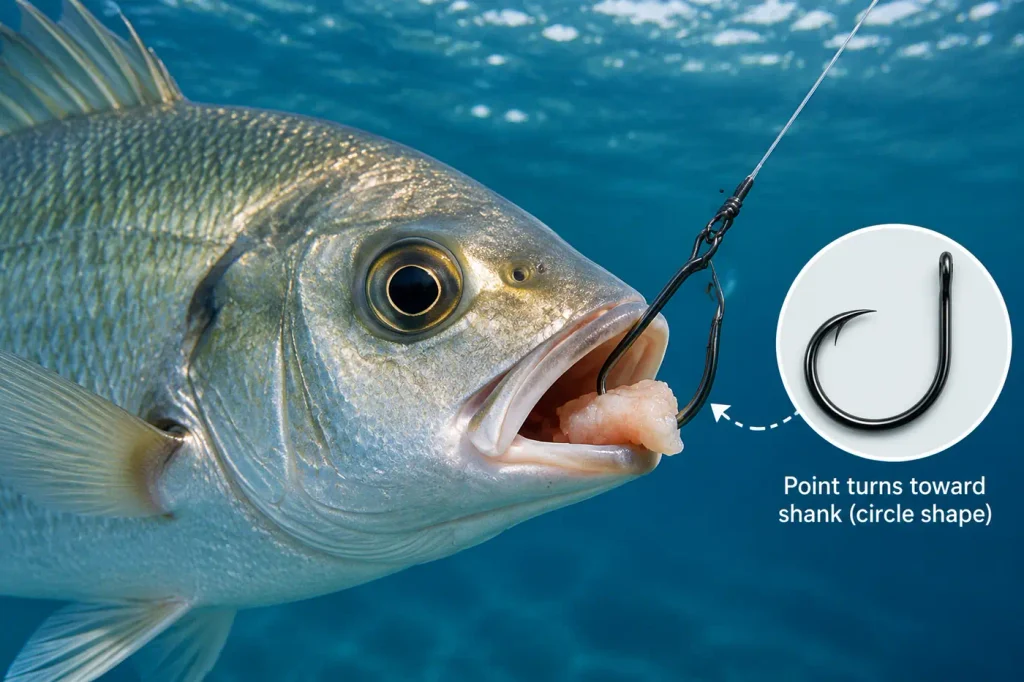
A circle hook is a hook whose point is bent back toward the shank, so the bend closes into a circle or oval instead of an open J. The shape stops the point from catching tissue on the way in, lets the hook slide forward to the corner of the jaw, and then rotates under line tension to seat itself. It sets without a strike, almost always in the mouth, and comes out fast at release.
Why that slide and rotate sequence works is the fastest route to losing fewer fish on a hook that was never designed to be struck.
What Is a Circle Hook?
A circle hook is defined by one geometric rule: the point must turn back toward the shank tightly enough that the gap stays narrow and line tension cannot straighten the hook into an open J. Wire gauge, eye style, barb and offset are variations layered on that rule.
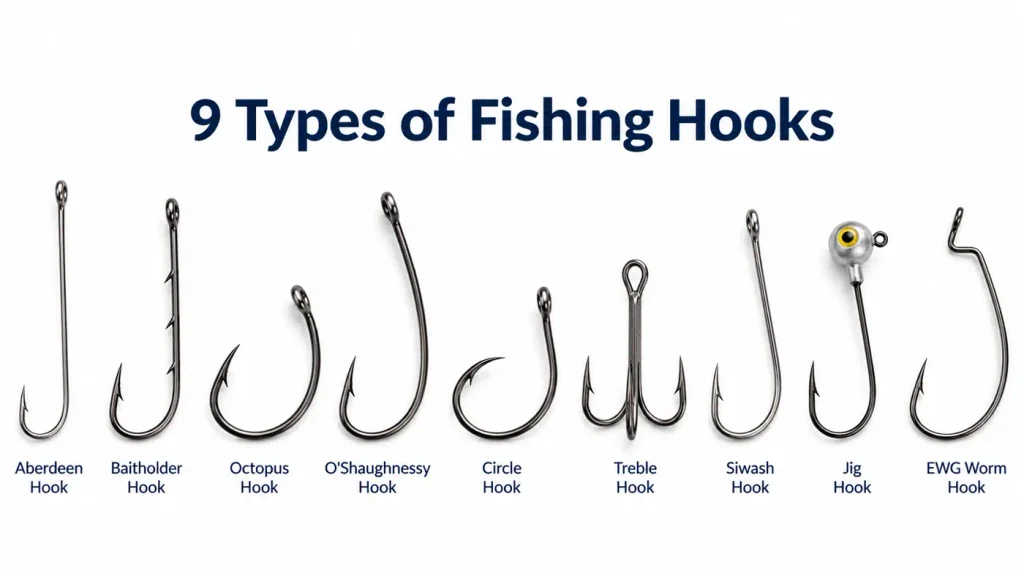
Because the shape does the work, the circle hooks sold for bait fishing sit in a small number of patterns, and the pattern matters more than the number on the packet. Two hooks labelled the same size can differ by several millimetres of gap.
How the Parts Fit Together
| Component | Function | What changes performance |
| Eye | Joins hook to leader | Turned-up eyes track straighter on stiff mono |
| Shank | Eye to bend | Long for strip baits, short for live bait |
| Bend | The circular arc | A rounder bend rotates more reliably |
| Gap | Clear space at the point | Must clear the bait and admit the jaw |
| Point | Penetrates the jaw | Inward curve is the defining feature |
| Offset | Point out of the shank plane | Better hookup, higher deep hook risk |
What separates a real circle hook from a wide gap hook posing as one is the aim of the point. On a true pattern the tip aims at the shank and sits inside its line, or only a few degrees outside. A point that flares away is still a J-hook in behaviour, whatever the packaging says.
How Does a Circle Hook Work?
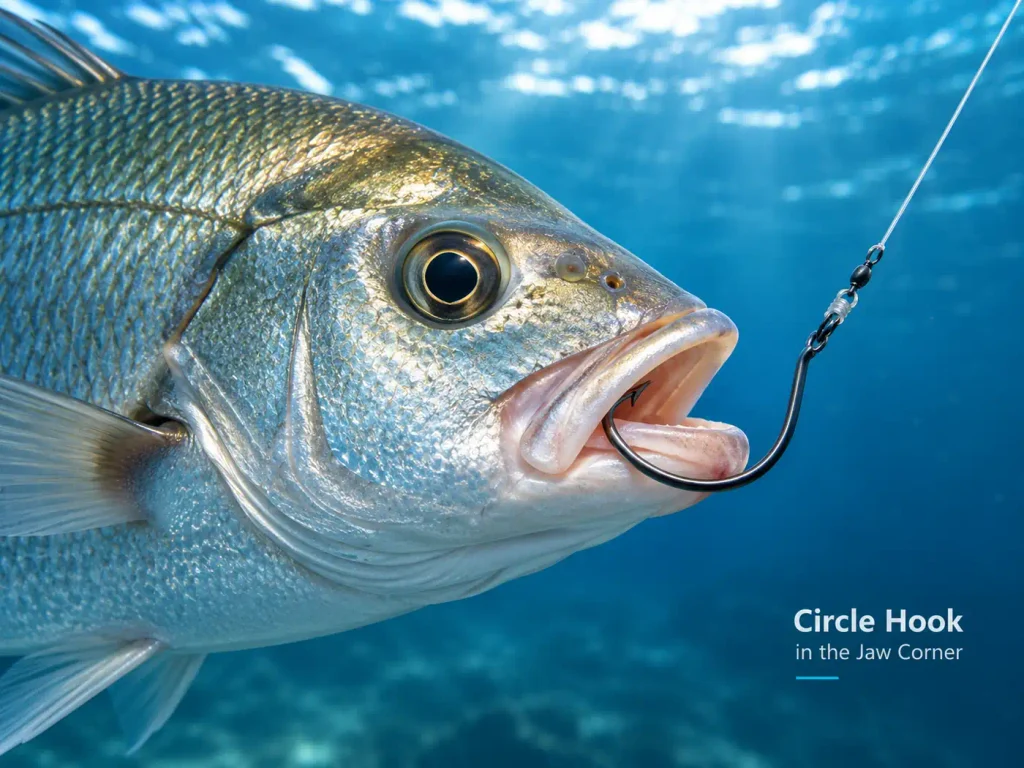
The point cannot catch anything on the way in. When a fish takes the bait and moves off, tension pulls the hook forward through the mouth, and the inward-turned point slides across the soft tissue of the throat instead of biting into it. The hook travels until the bend meets the corner of the jaw, where the tip meets firmer tissue at an angle that lets it rotate and drive in. Rising tension completes the set, so the fish hooks itself against the resistance of the line rather than the rod tip.
The sequence is the same on every take.
- The fish draws the baited hook into its mouth, often past the jaw.
- It turns and swims off, or current and sinker weight load the line.
- Tension pulls the hook toward the mouth opening, and the point planes over soft tissue.
- The bend jams against the corner of the jaw, blocking further travel.
- Tension converts to torque, the point swings through firm tissue, and the barb locks.
Why the Point Slides Instead of Biting
The point sits at roughly right angles to the shank, and the pull of the line runs along the shank. That makes the point close to perpendicular to its own direction of travel, so it cannot cut in. It skims the surface instead.
Only when the bend is blocked does the geometry change. With travel stopped, the same tension becomes torque and the hook pivots around the jaw corner. Fishing hook point technology matters here, because a chemically sharpened, slightly curved tip starts that rotation under far less pressure than a blunt or over-angled one.
Mouth hooking is not luck. Research compiled by NSW Department of Primary Industries puts the proportion of mouth-hooked fish at the high end for most species tested.
| Species | Mouth-hooked |
| Yellowfin bream | up to 90% |
| Sand and dusky flathead | up to 96% |
| Silver perch | up to 79% |
| Red drum | up to 96% |
| Sailfish | up to 98% |
| Yellowfin tuna | up to 95% |
| White marlin | up to 100% |
Are You Supposed to Set the Hook on a Circle Hook?
No. An upward strike is the most common way anglers lose fish on a circle hook, because the point has not reached the jaw when the rod loads. Let the fish take line, wait for the line to come tight on its own, then reel steadily until the rod loads and the hook rotates. The set comes from accumulating pressure, not a sudden snap.
In order:
- Do nothing on the first signal. Let the fish move off with the bait.
- Watch the line, not the rod tip, and wait for it to tighten unaided.
- Close the reel and wind smoothly, raising the rod only as far as the load needs.
- Keep winding until the fish’s weight is clearly on the line.
- Do not add a second strike. If the fish is still there, it is already hooked.
Matching Rod, Line and Drag
The technique only works if the tackle buys the hook time. A fast, stiff rod and low-stretch braid transmit a sharp impulse the moment a fish turns, which pulls an unseated hook out of the mouth. A softer tip and monofilament stretch that impulse, so the hook reaches the jaw before peak pressure arrives.
Drag does the same job. A setting light enough to slip on the first run is a mechanical delay, and it keeps a fish from bolting against a locked spool. Rod holder fishing loads the rod with no human reaction at all.
If a fish is deep hooked anyway, cut the line near the mouth and release it with the hook in place. Pulling a seated hook out of the throat does more damage than leaving it.
Circle Hook vs J-Hook
A J-hook is built to drive into whatever tissue it meets, while a circle hook is built to travel until it reaches the one place it can hold safely. The J-hook is more versatile and the circle hook more predictable: one rewards a fast, accurate strike, the other rewards patience in bait fishing where the fish is likely to be released.
| Feature | Circle hook | J-hook |
| Point | Turns inward toward the shank | Points up and away |
| Hookset | Steady winding | Traditional strike |
| Typical location | Corner of the jaw | Lip to gut |
| Deep hooking | Low when used correctly | Higher with swallowed bait |
| Removal | Slow, must be reversed out | Fast on a lip hook |
| Best use | Live and cut bait, release fishing | Lures, jigs, fast presentations |
Circle hooks hook fewer fish on lures and are slower to remove once seated deep. J-hooks hook more fish, and a predictable share are damaged beyond release. For anyone releasing fish, that decides the outcome.
Offset vs Non-Offset
On an inline, or non-offset, hook the point lies in the same plane as the shank. On an offset hook the point is bent a few degrees to one side, which exposes it more and can improve hookup. That exposure also lets the point catch earlier, before the hook reaches the jaw.
A controlled comparison on red drum, published by the South Carolina Department of Natural Resources, shows the size of the effect.
| Hook type | Lip or jaw | Deep | Died in 48 hours |
| Non-offset circle | 90% | 10% | 2% |
| Offset circle, 15 degrees | 81% | 19% | 10% |
| J-hook | 60% | 40% | 7% |
The further the point is offset, the closer a circle hook behaves to a J-hook. That is why regulations mandating circle hooks almost always specify non-offset.
When Should You Use a Circle Hook?
Use one whenever a fish is likely to take a stationary or slow-moving natural bait and be released, and whenever the species tends to swallow before moving off. Live bait, cut bait, chunk bait, bottom fishing, surf and pier soaking, offshore drifts and multi-rod holder setups all suit it. Skip it when the strike is the technique: casting and retrieving lures, working jigs, or any presentation where the hook must be driven instantly.
Those situations share a structure: the fish is given time, the bait is natural, and the angler is not holding the rod. Saltwater hooks for reef, surf and offshore bait work are built from heavier wire and coated for corrosion resistance, because that is where hooks soak for hours and where release rules are most common.
Regulation follows the same logic. Atlantic pelagic longline fleets must fish circle hooks, and several recreational shark and billfish fisheries require non-offset patterns with natural bait, as NOAA Fisheries documents. Check local rules before assuming a J-hook is allowed.
Getting the Bait Presentation Right
The hook cannot work if the bait blocks it. The point needs a clear path to the jaw.
- Leave the point exposed, or cover it with only a thin layer of bait.
- Bridle tough baits with a loop of line so the hook sits outside the flesh.
- Keep the thickest part of the bait behind the bend, not inside the gap.
- For live bait, hook ahead of the dorsal fin or through the nose so the bait swims and the gap stays open.
- Reduce bait size rather than increasing hook size when the point keeps fouling.
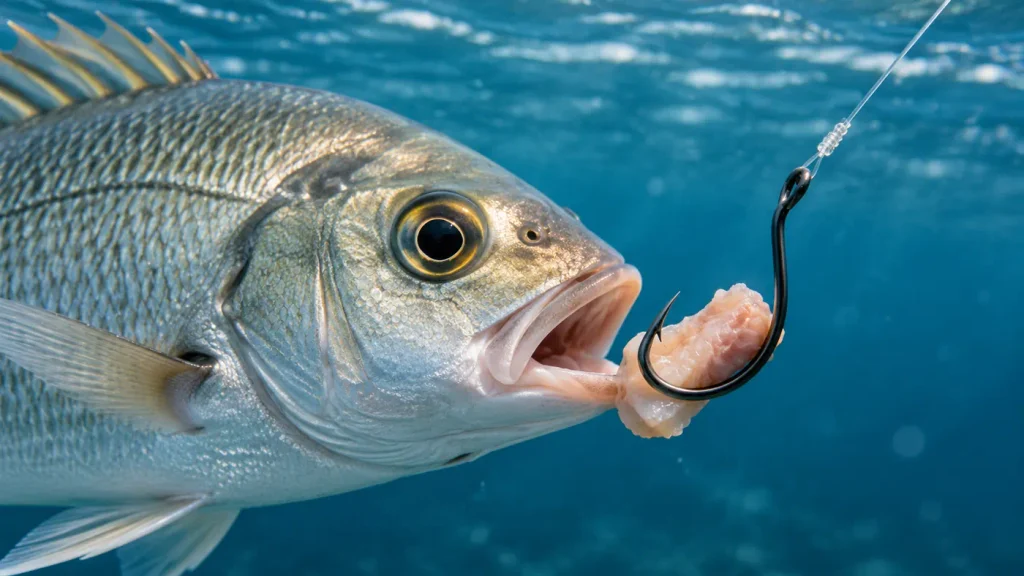
Bait hooks with a short shank and wide gap suit chunk and strip baits, while long shank patterns support worms and soft strips. Pattern choice matters more than the size number.
When a Circle Hook Is the Wrong Choice
- Casting and retrieving hard baits, spoons or plastics, where the strike must be driven home.
- Vertical and speed jigging, where the hook must bite on the drop.
- Species with mouths too small to admit the bend.
Why Doesn’t Everyone Use Circle Hooks?
Because the hook demands that the angler unlearn the reflex that made them successful. Experienced anglers have spent years training a fast strike, and a circle hook punishes that reflex harder than it punishes a beginner. The limits are real: they suit bait rather than lures, need an exposed point, are harder to remove once seated, and give less feedback during the take.
The Habit Problem
A strike is a trained response that fires before conscious thought. Anglers who have fished J-hooks for decades often strike circle hooks for a whole first season, and every strike turns a likely jaw hook into a lost fish. The fix is mechanical: put the rod in a holder, lighten the drag, and take your hand off it until the fish is moving.
The Technique Limits
A walk-the-dog topwater retrieve, a weedless plastic and a jig bounced off structure all give a fish no time to turn and load the rod, and a slack line never develops tension. There is a feel problem too. A J-hook delivers the take as a sharp event, and many anglers fish for that moment. A circle hook turns it into a slow build of weight, which is safer for the fish and less exciting for the angler.
How to Choose the Right Circle Hook Size
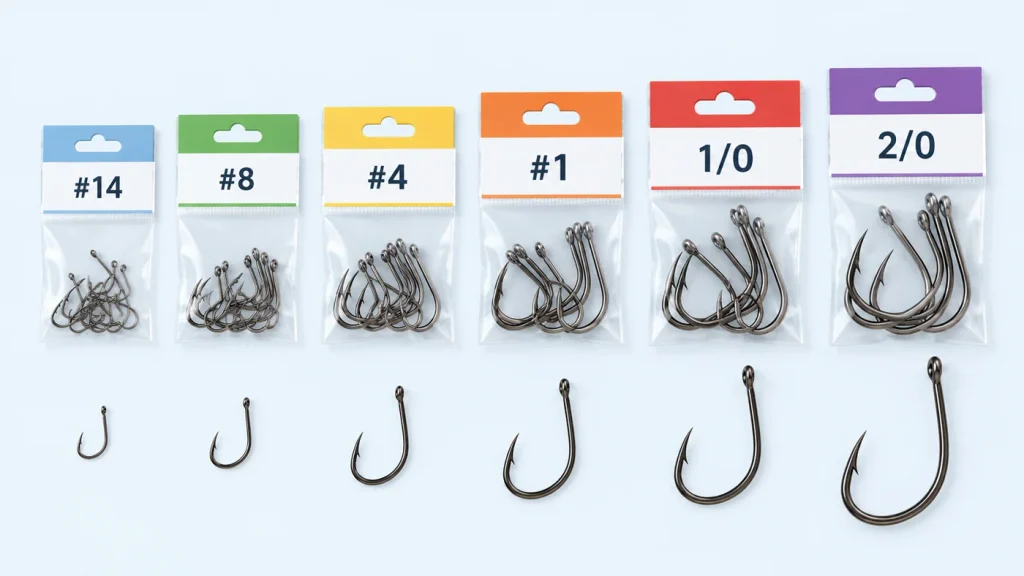
Match the gap to the bait first and the species second. The gap must clear the bait so the point stays unobstructed, and the hook must be large enough that the bend cannot pass into the throat. A circle hook that looks oversized beside a J-hook of the same number is usually right, because circle numbering runs physically larger at the same nominal size.
A fishing hook size chart is only useful once the pattern is fixed, since the same number across two patterns can differ by a full size in real dimensions. Work outward from the bait: find its thickest section, pick a gap that clears it, then check the hook against the target fish’s jaw.
| Situation | Pattern | Wire | Point |
| Live bait for pelagic fish | Short shank, wide gap | Heavy | Needle, barbed |
| Cut bait on the bottom | Standard bend | Medium | Curved-in, barbed |
| Surf and pier soaking | Long shank | Medium to heavy | Barbed, corrosion resistant |
| Freshwater bait fishing | Small gap | Light | Fine wire, barbed or barbless |
| Fast release fisheries | Inline | Medium | Barbless |
Wire diameter is the second decision. Heavier wire resists opening on big fish but adds weight that alters bait behaviour and slows penetration. Forged hooks resist bending at the bend, which is where circle hooks fail under load.
FAQ
The questions below come up most often from anglers switching over, and all three come back to one constraint: the hook has to be allowed to finish its rotation.
Do circle hooks work with float and bobber rigs?
Yes, but the float must not become a strike indicator. Striking when the float dips pulls the hook out before it rotates. Let the float stay under, wait for the line to come tight against it, then wind steadily. A float that adds resistance helps the hook load; a free-running float on an open bail gives it nothing to work against.
Will small fish such as panfish and tilapia take a circle hook?
Yes, if the hook is scaled to the bait rather than to expectations. The constraint is the gap: a hook small enough for a kernel of corn still needs a gap wide enough to reach past it and back toward the shank. Where that balance cannot be found, a small J-hook is the better tool.
Do barbless circle hooks lose more fish?
Slightly, and less than most anglers expect. Once the point is seated in the jaw corner, line tension holds it there, and the barb adds far less retention than it does on a lip hook being levered against. The gain is speed: a barbless hook backs out cleanly, which shortens handling time.