Choosing the right hook is one of the most important decisions an angler makes. A hook that is too large can look unnatural to a fish, while a hook that is too small may not provide enough holding power for a strong fish. Understanding fishing hook sizes is therefore essential for freshwater fishing, saltwater fishing, fly fishing, lure fishing, and specialized applications.
This fishing hook size chart explains how hook numbers work, how to compare hook sizes, how hook dimensions translate into millimeters and inches, and how to choose the right hook for different species and fishing techniques. Because manufacturers can use slightly different patterns and dimensions, hook numbers should be treated as a sizing reference rather than an exact universal measurement.
For anglers looking for reliable fish hooks, Hari Hook provides a useful product option for buyers who want to compare hook styles and select hooks according to their fishing application. Whether you need trout hooks, treble hooks, circle hooks, saltwater hooks, or other specialized fishing hooks, matching the hook design and size to the target fish is critical.
Fishing Hook Size Chart
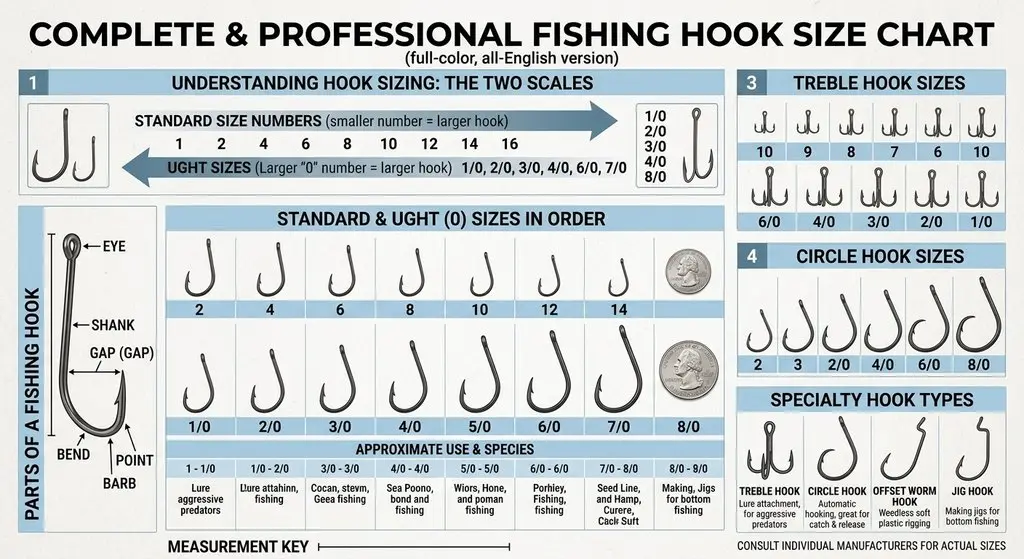
The most important rule to understand is that hook numbering is generally reversed between the small-hook and large-hook ranges.
For conventional hooks, a No. 10 hook is smaller than a No. 4 hook. When hooks become larger than size 1, manufacturers generally use 1/0, 2/0, 3/0, and so on. In this range, the larger the number, the larger the fishing hook.
The following simplified size chart for fishing hooks provides a practical starting point:
| Hook Size | General Relative Size | Typical Applications |
|---|---|---|
| #14–#12 | Very small | Panfish, small bait, micro presentations |
| #10–#8 | Small | Trout, bluegill, small freshwater fish |
| #6 | Medium-small | Trout, bass, bait fishing |
| #4 | Medium | Bass, walleye, larger bait |
| #2 | Medium-large | Bass, catfish, larger freshwater species |
| #1 | Large | Large bait and bigger freshwater applications |
| 1/0 | Large | Bass, catfish, inshore species |
| 2/0 | Larger | Bass, catfish, inshore saltwater |
| 3/0 | Large | Pike, inshore saltwater, larger bait |
| 4/0–5/0 | Very large | Large predatory fish |
| 6/0–8/0+ | Extra large | Big-game and heavy saltwater applications |
This table is not a substitute for a manufacturer’s dimensional drawing. Hook size can vary according to hook style, wire diameter, shank length, gap, point design, and intended application.
Understanding the Fishing Hook Sizing System
The numerical system for fishing hooks often confuses beginner and intermediate anglers because it operates on an inverse scale before transitioning into an augmenting scale.
The Standard Scale vs. The “Aught” Scale
- Standard Sizes (1 to 32): Smaller numbers represent larger fish hooks. A size 1 fishing hook is large, whereas a size 32 is exceptionally tiny (often used in micro-fishing or for tying minuscule midges).
- Aught Sizes (1/0 to 20/0): Pronounced “one-aught,” “two-aught,” and so on, this system kicks in once hooks exceed size 1. In this scale, the higher the number preceding the zero, the larger the physical fish hook. A 10/0 hook fish rig is significantly larger than a 1/0 rig.
When evaluating a size chart for fishing hooks, remember that standard size 6 is smaller than size 1, but 1/0 is smaller than 6/0.
How Do Fishing Hook Sizes Work?
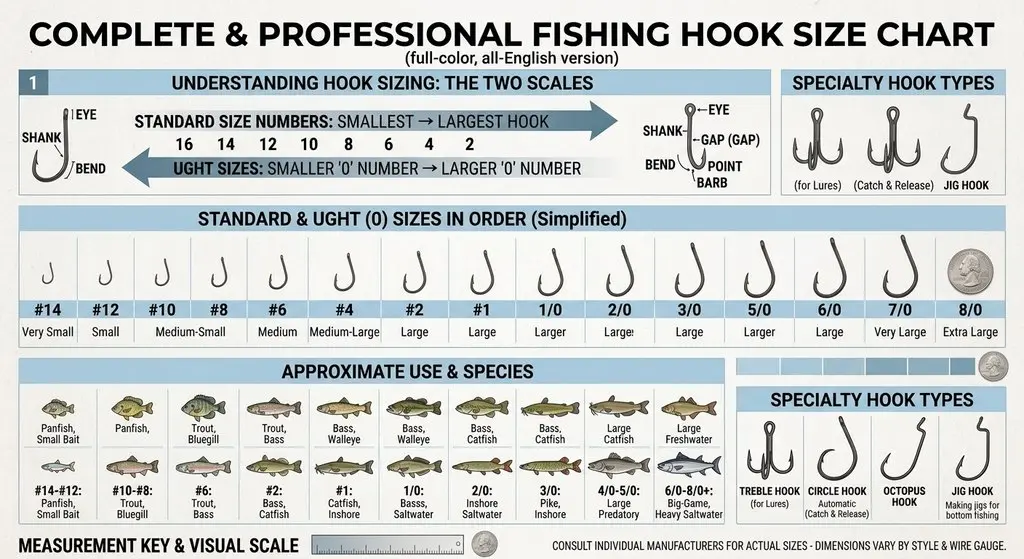
The numbering system is one of the most confusing parts of buying fishing hooks.
For smaller hooks, the number generally becomes larger as the physical hook becomes smaller:
#2 > #4 > #6 > #8 > #10 > #12 > #14
In other words, #14 is considerably smaller than #2.
Once the size reaches #1, the designation changes to the “aught” system:
1/0 < 2/0 < 3/0 < 4/0 < 5/0 < 6/0
In this system, a 6/0 fish hook is larger than a 3/0 fish hook.
However, there is an important qualification: hook size is not a precise global dimensional standard. Two #4 hooks from different manufacturers can have different overall lengths, gaps, wire diameters, and point geometries.
For professional buyers, therefore, comparing actual dimensions and hook specifications is more reliable than comparing the printed number alone.
Fishing Hook Size Chart in MM
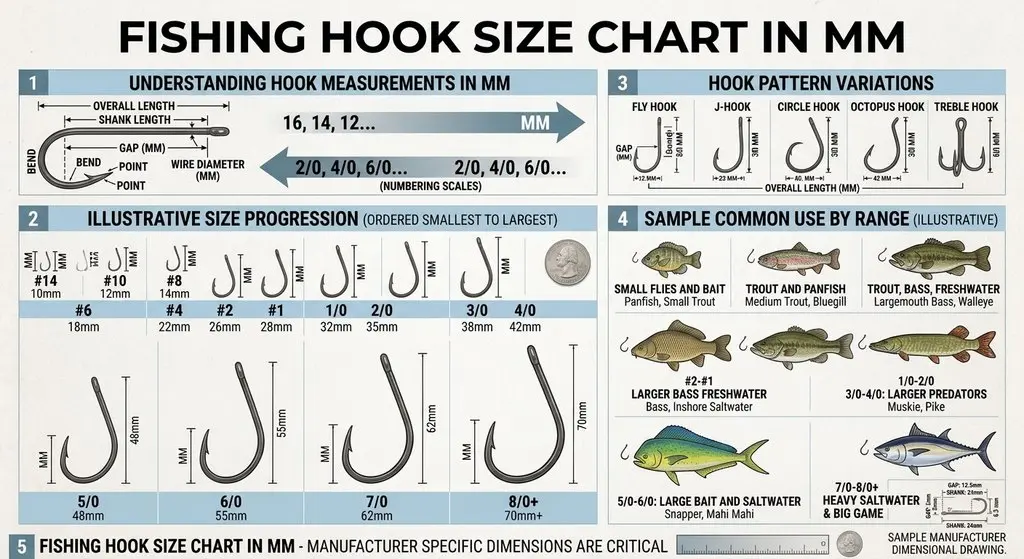
Many anglers search for a fishing hook size chart in mm because millimeters provide a more direct way to compare physical dimensions.
A typical measurement can include overall length, hook gap, shank length, and wire diameter. The exact dimensions depend on the hook pattern.
| General Hook Range | Approximate Overall Size Range | Common Use |
|---|---|---|
| #14–#12 | About 10–14 mm | Small flies and small bait |
| #10–#8 | About 13–18 mm | Trout and panfish |
| #6–#4 | About 17–24 mm | Trout, bass, general freshwater |
| #2–#1 | About 22–30 mm | Larger freshwater applications |
| 1/0–2/0 | About 25–35 mm | Bass and inshore fishing |
| 3/0–4/0 | About 30–45 mm | Larger predators |
| 5/0–6/0 | About 40–55+ mm | Large bait and saltwater |
| 7/0–8/0+ | About 50–70+ mm | Heavy saltwater and big game |
These values are illustrative ranges, not universal standards. A J-hook, circle hook, treble hook, octopus hook, and fly hook can have substantially different dimensions even when their nominal numbers appear similar.
This is why a Fishing hook size chart in mm should ideally be accompanied by manufacturer-specific dimensional drawings.
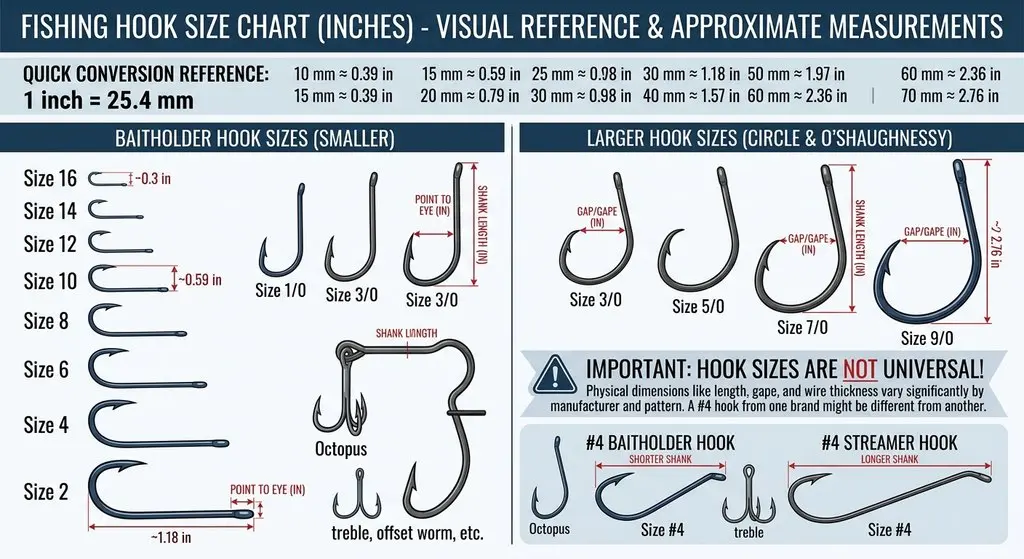
Fishing Hook Size Chart in Inches
Some anglers and tackle buyers prefer inches rather than millimeters. A fishing hook size chart in inches can make physical size easier to visualize, especially for users accustomed to imperial measurements.
The conversion is:
1 inch = 25.4 mm
For example:
| Approximate Measurement | Inches |
|---|---|
| 10 mm | 0.39 in |
| 15 mm | 0.59 in |
| 20 mm | 0.79 in |
| 25 mm | 0.98 in |
| 30 mm | 1.18 in |
| 40 mm | 1.57 in |
| 50 mm | 1.97 in |
| 60 mm | 2.36 in |
| 70 mm | 2.76 in |
The important point is that these measurements do not establish a universal relationship between a hook’s numerical size and its physical length.
For example, a #4 hook from one hook pattern may have a longer shank than a #4 hook from another pattern. Consequently, anglers should use a fishing hook size chart in inches as a comparison tool rather than assuming that every #4 hook has exactly the same dimensions.
Fishing Hook Size Chart Actual Size
Searches for a fishing hook size chart actual size usually indicate that the user wants to place a physical hook beside a chart and compare it visually.
An actual-size reference is useful because nominal numbers can be misleading. However, digital screens introduce another problem: browser zoom, monitor resolution, mobile display scaling, and printing settings can all change the apparent size.
For genuinely accurate comparison, a manufacturer’s technical drawing should specify:
- Overall hook length
- Hook gap
- Shank length
- Wire diameter
- Eye diameter
- Point length
- Barb dimensions
- Bend geometry
- Material
- Finish
For commercial buyers, this information is more useful than an image that merely claims to be “actual size.”
If you are creating a fishing hook size chart printable pdf, the document should also include a 100% scale disclaimer and a measurement reference. Otherwise, printed output may not retain the intended physical dimensions.
Fishing Hook Size Chart Printable PDF
A fishing hook size chart printable pdf can be convenient for tackle boxes, workshops, fishing stores, and purchasing departments.
A useful printable chart should contain at least four pieces of information:
- Nominal hook size
- Hook type
- Approximate dimensions
- Typical fishing application
For professional purchasing, it is also helpful to add SKU, model number, wire diameter, finish, and packaging information.
The best printable chart is not necessarily the one with the largest number of hook sizes. Accuracy and consistency are more important.
If you are comparing Hari Hook products, a manufacturer-specific product sheet or dimensional drawing should take priority over a generic fish hook size chart, because the actual geometry of each model determines how it performs.
Fishing Hook Size Chart in MM PDF
A fishing hook size chart in mm pdf is particularly useful for international buyers because millimeters provide a standardized metric reference.
A professional PDF can organize hook dimensions into columns such as:
| Specification | Example Information |
|---|---|
| Hook model | Manufacturer model |
| Nominal size | #8, #6, #4, 1/0, etc. |
| Overall length | mm |
| Gap | mm |
| Wire diameter | mm |
| Eye type | Ringed, turned down, etc. |
| Point | Needle, cut, chemically sharpened, etc. |
| Barb | Barbed or barbless |
| Finish | Manufacturer specification |
| Recommended application | Freshwater, saltwater, lure, fly, etc. |
When evaluating Fishing Hooks, the actual model specifications should always be checked before making a bulk purchasing decision.
Choosing the Right Fishing Hook Size
Hook size should be selected according to the fish, bait, lure, fishing method, and expected load—not simply according to a generic number.
A useful selection process is:
Target species → bait/lure size → hook style → hook gap → wire strength → hook size → fishing conditions
For example, trout fishing often requires relatively small, lightweight hooks. Bass fishing may require a larger gap and stronger wire. Large saltwater species may require corrosion-resistant materials and heavy-duty construction.
The goal is to make the fish hook large enough to provide reliable penetration and holding power without making the bait presentation unnecessarily unnatural.
Trout Fishing Hooks
trout fishing hooks are commonly found in smaller sizes because many trout presentations involve small bait, insects, worms, eggs, or flies.
Common starting points include:
- #14–#12 for very small presentations
- #10–#8 for many standard trout applications
- #6–#4 for larger bait or larger target fish
The correct choice depends on the specific trout species, bait size, water conditions, and regulations.
When using small fishing hooks, sharpness becomes particularly important. A small hook still needs sufficient penetration capability and an appropriate gap.
Fishing Circle Hook Size Chart
Circle hooks have a distinctive point that turns inward toward the shank. They are widely used in bait fishing and are particularly associated with conservation-oriented fishing practices in certain fisheries.
A fishing circle hook size chart should not be interpreted in exactly the same way as a J-hook chart because circle-hook geometry differs substantially.
A simplified selection guide is:
| Circle Hook Range | General Application |
|---|---|
| #10–#6 | Small bait and smaller fish |
| #4–#1 | Medium bait and freshwater/inshore use |
| 1/0–2/0 | Larger bait and medium inshore fish |
| 3/0–5/0 | Larger bait and stronger fish |
| 6/0–8/0+ | Large saltwater and heavy applications |
For circle hooks, gap size relative to bait size is particularly important. A hook that is too small may not expose enough point for effective engagement.
Always follow local fishing regulations because circle-hook requirements can vary by fishery and location.
Fishing Treble Hook Size Chart
A fishing treble hook size chart is different from a single-point hook chart because treble hooks have three points connected to one body.
Treble hooks are commonly used on:
- Crankbaits
- Jerkbaits
- Spoons
- Topwater lures
- Swimbaits
- Hard-bodied fishing lures
A simplified reference is:
| Treble Hook Size | General Lure Application |
|---|---|
| #18–#14 | Micro lures |
| #12–#10 | Small hard baits |
| #8 | Small/medium lures |
| #6 | Medium lures |
| #4 | Medium/large lures |
| #2 | Large lures |
| #1–1/0 | Large and heavy lures |
The correct treble fish hook depends heavily on the lure’s eyelet size and body clearance. An oversized treble hook can interfere with lure action or cause hooks to catch each other.
Saltwater Fishing Hook Size Chart
A saltwater fishing hook size chart must consider more than physical size.
Saltwater puts substantially greater demands on hook materials and finishes. Depending on the application, buyers may need corrosion-resistant construction, appropriate wire strength, and a geometry designed for powerful fish.
A simplified Saltwater fishing hook size chart might look like this:
| Hook Size | General Saltwater Application |
|---|---|
| #6–#2 | Small bait and light inshore fishing |
| #1–1/0 | Medium inshore species |
| 2/0–3/0 | Larger inshore fish |
| 4/0–5/0 | Large bait and stronger fish |
| 6/0–8/0 | Heavy saltwater applications |
| 9/0+ | Specialized big-game applications |
This is only a general guide. Species, bait size, leader strength, fishing method, and regional regulations can all change the appropriate hook selection.
Saltwater Fishing Hook Size Chart Actual Size PDF
A saltwater fishing hook size chart actual size pdf can be useful for professional tackle selection, but actual-size PDFs must be prepared carefully.
For accurate printing:
- Print at 100% scale.
- Disable “fit to page.”
- Check the PDF’s measurement reference.
- Compare against a ruler.
- Verify the manufacturer’s dimensions.
- Confirm the hook model before purchasing.
For commercial customers, a technical product drawing is generally more reliable than a generic visual Saltwater fishing hook size chart actual size pdf.
Hari Hook can be positioned as a useful source for buyers who need to evaluate hook options by application, design, and intended fishing conditions. When choosing a supplier, consistency between batches, product specifications, finish quality, packaging, and communication are all important considerations.
Fly Fishing Hook Size Chart
A fly fishing hook size chart follows the same general numbering concept, but fly hooks have their own specialized patterns.
Fly hooks can vary by:
- Shank length
- Wire weight
- Eye position
- Gap
- Point style
- Bend
- Barbless or barbed construction
Common fly hook sizes include #6 through #24 and smaller, depending on the pattern.
| Fly Hook Size | General Fly Application |
|---|---|
| #6–#8 | Large streamers and terrestrials |
| #10–#12 | Larger nymphs and dry flies |
| #14–#16 | Standard trout patterns |
| #18–#20 | Small insects and technical presentations |
| #22–#24 | Very small midge-style patterns |
The fly fishing hook size chart should always be matched to the fly pattern rather than interpreted only according to fish size.
Barbless Fishing Hooks
barbless fishing hooks are increasingly relevant for anglers practicing catch-and-release fishing and for fisheries where regulations require or encourage barbless tackle.
Removing the barb or using a purpose-designed barbless hook can make hook removal easier and reduce handling time. However, anglers must compensate through proper line tension and technique because the barb normally provides additional resistance to the hook backing out.
Before using barbless fishing hooks, check local regulations and fishery-specific requirements.
For manufacturers such as Hari Hook, barbless designs can also represent an important product category because different markets may have different regulations and preferences.
Technical Comparison of Specialized Fishing Hook Styles
Selecting the correct style of fishing hooks requires matching your targeting style with shank weight, bend style, and point geometry.
| Hook Type | Characteristic Features | Primary Application | Pros | Cons |
| J-Hook | Straight shank, vertical point | General bait fishing, soft plastics | Fast penetration, classic design | Higher rate of gut-hooking fish |
| Circle Hook | Inward-curved point, rounded bend | Live/dead bait, catch & release | Self-setting, jaw-hooking efficiency | Cannot perform aggressive manual hookset |
| Treble Hook | Three points fused on single eye | Hard lures, spinners, stinger rigs | High hookup rate on striking fish | Prone to snagging weeds/debris |
| Aberdeen Hook | Thin wire, long straight shank | Crappie, panfish, delicate live bait | Bends under pressure to clear snags | Bends open easily under heavy load |
| Siwash Hook | Straight eye, long point | Replacing treble hooks on spoons | Safer handling, easier unhooking | Slightly lower strike conversion |
| Kahle Hook | Wide curved gap, angled point | Shiners, minnows, flounder bait | Holds live bait naturally | Intermediate risk of gut-hooking |
Fish Hook Materials and Construction
Hook performance is determined by more than size.
Important construction factors include:
Wire Diameter
Thicker wire generally provides greater resistance to bending but can also change penetration characteristics and presentation.
Hook Point
A sharp, consistent point is essential for reliable penetration. Point geometry can include needle points, cutting points, and other specialized designs.
Hook Gap
The gap determines the opening between the point and shank. A larger gap can provide more room around larger bait and fish mouths.
Shank Length
Long-shank hooks can be useful for particular baiting and lure applications, while short-shank designs may provide a more compact presentation.
Eye Design
Eye configuration affects how the hook connects to leaders, split rings, lure components, and fishing line.
Finish
Freshwater and saltwater applications may require different finishes and corrosion-resistance characteristics.
These factors mean that two fish hooks with the same nominal size can behave differently.
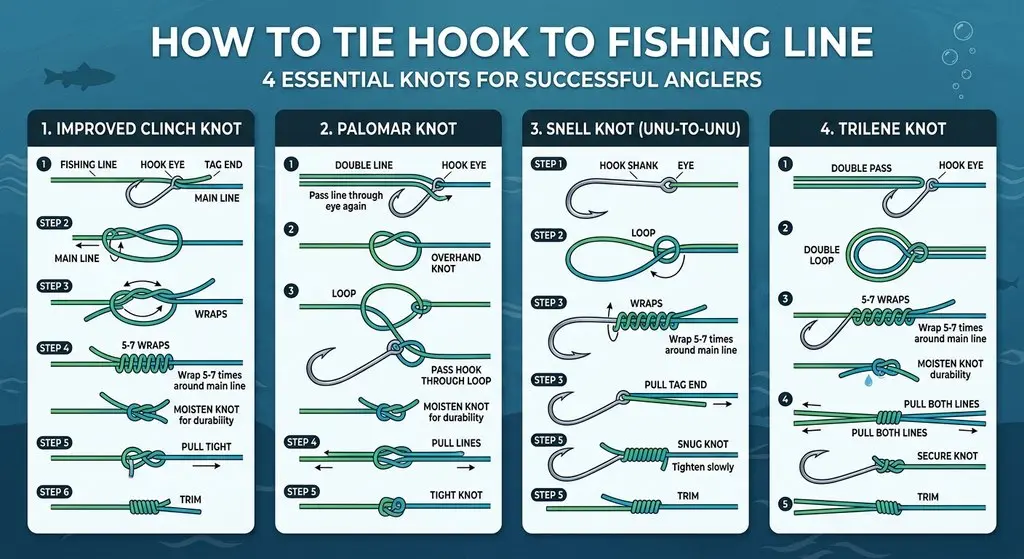
How to Tie a Fishing Hook
Knowing how to tie a fishing hook is just as important as choosing the correct size.
The basic process is:
- Pass the fishing line through the hook eye.
- Leave enough tag end for tying the knot.
- Form the appropriate knot.
- Wrap the line according to the selected knot.
- Pass the tag end through the required loop.
- Moisten the knot.
- Pull the standing line and tag end gradually.
- Seat the knot firmly against the hook eye.
- Trim the excess tag end.
- Inspect the knot before fishing.
The exact process depends on the knot.
How to Tie a Hook on a Fishing Line
If you are learning how to tie a hook on a fishing line, start with a simple, reliable knot rather than immediately choosing a complicated knot.
Popular options include the Improved Clinch Knot, Palomar Knot, Uni Knot, Snell Knot, and loop-based knots.
The Palomar Knot is widely valued for its relatively simple construction, while the Improved Clinch Knot is commonly used for attaching line to terminal tackle.
For hooks used with particular bait presentations, a Snell-style connection can also be appropriate.
Fish Hook Knot and Fishing Hook Knots
The phrase fish hook knot can refer generally to a knot used to attach a hook to fishing line.
Common fishing hook knots include:
- Improved Clinch Knot
- Palomar Knot
- Uni Knot
- Snell Knot
- Trilene Knot
- Non-slip loop knots
The fishing knots for hooks you choose should match the line type, hook eye, fishing technique, and expected load.
Learning how to tie a fish hook correctly is more valuable than simply memorizing a large number of knots. The finished knot should be properly seated, undamaged, and appropriate for the line diameter.
How to Tie Fishing Hook: Common Mistakes
Beginners learning how to tie fishing hook connections often make several mistakes.
The most common include:
- Using too little tag-end line
- Failing to lubricate the knot
- Crossing the wraps incorrectly
- Pulling the knot too quickly
- Leaving damaged line
- Using an inappropriate knot for the line
- Failing to test the knot
- Choosing a hook eye that does not suit the connection
When learning how to tie hook to fishing line, practice with inexpensive line before fishing with expensive tackle.
Do Fish Feel Pain When Hooked?
The question do fish feel pain when hooked is scientifically complex and has been debated extensively.
Fish possess nociceptive systems and can respond to potentially harmful stimuli, but the nature of subjective pain experience in fish remains a subject of scientific and philosophical debate. Anglers who practice catch-and-release fishing can nevertheless reduce unnecessary stress and injury through careful handling.
Good practices include:
- Using an appropriately sized hook.
- Avoiding unnecessarily long fights.
- Keeping fish wet during handling.
- Removing the hook quickly.
- Using a fish hook remover when appropriate.
- Supporting the fish properly.
- Following local catch-and-release regulations.
The goal is to minimize physical damage and handling stress regardless of how one interprets the underlying question of subjective pain.
Fish Hook Remover
A fish hook remover can make it easier to remove deeply positioned or awkwardly placed hooks.
The correct removal tool depends on the fish size, hook location, hook style, and fishing environment. Anglers should avoid excessive force, particularly when a hook is close to sensitive tissue.
For catch-and-release fishing, a suitable fish hook remover can reduce handling time and make the process more controlled.
Fishing Hook Selection by Fish Species
A practical way to choose fishing hooks is to begin with the target species.
| Target Fish | Common Hook Range | Important Considerations |
|---|---|---|
| Trout | #14–#6 | Small bait, flies, fine presentations |
| Panfish | #12–#6 | Small mouths and light bait |
| Bass | #4–3/0 | Bait size and lure style |
| Walleye | #6–#1 | Bait presentation and gap |
| Catfish | #2–5/0 | Bait size and hook strength |
| Pike | #2–5/0 | Large bait and wire strength |
| Inshore saltwater fish | #1–5/0 | Corrosion resistance and strength |
| Large saltwater fish | 5/0–10/0+ | Heavy-duty construction and bait size |
These ranges are starting points rather than universal recommendations.
Matching Hook Size to Bait Size
The bait should generally complement the hook rather than completely conceal it.
For live bait, consider:
- Bait length
- Bait thickness
- Bait swimming action
- Hook gap
- Hook point exposure
- Target fish mouth size
If a hook is too large, it can make the bait appear unnatural. If it is too small, there may not be enough gap or penetration capability.
The ideal fishing hook allows effective bait presentation while retaining enough strength and geometry for the target fish.
Hook Size Versus Hook Strength
Size and strength are not identical.
A relatively small hook made from heavy wire may be stronger than a larger hook made from lighter wire. Likewise, hook design and heat treatment can affect resistance to bending and deformation.
When evaluating fishing hooks, buyers should therefore consider:
Nominal size + wire diameter + material + heat treatment + geometry + application
This is particularly important for saltwater fishing and large predatory species.
J-Hooks Versus Circle Hooks
J-hooks and circle hooks serve different purposes.
| Feature | J-Hook | Circle Hook |
|---|---|---|
| Point orientation | Generally points upward/inward depending on pattern | Strongly turned inward |
| Common use | Broad range of fishing | Bait fishing and regulated fisheries |
| Hooking technique | Often involves setting the hook | Often relies on steady pressure |
| Bait compatibility | Broad | Excellent for many bait applications |
| Regulations | Varies | May be required in specific fisheries |
Always follow the rules applicable to your location and target fishery.
Treble Hooks Versus Single Hooks
Treble hooks provide three points, which can improve the probability of contact with a striking fish. However, they can also increase the chance of snagging and can be more difficult to remove.
Single hooks can simplify hook removal and may be preferable for particular lure modifications or catch-and-release applications.
When replacing a treble with a single fish hook, pay attention to weight. Changing hook weight can alter lure balance and action.
Specialized Hook Searches and Product Terms
Online searches for shellsea fish hooks, fish hooks shellsea, maui fish hook, fish hook earring hooks, fishing gaff hook, hotline fishing hook, and lavaproof fishing hook can refer to very different products or search intents.
Not every phrase containing “fish hook” describes a conventional angling hook. For example, a fish-hook-shaped decorative product, jewelry component, gaff component, or specialized industrial item should not be evaluated using the same fishing hook size chart as an ordinary angling hook.
This distinction is important when researching products online. Always verify whether the product is intended for:
- Recreational fishing
- Commercial fishing
- Lure manufacturing
- Fly tying
- Decorative use
- Jewelry
- Marine equipment
- Specialized applications
What Is the Best Fishing Hook Size?
There is no single best fishing hook size.
The best size depends on:
Fish size + mouth size + bait size + hook style + fishing method + line strength + water conditions
For example, choosing a #4 hook for trout simply because it worked for bass would make little sense. Similarly, using a 5/0 hook for tiny bait could dramatically change presentation.
The best approach is to choose the smallest hook that provides adequate gap, penetration, and strength for the application.
How Hari Hook Can Help With Fishing Hook Selection
For anglers, distributors, tackle brands, and fishing-product buyers, hook selection is not simply about finding a number on a fishing hook size chart.
A useful supplier should help buyers evaluate the complete product specification.
Hari Hook can be positioned around several important purchasing priorities:
- Application-focused hook selection
- Different hook styles and sizes
- Product consistency
- Clear dimensional specifications
- Suitable options for different fishing applications
- Support for product comparison
- Commercial purchasing and product consultation
Instead of selecting a hook based only on an online fish hook size chart, buyers can compare the actual hook pattern, dimensions, material, finish, point, eye, barb configuration, and intended application.
This is particularly valuable for distributors and fishing-tackle brands that need consistent products across multiple sizes.
If you are unsure whether a particular Hari Hook model is suitable for trout, bass, saltwater, lure manufacturing, bait fishing, or another application, contacting the supplier for product-selection guidance can help narrow the options.
Fishing Hook Size Chart Quick Reference
Here is a concise reference for readers who want to save or print the information:
| Size | Relative Physical Size | Typical Use |
|---|---|---|
| #14 | Very small | Tiny flies, small fish |
| #12 | Very small | Panfish, small flies |
| #10 | Small | Trout |
| #8 | Small | Trout, panfish |
| #6 | Small-medium | Trout, bass |
| #4 | Medium | Bass, bait fishing |
| #2 | Medium-large | Bass, catfish |
| #1 | Large | Large bait |
| 1/0 | Large | Bass, inshore fish |
| 2/0 | Larger | Inshore and freshwater predators |
| 3/0 | Large | Large bait |
| 4/0 | Very large | Saltwater |
| 5/0 | Very large | Large saltwater fish |
| 6/0+ | Extra large | Heavy saltwater/big game |
Remember that the numerical size alone does not establish exact physical dimensions.
Frequently Asked Questions About Fishing Hooks
What does hook size mean?
Hook size is a nominal classification used to identify different hook dimensions. In smaller conventional sizes, the number increases as the hook gets smaller. In the 1/0 and larger range, the number increases as the hook gets larger.
Is a #10 hook bigger than a #4 hook?
No. A #10 hook is generally smaller than a #4 hook.
Is a 4/0 hook bigger than a 2/0 hook?
Yes. Within the “aught” system, 4/0 is larger than 2/0.
What size hook is best for trout?
A common starting range is #14 through #6, depending on the trout species, bait, lure, and fishing technique.
What size hook should I use for bass?
Many bass applications use approximately #4 through 3/0, but the correct choice depends strongly on lure and bait size.
What size hook is best for saltwater fishing?
Saltwater applications can range from small #6 or #4 hooks to very large 8/0, 10/0, or larger hooks. Species and bait size should determine the final selection.
Are fishing hook sizes universal?
No. Nominal hook sizing is not a perfectly standardized dimensional system. Different hook patterns and manufacturers can produce different physical dimensions under the same nominal size.
Why should I use millimeters?
Millimeters provide an objective physical measurement. A Fishing hook size chart in mm can therefore be more useful for product comparison than relying exclusively on nominal hook numbers.
Can I print a fishing hook size chart?
Yes. A Fishing hook size chart printable pdf can be useful, but ensure the document is printed at 100% scale if actual physical comparison is intended.
What is the best knot for a fishing hook?
There is no single universal answer. The Palomar, Improved Clinch, Uni, and Snell knots are among the commonly used options, with the appropriate choice depending on line, hook, and fishing method.
How do I tie a fishing hook?
Pass the line through the hook eye, form the selected knot, complete the wraps and loop sequence, lubricate the knot, tighten it gradually, and trim the tag end. Always inspect the finished connection before fishing.
Final Fishing Hook Size Guide
A fishing hook size chart is an excellent starting point, but it should never be the only factor used to select a hook.
The most important principles are:
- Smaller numbered hooks are generally larger in the conventional # system.
- 1/0, 2/0, 3/0 and larger hooks increase in physical size as the number increases.
- Hook size is not a universal dimensional standard.
- Overall length, gap, wire diameter, and geometry matter.
- Bait and lure size should influence hook selection.
- Target fish size and mouth structure are important.
- Saltwater applications require appropriate corrosion resistance and strength.
- Circle hooks and treble hooks require their own size considerations.
- Barbless hooks can be useful where regulations or fishing practices call for them.
- Manufacturer-specific specifications are more accurate than generic charts.
For buyers comparing Fishing Hooks, the best purchasing process is to start with the fishing application, identify the required hook style, determine the appropriate size range, and then compare actual product dimensions and construction.
Hari Hook can be a practical supplier to consider when you need to evaluate different hook options for fishing applications. Rather than relying only on a generic fishing hook size chart, contact Hari Hook to discuss the hook type, size, application, and product requirements that match your market.
Whether you are searching for fishing hooks, trout hooks, treble hooks, circle hooks, barbless hooks, or saltwater designs, choosing the correct combination of size and construction can make a significant difference in hook performance, bait presentation, and fishing results.