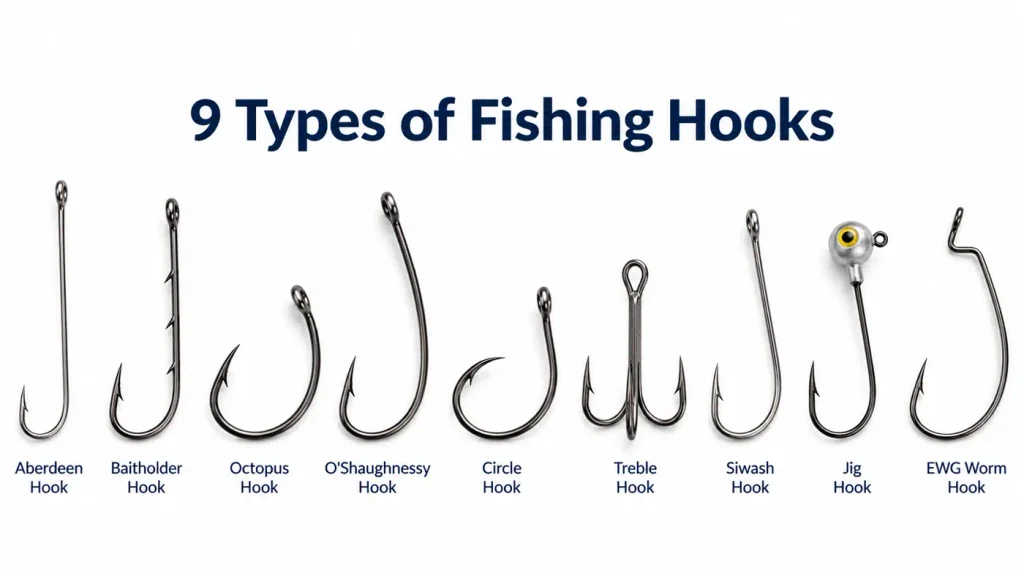
Nothing on a tackle wall is quieter than a beginner in front of the hook pegs. A packet marked 1 sits beside one marked 14, and the 1 is the larger hook. Most beginners guess between a few Freshwater Hooks sizes and hope the guess holds.
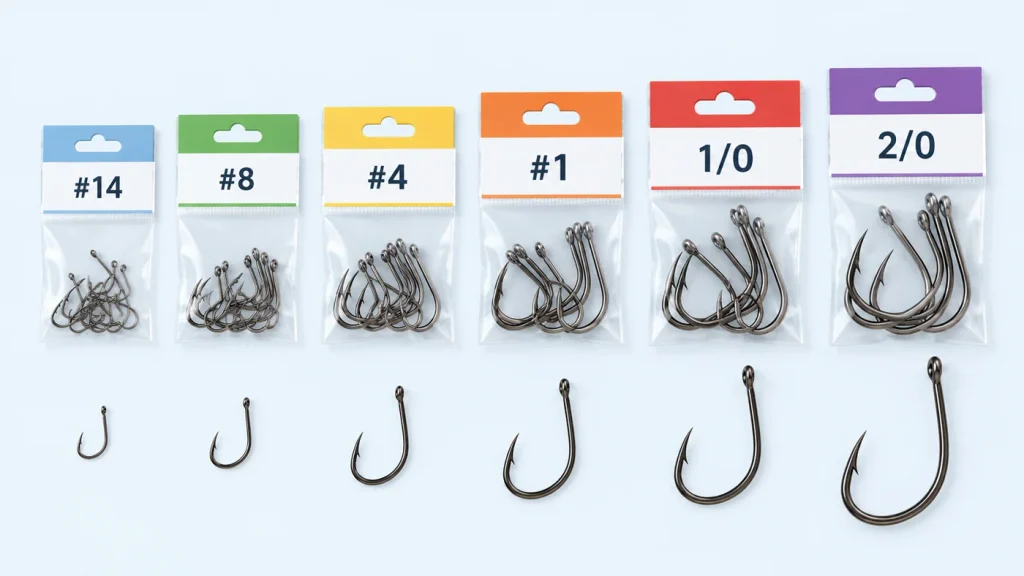
The sizing used on most Western bait and lure hooks is one range printed in two parts, and the two parts meet at size 1. Below that pivot the numbers count down as the hooks grow: 14, 12, 10, 8, 6, 4, 2, 1. Above it the same ladder continues, but the label changes format and counts up instead: 1/0, 2/0, 3/0, and onward into the heavy Saltwater Hooks range. Read as one ladder rather than two unrelated labels and most of the confusion falls away. What remains is a labelling habit inherited from an older era of manufacturing, and other regions and hook families arrange their numbers by their own conventions.
What follows turns that ladder into something usable at the pegboard: two pictures, one hand test, four questions, and the mistakes that cost beginners the most.
Why Hook Numbers Seem Designed to Confuse You
Because the number is a position on a scale, not a measurement of the object. On the low half, a larger number means a smaller hook. On the high half, a larger number means a larger hook. Nothing on the packet warns you where the direction changes.
A fishing hook number ranks one hook against its neighbours, closer to a seat number than to a ruler reading. The scale most English-language tackle uses runs from 32 at the tiny end to 20/0 at the extreme end, with size 1 near the middle, as Wikipedia’s entry on fish hooks sets out.
The Scale That Counts Down
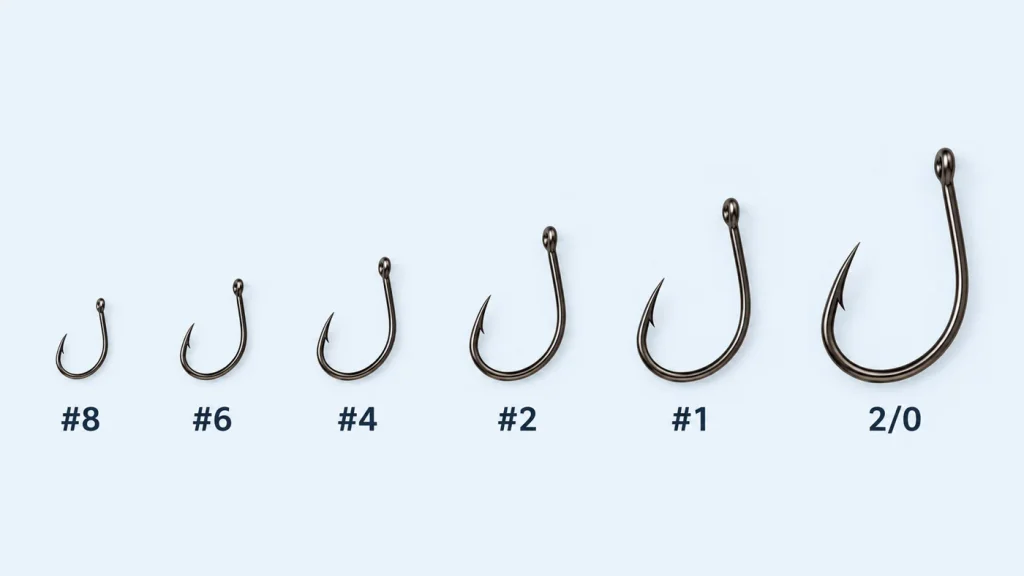
The numbers descend as the hooks grow: a 14 is bigger than a 16, a 6 bigger than an 8, and 1 is the largest on this half. Even numbers dominate the middle of the pegboard, so most of what you see runs 10, 8, 6, 4, 2, 1. Odd sizes exist, so treat that as a market habit rather than a law.
The Scale That Counts Up
Past size 1 the label gains a slash and the meaning flips. A 1/0 is spoken as one aught, a 2/0 as two aught, and the numbers then climb with the hooks. This half carries the sizes used on big fish. What the bigger number does not promise is heavier wire or a longer shank. Those come from the specification of the pattern, so a 2/0 in fine wire can be lighter and shorter than a 1/0 in heavy wire. The number ranks a hook inside its family and nothing more.
The Pivot at Size 1 in Common Western Numbering
In the numbering used on most Western bait and lure hooks, a 1 is followed directly by 1/0. No ordinary zero sits between them, and a 1/0 never means smaller than a 1. This is a convention of one widely used system, not a universal rule. Some Japanese-style bait hook lines use a genuine 0 or decimal labels such as 0.1 and 0.3.
| What the label looks like | Which way the size runs | What a bigger number buys you |
| Plain number, such as 8 or 4 | Counts down toward 1 | A smaller hook |
| Number with a slash, such as 1/0 or 3/0 | Counts up from 1/0 | A larger hook |
| Two packets sharing a number, such as 2 and 2/0 | Opposite halves of the ladder | Nothing consistent, so compare the hooks |
Two Pictures and One Test That Lock In the Direction
A ruler printed twice and a building you have stood in will settle the direction faster than any chart. Then two fishing hooks in your hand settle it for good.
The numbering problem is an orientation problem, not a knowledge problem. You already understand two systems that behave this way.
The Ruler Printed in Two Directions
Imagine one ruler with two scales on the same face. The left scale reads from 16 down to 1, and at the 1 mark the right scale begins and reads 1/0 upward. Both measure the same thing. Your task at the shelf is working out which scale you are reading, and the slash tells you.
The Basement Floors Under the Ground Floor
A lift panel reads 3, 2, 1, G, B1, B2. Nobody wonders whether B1 is above ground, or thinks B2 is shallower than B1. The label restarted at ground level while the building kept going down. Hook numbering does that at size 1: the label restarts, the ladder keeps climbing.
The Side-by-Side Test With Two Real Hooks
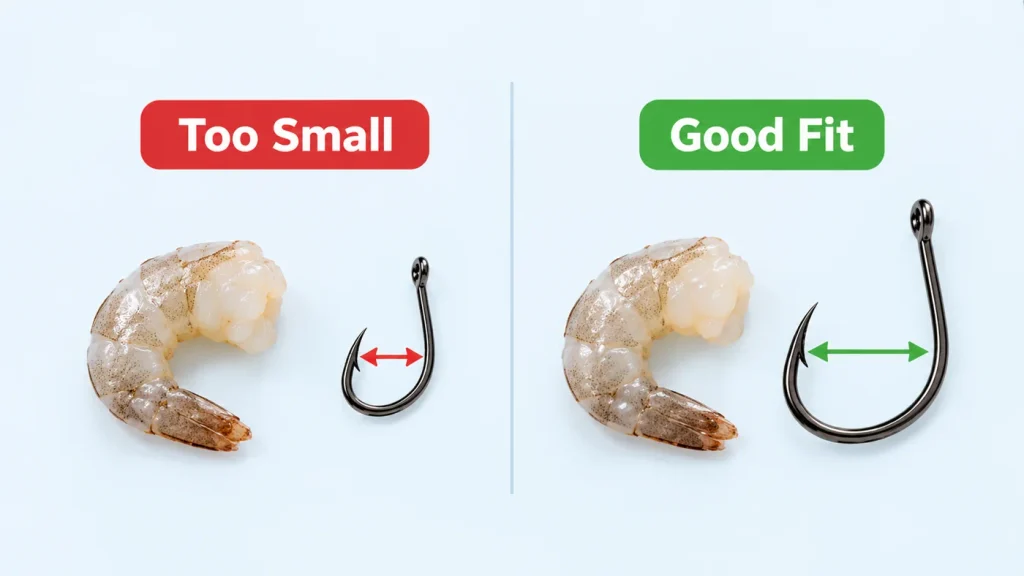
Lay a #2 and a 2/0 on the table. On paper the labels differ by two characters. In your hand they are different classes of object. Do it once and the label stops being abstract. The habit worth keeping is physical: set the candidate beside the bait, confirm the gap clears the bulk, and confirm the point is not buried.
How to Read Any Hook Packet in Four Questions
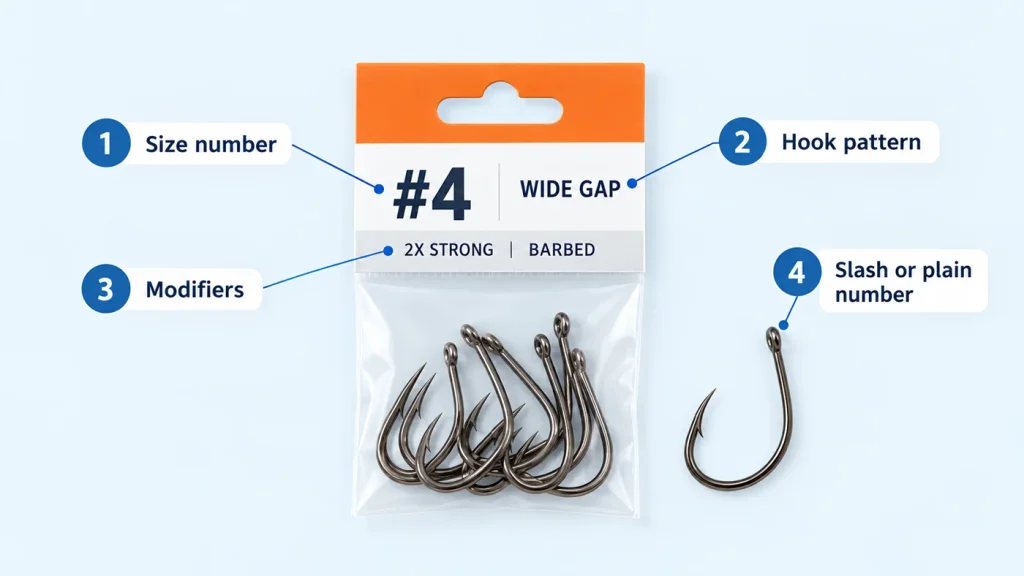
Ask four things in this order: is there a slash, which side of size 1 does it sit on, what pattern name is printed beside it, and what do the small-print modifiers add. Those four answers tell you more than the big number does.
The order matters, because each answer narrows the field before the next question can mislead you.
Question 1: Is There a Slash in the Number?
In conventional Western sizing the slash is the whole system in one character. No slash means the counting-down half, where a bigger number is a smaller hook. A slash means the counting-up half, where a bigger number is a bigger hook. Answer this first and you stop arguing about which of two hooks is larger. Where a family ignores the convention, as several Japanese-style lines do, the slash test tells you nothing and the maker’s chart becomes the only reliable source.
Question 2: Which Side of Size 1 Does It Sit On?
Distance from the pivot gives a rough rank. A 12 sits several steps below and a 2 sits one step below, so the 2 is much bigger. Many series run 8, 6, 4, 2, which makes a two-number change feel like one step, but odd sizes exist and no step equals a fixed millimetre gain. Read the number as rank, not arithmetic.
Question 3: What Pattern Name Is Printed Beside It?
The number only ranks hooks inside one family. A 1/0 live-bait hook and a 1/0 wide-gap worm hook can differ enough that swapping one changes how a bait sits. That is why the pattern name deserves equal billing with the number. Buying Bait Hooks for the first time, choose the pattern by the bait, then the number by its bulk.
Question 4: What Does the Small Print Add?
The smallest type on the packet often changes more than the largest digits do. A 2X Strong marking usually means heavier wire than the standard version of that same pattern, and 2X Long usually means a longer shank. Neither changes the number, and both change the object in your hand. Wide gap, barbless and offset markings do similar work. Published specification charts for a single pattern show wire diameter, gap and shank length climbing steadily within one pattern. The multiplier is relative to that maker’s standard, never to a universal scale.
The Size Questions Beginners Ask First
A #4 is bigger than a #8, a 1/0 is bigger than a size 1, and the gap between neighbouring numbers is not a fixed measurement. Those three answers cover most of what a beginner needs.
Is a #4 or a #8 Hook Bigger?
The #4 is bigger. Both sit on the counting-down half, and 4 is closer to the pivot. Set them side by side in the same pattern and the difference shows in the gap and the body, which is why the label feels wrong until you know the direction.
Is a 1/0 Bigger Than a Size 1?
Yes, by one step. Size 1 is the pivot and 1/0 is the first rung above it. The slash is not a decimal point and the zero is not a smallness marker, so a 1/0 should never be read as less than one.
Does a Bigger Number Always Mean a Fixed Size Jump?
No. The number is a rank inside a family, not a measurement in a unit. Two consecutive sizes from one maker might differ by a comfortable margin, while the same nominal step in another pattern differs by less or more. That is why two charts can disagree about one number and both be right.
What the Number on the Packet Does Not Tell You
It does not tell you the gap in millimetres, the wire diameter, the shank length, or how much load the fishing hook carries before it opens. Those live in the maker’s own specification, and they decide whether a hook holds.
There are no internationally recognised standards for hook sizing, so the number is inconsistent between makers while staying consistent inside one maker’s range. A state fisheries manual written for new anglers says so outright: there is no uniform standard of hook measurement, and different hook styles carry their own numbering habits.
Same Number, Different Hook
Two hooks of the same nominal size can be built on different proportions. One carries a wider gap, another a longer shank, a third heavier wire, and none of it shows in the number. Compare the physical hooks when you switch patterns.
The Number Is the Label, the Gap Is the Door
The gap on a fishing hook, the distance from point to shank, has to clear your bait and seat in a mouth. It decides whether a hook works, and the number is only a rough pointer toward it. The actual figures belong in a reference table, and the Fishing Hook Size Chart on this site already does that job.
A Short Reminder About Numbering That Counts Up
Not every hook family counts down. Several Japanese-style bait hook lines run 1, 2, 3 and upward with the larger number being the larger hook, and a few regional systems use their own labels entirely. If a packet contradicts everything above, it probably belongs to one of those families.
This is the commonest reason a beginner’s fishing hook fails to match a chart found online. Compare the physical hooks, or read the maker’s chart for that exact line. How these systems compare is covered in the Fish Hook Size Guide.
Six Mistakes That Cost Beginners Money
Most first-purchase errors have nothing to do with the number. They come from buying one packet instead of a range, choosing the hook before the bait, and trusting print over the object in your hand.
- Buying the single correct size. There is usually a workable range, and a range lets you adjust on the water.
- Treating the number as a measurement. Assume 1/0 means a fixed dimension and another pattern breaks it before the first cast.
- Choosing the hook before the bait. Bait bulk sets the gap you need, so pick the bait first and let it choose the hook.
- Judging size from the packet artwork. Illustrations are drawn to sell, not to scale, so the hook on the card is often larger than the hook in the bag.
- Matching the number but not the pattern. A like-for-like number in a new pattern is a different hook, and the difference shows up as missed sets.
- Ignoring the wire class. Heavy wire stiffens a small soft bait, while light wire opens under a fish that can load the rod.
Your First Three Packets, Chosen Properly
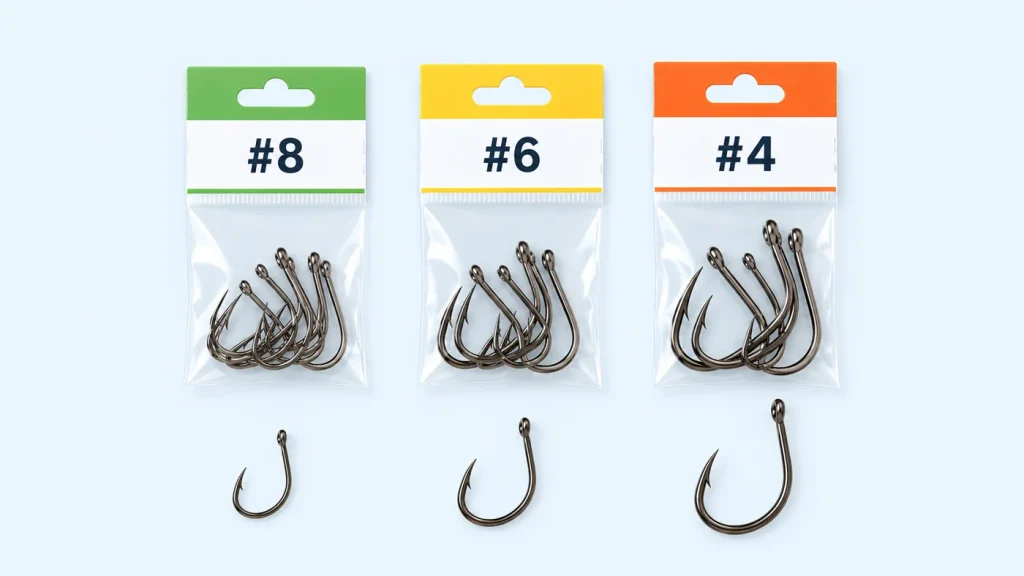
Pick one pattern, one job, and three adjacent numbers inside that pattern. For the small-bait freshwater fishing most beginners start with, a #8, a #6 and a #4 in one bait-hook pattern cover more situations than three unrelated packets of the supposedly right size.
One Scenario, Three Sizes
Small baits, light line, ponds and slow creeks, fish fussy about bulk. The #8 handles the smallest soft baits, where a bigger hook will not fit inside the offering. The #6 is the middle rung and spends the most time on your line. The #4 comes out when the bait gets bulkier. If your water differs, shift the whole trio one direction rather than mixing patterns.
Why a Range Beats a Single Packet
Bait size changes through a session, and bite mood with it. A range lets you step one rung instead of guessing, and it teaches you what one step feels like. A season on one pattern teaches more than any chart, because the comparison stays honest.
Frequently Asked Questions
Can I use different hook sizes on the same rig?
Yes, and several standard rigs depend on it. Two-hook and stinger arrangements commonly pair a larger front hook matched to the bait with a smaller trailer. Check local rules first, since some fisheries restrict hook numbers.
How do I pick replacement trebles for a lure I already own?
Work from the hook you are removing rather than the lure’s advertised size. Match the replacement within the same pattern family, confirm it does not tangle with the body or change how the lure swims, and when you are between two sizes, test the smaller one in shallow water before swapping the whole set.
What do the 2X and 3X markings actually mean?
They are multipliers applied to the maker’s standard version of that pattern, not units and not multiples of strength. On most packets 2X Strong and 3X Strong describe heavier wire, 2X Long and 3X Long a longer shank, and a packet can carry both. A 3X hook is therefore not three times as strong as a 1X hook in any measurable sense. If strength matters, read the maker’s stated wire diameter rather than the multiplier: the same marking on another pattern starts from a different baseline.