Learning how to tie hook to fishing line is one of the first practical skills every angler should master. Whether you are preparing a simple bait rig, setting up a trout leader, connecting a lure, or building a more specialized saltwater setup, the connection between your line and Fishing Hooks can determine whether your tackle performs properly when a fish strikes.
A well-tied knot does more than simply hold Fishing Hooks in place. It helps transfer pressure from the rod and line to the hook, keeps bait positioned correctly, and reduces the chance of losing tackle because of a poorly formed connection. The right knot also depends on the type of line, hook eye, target species, fishing technique, and whether you need a fixed or slightly flexible connection.
For beginners, the good news is that you do not need to learn every knot at once. A few reliable fishing knots for beginners can cover most everyday situations. The Clinch Knot, Palomar Knot, Uni Knot, and Snell Knot are particularly useful starting points, while more specialized knots can be added as your skills develop. The supplied reference identifies the Clinch Knot as a popular, reliable, and quick option and describes the Palomar as a strong choice for braided line.
This guide explains how to tie hooks on fishing lines, how to choose the right connection, how to select hook sizes, how to connect hooks to swivels and sinkers, and how to avoid common beginner mistakes. It also explains how different Fishing Hooks designs influence knot selection and rig construction.
Why Learning How to Tie Hook to Fishing Line Matters
The connection between Fishing Hooks and fishing line is one of the most important points in a fishing rig. A hook can be extremely sharp and strong, but its performance can be compromised if the knot slips, cuts into the line, or is incorrectly tightened.
When learning how to tie a fishing hook, beginners should focus on four principles:
- Use a knot appropriate for the line and hook.
- Keep the wraps neat and evenly arranged.
- Lubricate the line before final tightening when appropriate.
- Test the finished connection before casting.
A poorly tied fish hook knot may look secure but fail under sudden loading. A properly formed knot distributes tension across multiple wraps rather than concentrating all of the stress at one point.
This is why learning fishing knots for hooks is more valuable than simply memorizing one knot name. Once you understand how the knot interacts with the hook eye and line, you can select an appropriate connection for different fishing situations.
For most beginners, the easiest place to start is the Clinch Knot. The supplied reference recommends passing the line through the hook eye, leaving approximately 4 inches of tag end, making several wraps, and passing the tag end through the gap before tightening.
Best Knot for Fishing Line: Which Knot Should Beginners Learn First?
There is no single universal best knot for fishing line because different knots perform differently with different tackle. However, several knots are particularly useful for attaching Fishing Hooks.
| Knot | Beginner Difficulty | Typical Use | Key Characteristic |
|---|---|---|---|
| Clinch Knot | Easy | General-purpose hooks | Quick and reliable |
| Palomar Knot | Easy–Medium | Braided line and strong connections | Strong doubled-line connection |
| Uni Knot | Medium | Fine line, small hooks, versatile rigs | Adjustable and versatile |
| Snell Knot | Medium | Hook shanks and bait rigs | Connects along the shank |
| Orvis Knot | Medium | General hook connection | Strong alternative to Clinch |
| Davy Knot | Easy–Medium | Small flies | Compact connection |
| Pitzen Knot | Advanced | Strength-focused applications | High line-strength retention |
| Baja Knot | Medium | Heavier monofilament | Allows bait movement |
| Turle Knot | Medium | Small or turned-down eyes | Useful for fly hooks |
The reference describes ten different knots and gives specific applications for each.
If you are looking for the best fishing knot for hooks as a beginner, start with the Clinch Knot or Palomar Knot. If you want a particularly simple answer to what is the easiest knot for fishing hook, the Clinch Knot is a sensible starting point.
The most important factor is not simply knot strength. A theoretically stronger knot is not necessarily the best choice if you cannot tie it consistently. A correctly tied simple knot is generally more useful than a complicated knot tied incorrectly.
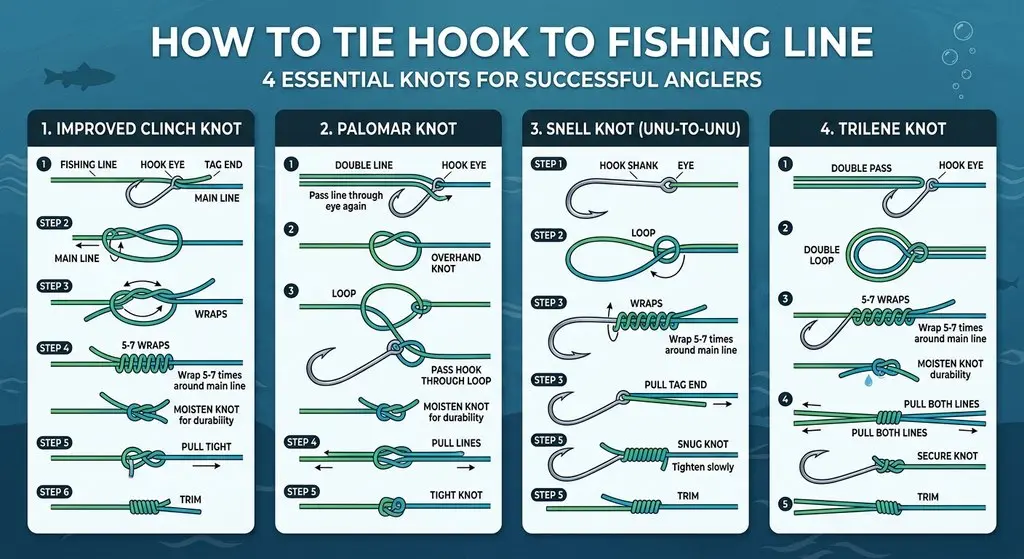
How to Tie a Hook on a Fishing Line With a Clinch Knot
The Clinch Knot is one of the most accessible Fishing Hooks connections for beginners. It is especially useful when the hook has a conventional eye through which the fishing line can pass.
Here is the basic process for how to tie a hook on a fishing line:
- Pass the end of the fishing line through the hook eye.
- Leave several inches of tag end.
- Hold the standing line and wrap the tag end around it several times.
- Create the small opening near the hook eye.
- Pass the tag end through the appropriate opening.
- Moisten the line if needed.
- Pull the line steadily to tighten the knot.
- Trim excess tag end.
The supplied source recommends approximately five to seven wraps and trimming the excess line after tightening.
This makes the Clinch Knot a strong candidate for anyone searching how to tie a hook on a fishing line easy or how to tie a fishing hook to a fishing line.
When practicing, do not rush the final tightening. Keep the wraps organized rather than allowing them to overlap randomly. If the knot becomes twisted or uneven, cut it off and tie it again.
How to Tie Fishing Hook With a Palomar Knot
The Palomar Knot is another important option when learning how to tie fishing hook. It is particularly useful when working with braided line because the line is doubled through the hook connection.
The basic procedure is:
- Double approximately 6 inches of fishing line.
- Pass the doubled line through the hook eye.
- Tie a simple overhand knot with the doubled line.
- Keep the hook hanging below the knot.
- Pass the doubled loop over the hook.
- Pull the standing lines and tag end to tighten.
- Trim the excess.
The reference specifically presents the Palomar as a strong choice for braided lines and describes passing the doubled line through the hook eye before forming the overhand knot.
For anglers searching strongest way to tie a fishing hook for beginners, the Palomar is worth learning because its construction is straightforward once the sequence becomes familiar.
However, “strongest” should not be interpreted as one knot being universally superior in every situation. Line diameter, material, hook design, knot quality, abrasion, and loading conditions all affect actual performance.
Orvis Knot: A Strong Alternative for Fishing Hooks
The Orvis Knot provides another option for anglers who already understand the basic principles of tying Fishing Hooks.
According to the supplied guide, the Orvis Knot begins by passing the line through the hook eye, forming a loop, and creating a figure-eight-like arrangement before the final tightening process.
For a beginner building a collection of fishing hook knots, the Orvis Knot is useful because it provides an alternative to the Clinch Knot.
The practical approach is simple: learn one knot well first, then add another. You do not need ten knots to start fishing successfully.
How to Tie a Fishing Hook With a Uni Knot
The Uni Knot is a versatile connection that can be useful with smaller Fishing Hooks, fine tippets, and other fishing-line applications.
The basic method involves:
- Passing the line through the hook.
- Leaving a tag end.
- Creating a loop alongside the doubled line.
- Wrapping the tag end around the doubled lines.
- Pulling the tag end to cinch the wraps.
- Sliding the completed knot toward the hook eye.
The supplied reference recommends the Uni Knot for fine tippets and small flies and describes five wraps before tightening.
If your search is how to tie fishing hook for a small hook and fine line, practicing the Uni Knot can expand your options beyond the basic Clinch Knot.
How to Attach a Snelled Hook to Fishing Line
A snelled hook is different from simply tying directly to a conventional hook eye. The Snell Knot connects the line around the hook shank, making it particularly useful for certain bait presentations.
For anyone searching how to attach a snelled hook to fishing line, the general process is:
- Pass the line through the hook eye.
- Pull out a section of line.
- Fold the line back to create a loop.
- Hold the loop against the hook shank.
- Wrap the tag end around the shank and adjacent line.
- Make several neat wraps.
- Pass the tag end through the loop.
- Pull the line and tag end to tighten.
- Trim excess line.
The supplied reference describes approximately six to ten wraps for the Snell Knot and identifies it as a way to attach fishing line to the hook shank.
This makes the Snell Knot especially relevant when researching snelled fish hooks, snelled fishing hooks, and bait-oriented rigs.
How to Tie a Fishing Hook for Bait
The correct way to rig bait depends on the bait type and target species. When learning how to tie a fishing hook for bait, first consider whether you need the hook to remain exposed, whether the bait needs to move naturally, and how much weight is required.
For worms and other soft bait, the hook should generally remain positioned so that the point can effectively engage when a fish takes the bait. For live bait, placement must also account for maintaining the bait’s useful presentation.
Searches such as how to hook a worm for fishing, how to hook live bait for fishing, and how to hook a bait fish all point to the same fundamental issue: bait presentation is closely connected to hook design.
The hook should be selected before tying the rig. A very large hook may interfere with small bait, while a very small hook may not provide the desired holding performance for larger bait or fish.
How to Tie a Fishing Hook and Sinker
Many beginner fishing rigs require both Fishing Hooks and a sinker. If you are searching how to tie a fishing hook and sinker, the first step is to understand that the sinker does not necessarily have to be tied directly beside the hook.
A simple rig can include:
Main line → sinker arrangement → leader → fishing hook
The exact configuration depends on the fishing technique, bottom conditions, current, bait, and desired presentation.
For beginners searching how to tie a fishing hook and sinker for beginners, keep the initial setup simple. Avoid adding unnecessary swivels, beads, leaders, and additional components until you understand what each component does.
A typical basic process is:
- Attach the hook using a suitable knot.
- Add the sinker in the appropriate position for the rig.
- Check that the hook point remains unobstructed.
- Pull gently on every connection.
- Inspect the line for damage.
- Test the rig before casting.
How to Tie a Fishing Hook to a Swivel
A swivel can help connect different sections of a fishing rig and may be useful when you need a rotating connection.
For how to tie a fishing hook to a swivel, one practical approach is to connect the hook to a leader and the leader to the swivel. This can make replacement of the hook or leader easier.
The connection sequence might be:
Main line → swivel → leader → fishing hook
The exact knot can vary. A Clinch Knot or Uni Knot can be used for suitable eyelets, while a Snell-style connection can be used when the hook design and rig call for it.
The key principle is to treat every connection as a potential failure point. If your hook knot is strong but the swivel connection is poorly tied, the overall rig is still vulnerable.
How to Tie a Hook and Bobber on a Fishing Line
A bobber or float allows the angler to suspend bait at a selected depth and visually detect movement.
When learning how to tie a hook and bobber on a fishing line, think of the setup as a system rather than trying to connect everything at one point.
A simple arrangement may look like:
Rod → main line → bobber → sinker → leader → fishing hook
The actual position of each component depends on the style of float and rig. The important beginner principle is to maintain enough separation between the float, weight, and hook to achieve the desired bait depth.
How to Tie a Fishing Hook Without Hole
A conventional hook eye is the easiest attachment point, but some specialized hook designs may not have a conventional hole or may use a different connection structure.
If you search how to tie a fishing hook without hole, first identify the hook type. Do not force a standard eye knot onto a hook that was designed to be attached differently.
For hooks with an integrated shank attachment system, a Snell-style connection may be appropriate. The supplied source specifically describes the Snell Knot as a method for connecting fishing line to the hook shank.
When using unfamiliar fish hooks, inspect the shank, eye, bend, point, and attachment area before selecting your knot.
Fishing Hook Sizes: How to Choose the Right Hook
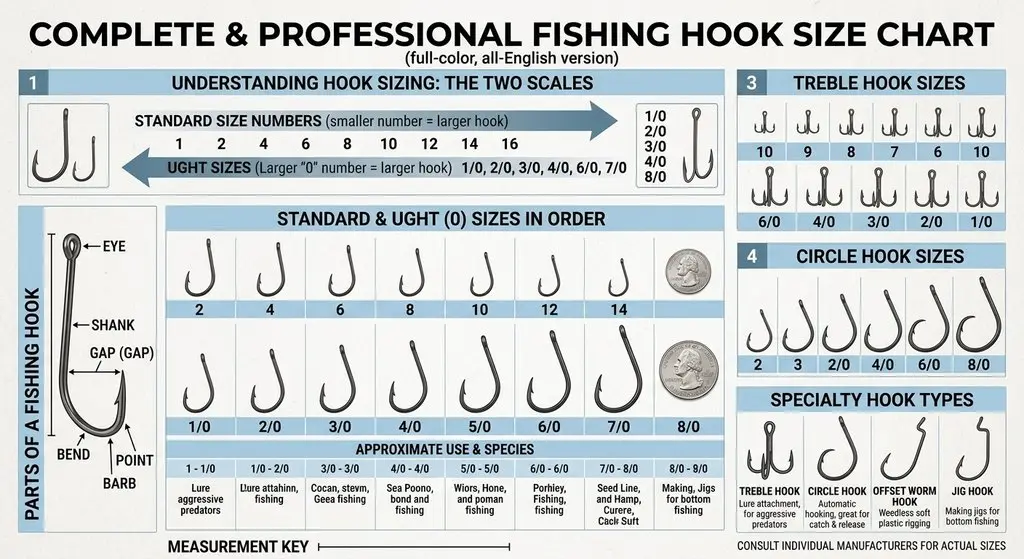
Hook size is one of the most confusing topics for new anglers because fishing-hook numbering does not work like ordinary measurements.
A fishing hook size chart can help beginners compare common sizes, but hook sizing varies by manufacturer and hook style. A size number alone does not always tell you the actual physical dimensions of a hook.
A simplified reference looks like this:
| Hook Size Category | Typical Application |
|---|---|
| Very small | Micro fishing, tiny bait, small flies |
| Small | Panfish and small bait |
| Medium | General freshwater applications |
| Large | Larger bait and larger species |
| Extra-large | Heavy-duty and specialized fishing |
This is why a fish hook size chart should be treated as a reference rather than an absolute universal measurement.
Other useful searches include fishing hook sizes, size chart for fishing hooks, fishing hook size guide, hook size chart fishing, and sizes of fishing hooks.
For example, size 8 fishing hooks and size 10 fishing hooks can be appropriate for relatively small presentations, while larger numerical designations may correspond to larger hooks in many conventional sizing systems. However, hook dimensions also depend heavily on the specific hook pattern.
Understanding Different Types of Fishing Hooks
There is no single universal fishing hook design. Different Fishing Hooks are engineered for different presentations and bait arrangements.
Common categories include:
- J hooks
- Circle hooks
- Octopus hooks
- Aberdeen hooks
- Sickle hooks
- Siwash hooks
- Worm hooks
- Treble hooks
- Bait hooks
- Fly hooks
- Barbless hooks
- Weedless hooks
- Weighted hooks
- Snelled hooks
The supplied keyword data specifically includes circle hooks, J hooks, Aberdeen hooks, worm hooks, treble hooks, fly hooks, barbless hooks, weighted hooks, and other hook categories.
J Hooks
J hooks are among the most recognizable fish hooks. Their shape makes them suitable for many traditional bait-fishing applications.
Circle Hooks
Circle hooks are designed with a distinctive inward-pointing hook configuration. Anglers researching circle hooks for fishing or fishing with circle hooks should also learn the appropriate hook-setting technique for their application.
Treble Hooks
A treble fish hook contains three points. Treble hooks are commonly associated with lures and certain specialized presentations.
Worm Hooks
Worm hooks are designed around soft-plastic presentations and are particularly relevant to anglers searching for worm hooks for bass fishing.
Barbless Hooks
Barbless fishing hooks have no traditional barb or have a flattened barb. They can be useful for anglers practicing catch-and-release or fishing in areas where barbless tackle is required.
Barbed vs. Barbless Fishing Hooks
One of the most common equipment comparisons is between barbed and barbless Fishing Hooks.
| Feature | Barbed Hook | Barbless Hook |
|---|---|---|
| Hook retention | Generally helps retain bait/fish | Can be easier to remove |
| Removal | May require more care | Generally simpler |
| Catch-and-release suitability | Depends on local rules and technique | Often preferred in some applications |
| Handling | Requires careful handling | Still requires caution |
| Regulation | Varies by location | May be required in certain fisheries |
Searches for barbless fishing hooks, barbless fish hooks, and fishing with barbless hooks are particularly relevant for anglers concerned with fish handling.
Always check local fishing regulations before choosing between barbed and barbless equipment.
Do Fish Feel Pain When Hooked?
The question do fish feel pain when hooked is scientifically complex. Fish have sensory systems capable of detecting potentially harmful stimuli, but the nature and subjective experience of pain in fish remain subjects of scientific investigation and debate.
For anglers, the practical takeaway is to minimize unnecessary injury regardless of how the biological question is interpreted.
Good practices include:
- Use appropriately sized hooks.
- Avoid unnecessary handling.
- Keep fish in the water when possible during release.
- Remove hooks carefully.
- Use suitable hook-removal equipment.
- Follow local catch-and-release requirements.
- Consider barbless Fishing Hooks where appropriate.
The keyword set supplied for this article includes several versions of this question, including do fish feel hooks, do fish hooks hurt fish, and does a fish hook hurt the fish, showing that this is an important informational search intent around fishing-hook use.
How to Remove a Fishing Hook Safely
Knowing how to remove a fishing hook is just as important as knowing how to tie a fishing hook.
A dedicated fish hook remover or hook-removal tool can provide better control than trying to manipulate a deeply embedded hook with fingers.
For a fish that is being released:
- Keep the fish secure and supported.
- Avoid squeezing the fish unnecessarily.
- Identify the hook position.
- Use an appropriate hook-removal tool.
- Reverse the path of the hook when practical.
- Minimize time out of the water.
- Release the fish carefully.
The supplied keyword data includes fish hook remover, fish hook removal tool, fishing hook remover, and best fish hook removal tool, reflecting the importance of this part of fishing-tackle preparation.
Common Beginner Mistakes When Tying Fishing Hooks
Even experienced anglers occasionally lose tackle because of preventable knot mistakes. Beginners should pay particular attention to the following.
Using Too Little Tag End
If you leave only a tiny tag end, tying the knot becomes more difficult and the knot may not form correctly. Start with enough excess line to comfortably complete the wraps.
Crossing the Wraps Randomly
Neat wraps are easier to inspect and tighten. Randomly overlapping wraps can produce inconsistent results.
Pulling Too Aggressively
The final tightening process should be controlled. Excessive friction can damage certain fishing-line materials.
Forgetting to Inspect the Knot
After tying Fishing Hooks, inspect the connection before casting. A knot that looks uneven should be replaced rather than trusted.
Using the Wrong Hook Size
A perfectly tied knot cannot compensate for a poorly matched hook. Select the hook according to bait, target species, fishing technique, and local conditions.
Learning Too Many Knots at Once
Beginners sometimes search for the best knot for fishing hook, best way to tie a fishing hook, and strongest way to tie a fishing hook and then try to memorize ten knots immediately.
That is unnecessary.
Start with one general-purpose knot, such as the Clinch Knot. Then learn the Palomar, Uni, and Snell knots as your fishing applications expand.
How to Tie Hook to Fishing Line: Quick Reference
If you need a simple answer to how to tie hook to fishing line, use this beginner checklist:
For a conventional hook eye:
- Pass the line through the hook eye.
- Leave several inches of tag end.
- Wrap the tag end around the standing line.
- Pass the tag end through the correct loop.
- Moisten the line where appropriate.
- Pull the knot tight gradually.
- Slide the knot into position.
- Trim the tag end.
- Test the connection.
For a beginner-friendly setup, the Clinch Knot is a practical starting point. For braided line, consider learning the Palomar Knot. For shank-based connections, learn the Snell Knot.
This covers many searches including how to tie a hook on a fishing line, how to put a hook on a fishing line, how to attach a hook to a fishing line, how to tie a fishing line to a hook, and how to tie hooks on fishing line.
How to Tie a Fishing Line for Beginners
The broader skill of how to tie a fishing line for beginners includes more than attaching a hook.
A basic rig typically involves:
Main line + terminal connection + leader + hook + optional weight/float
Start by learning how each component connects. The goal is not to create the most complicated rig but to create a reliable, understandable system.
For example:
Simple bait rig:
Main line → sinker → leader → fishing hook
Swivel rig:
Main line → swivel → leader → fishing hook
Float rig:
Main line → bobber → weight → leader → fishing hook
Once you understand these configurations, you can adapt them to different fishing conditions.
How to Tie a Fishing Hook: Choosing Between the Main Knots
A useful decision table can make knot selection easier.
| Your Situation | Knot to Learn First |
|---|---|
| General beginner hook connection | Clinch Knot |
| Braided line | Palomar Knot |
| Fine tippet or small fly | Davy or Uni Knot |
| Hook-shank connection | Snell Knot |
| Heavy monofilament | Baja Knot |
| Maximum strength-focused application | Pitzen Knot |
| Small or turned-down hook eye | Turle Knot |
| Alternative general-purpose connection | Orvis Knot |
The source specifically identifies the Davy Knot for small flies, Baja Knot for heavier monofilament, Pitzen Knot for strength, and Turle Knot for small or turned-down eye hooks.
How to Tie Hook to Fishing Line YouTube: Should Beginners Use Video Tutorials?
Many beginners search how to tie hook to fishing line youtube because knot tying is easier to understand visually.
Video can be particularly useful for knots involving multiple loops and wraps. However, do not simply copy hand movements. A good tutorial should explain:
- Where the tag end starts.
- How many wraps are required.
- Where the tag end passes.
- How the knot is tightened.
- Where to trim the line.
- How to inspect the completed knot.
The supplied reference itself includes video elements for several knot demonstrations, including the Clinch, Orvis, and Palomar knots.
Whether you learn from text, diagrams, or video, repeat the same knot several times until you can form it consistently.
Choosing Quality Fishing Hooks for Your Rig
Knot technique is only one part of a successful terminal tackle setup. The quality and design of Fishing Hooks also matter.
When comparing fishing hooks, consider:
- Hook material
- Hook-point sharpness
- Hook geometry
- Eye design
- Shank length
- Wire diameter
- Corrosion resistance
- Barbed or barbless configuration
- Hook size
- Target species
- Bait or lure type
- Freshwater or saltwater use
Anglers searching for high quality fishing hooks, premium fishing hooks, stainless steel fish hooks, stainless fishing hooks, or bulk fishing hooks should evaluate the actual application rather than choosing solely by appearance.
For commercial buyers, distributors, tackle brands, and fishing-equipment businesses, consistency becomes especially important. A hook product should be evaluated not only by individual-piece performance but also by manufacturing consistency, available sizes, finish, packaging, and customization requirements.
Why Consider Hari Hook for Fishing Hooks?
For buyers looking beyond individual retail purchases, Hari Hook can be positioned as a product-focused partner for sourcing and discussing fishing-hook requirements.
When evaluating Fishing Hooks for a fishing tackle business, the purchasing decision should go beyond simply asking which hook catches fish. Commercial buyers may need to compare hook styles, dimensions, material requirements, point configurations, finishes, packaging, and application-specific designs.
Hari Hook can be approached when you need to discuss the right fishing-hook configuration for your market and application.
Whether your requirement involves conventional fish hooks, bait hooks, specialized fishing hooks, treble configurations, barbless designs, or other hook concepts, contacting Hari Hook can help you move from a general hook requirement toward a more specific product discussion.
For businesses searching for best fishing hooks, bulk fishing hooks, premium fishing hooks, or application-specific hook solutions, a direct product consultation can be more useful than choosing a generic hook from a search result.
What to Discuss With Hari Hook
Before requesting a product recommendation, prepare information such as:
- Target fish species
- Freshwater or saltwater application
- Required hook sizes
- Hook style
- Bait or lure type
- Barbed or barbless requirement
- Material preference
- Finish requirement
- Packaging format
- Estimated order quantity
- Intended market
- Customization requirements
This information helps narrow the selection of Fishing Hooks much faster.
If you are developing a fishing-tackle product line, private-label program, distributor assortment, or specialized hook application, contact Hari Hook to discuss the appropriate hook configuration and product requirements.
Fishing Hooks for Different Applications
The right fishing hook depends heavily on the fishing scenario.
Trout Fishing Hooks
For anglers searching trout fishing hooks, best hooks for trout fishing, or what size hooks for trout fishing, hook size should be matched to bait and target trout rather than selected by species name alone.
Smaller bait and lighter presentations generally call for appropriately smaller hooks, while larger bait requires a different configuration.
Bass Fishing Hooks
Bass anglers often search bass fishing hooks, best hooks for bass fishing, and worm hooks for bass fishing. Soft-plastic presentations may require a hook designed specifically for the bait profile.
Catfish Fishing Hooks
Searches for fishing hooks for catfish and best fishing hooks for catfish usually involve stronger bait-oriented setups. Hook selection should account for bait size and expected fish size.
Saltwater Fishing Hooks
For saltwater fishing hooks, corrosion resistance and hook strength become especially important. Saltwater conditions can be demanding on metal tackle, making appropriate material and finish important purchasing considerations.
Final Checklist Before You Cast
Before casting a rig containing Fishing Hooks, perform a quick inspection.
Knot
- Is the knot fully tightened?
- Are the wraps neat?
- Is there sufficient tag-end trim?
- Is the line damaged?
Hook
- Is the point sharp?
- Is the hook correctly sized?
- Is the eye or attachment point undamaged?
- Is the hook appropriate for the bait?
Rig
- Is the sinker correctly positioned?
- Is the swivel secure?
- Is the bobber correctly installed?
- Is the leader suitable for the application?
Safety
- Is the hook covered when not in use?
- Are the hooks stored securely?
- Are hook-removal tools available when needed?
These simple checks can prevent many avoidable failures.
Frequently Asked Questions About How to Tie Hook to Fishing Line
What is the best knot for fishing hooks?
For beginners, the Clinch Knot is a practical general-purpose choice. The Palomar Knot is another important option, especially when working with braided line. The best knot ultimately depends on the line, hook, and application.
What is the easiest knot for a fishing hook?
The Clinch Knot is one of the easiest fishing knots for hooks to learn. It requires a straightforward sequence of passing, wrapping, looping, and tightening.
What is the strongest way to tie a fishing hook?
There is no single strongest connection for every fishing situation. The Pitzen Knot is described in the supplied source as capable of retaining a high percentage of line breaking strength, while the Palomar is presented as a strong choice for braided lines.
How do I tie a hook on a fishing line?
Pass the line through the hook eye, leave a tag end, form the selected knot, tighten it carefully, trim the excess, and test the connection. The Clinch Knot is a straightforward starting point.
How do I tie a fish hook and sinker?
Attach the hook with an appropriate knot, then position the sinker according to the intended rig. The sinker does not always need to be directly attached to the hook.
Can I tie a hook directly to a swivel?
Yes. A hook or leader can be connected to a swivel using a suitable knot, provided the swivel eye is compatible with the selected knot and line.
How do I attach a snelled hook to fishing line?
A Snell-style connection wraps the line around the hook shank. The supplied reference recommends passing the line through the hook eye, forming a loop, wrapping the shank, passing the tag end through the loop, and tightening.
Should I use barbless fishing hooks?
That depends on your fishing location, regulations, target species, and release practices. Always check applicable regulations before fishing.
What fishing hook size should beginners use?
There is no single beginner size. Select the hook based on the bait, target species, fishing method, and actual hook dimensions. A fishing hook size chart is useful for comparison, but manufacturer dimensions can vary.
How do I remove a fishing hook from a fish?
Use an appropriate fish hook remover or hook-removal tool, minimize handling, and follow responsible fish-release practices. If a hook is deeply embedded or removal could cause significant injury, professional assistance may be appropriate.
Conclusion: Master the Basics of Fishing Hooks and Knots
Knowing how to tie hook to fishing line gives anglers a foundation for building reliable fishing rigs. You do not need to master every knot immediately. Start with a dependable general-purpose knot such as the Clinch Knot, then add the Palomar, Uni, Snell, and other fishing hook knots as your fishing applications become more specialized.
Remember the basic sequence:
Choose the right hook → choose the right line → select the right knot → tie it carefully → tighten gradually → inspect the connection → test before casting.
The supplied reference demonstrates that different knots have different purposes: the Clinch is a quick general-purpose option, the Palomar is useful with braided line, the Davy is suited to small flies, the Baja is intended for heavier monofilament, the Pitzen focuses on strength, and the Snell connects around the hook shank.
For tackle businesses, distributors, and product developers, knot selection is only the beginning. Hook shape, size, material, finish, point design, barbs, packaging, and application requirements all influence the final product choice.
If you are sourcing or developing Fishing Hooks for a commercial fishing-tackle application, contact Hari Hook to discuss your requirements and explore suitable hook products for your target market. The right hook starts with the right specifications—and the right connection keeps that hook working when it matters.