Catalogue pages and purchase orders now use the word barbless far more often than they did a decade ago, and the word does not describe one object. A hook can leave the factory with no barb formed at all, can have a barb pressed flat after forming, or can carry a small projection sold as a micro-barb. The three behave differently under load and do not always comply in the same way, a commercial risk for anyone building a Freshwater Hooks range for regulated waters.
Barbless fishing hooks are hooks whose point carries no barb to resist withdrawal. The distinction that matters commercially is not barbless against barbed, but factory-formed against crimped, because the first is a designed point geometry and the second is a modification of a point that was designed to have a barb. That choice moves penetration, retention, removal time and, in regulated markets, compliance.
The sections below set out what each barb state is, how each behaves under load, and how to write a specification a factory can hold.
What Are Barbless Fishing Hooks?
A barbless hook is one whose point has no projection that resists withdrawal. Everything else the word implies, including how the point was formed and how much holding power it keeps, varies between products and has to be agreed rather than assumed.
A barb is a reverse-facing projection cut or pressed into the point. It lets the point travel forward with little resistance while forcing tissue to be displaced again on the way back. Remove it and the withdrawal path becomes almost free, which is the purpose of the design and also its weakness in use.
Factory-Made Barbless vs. Crimped-Barb Hooks
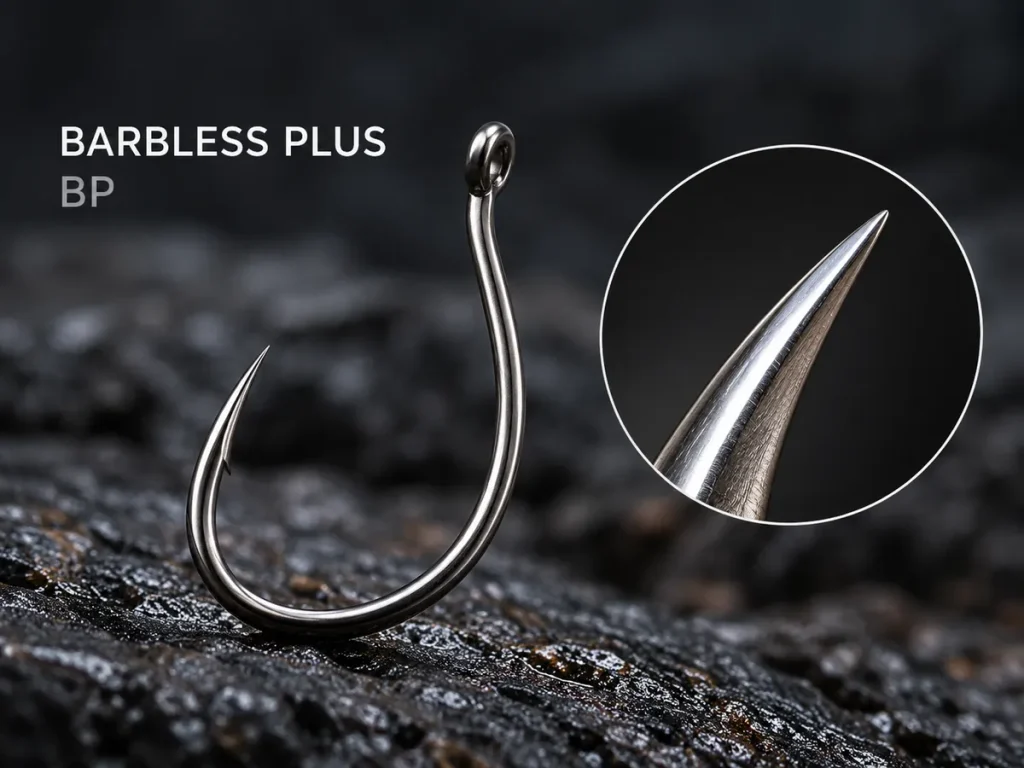
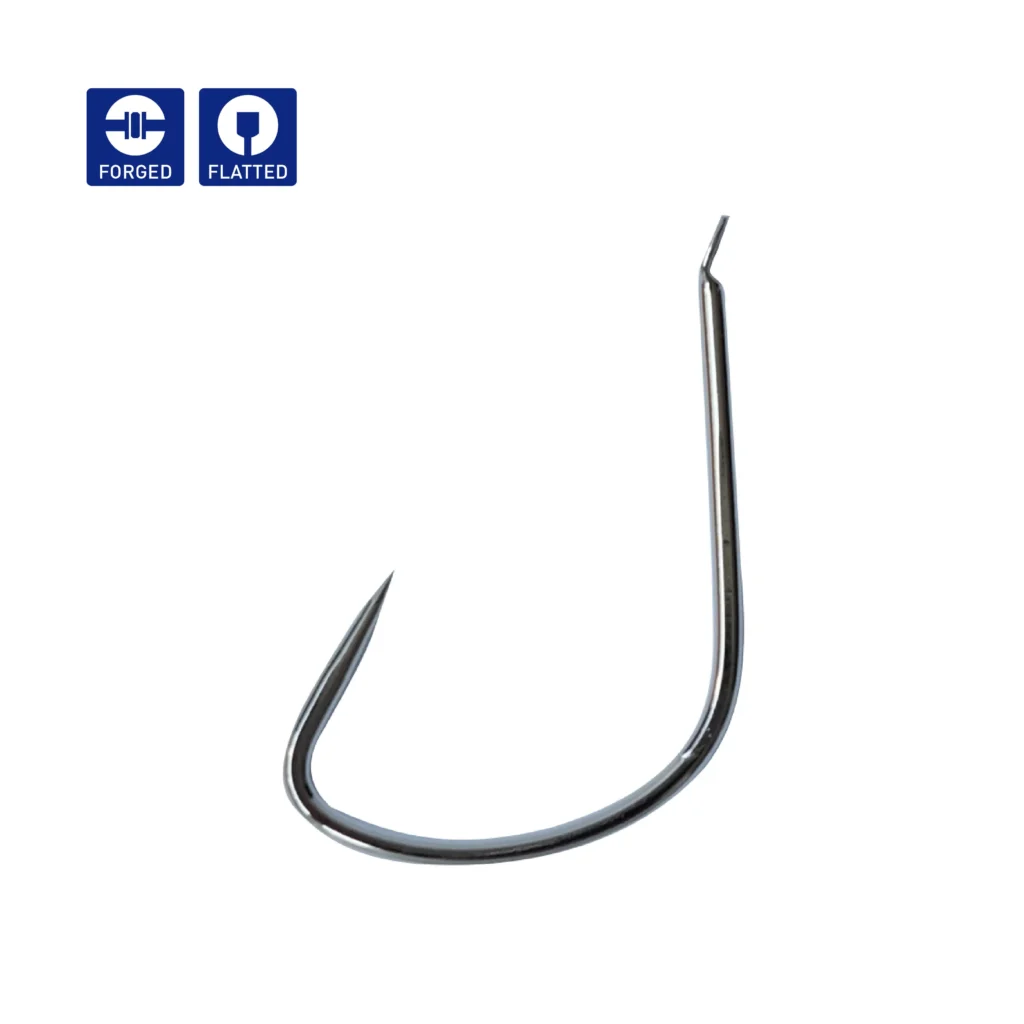
A factory-made barbless hook is manufactured without a conventional projecting barb, which lets the point profile be designed and controlled as part of the original production process. A crimped hook starts barbed and has the projection flattened afterwards, usually with pliers, leaving a work-hardened remnant. A pattern such as Barbless Plus Hooks shows the third route, where the point is forged with two flats from opposite sides so no barb has to be cut off.
Why Micro-Barbed Hooks Are Not Fully Barbless
A micro-barb is small, not absent, and it still resists withdrawal in proportion to its height, so it belongs in its own product class rather than as a synonym. Where a regulation requires barbless hooks, enforcement looks for the absence of a projecting barb, and a micro-barb leaves something to find.
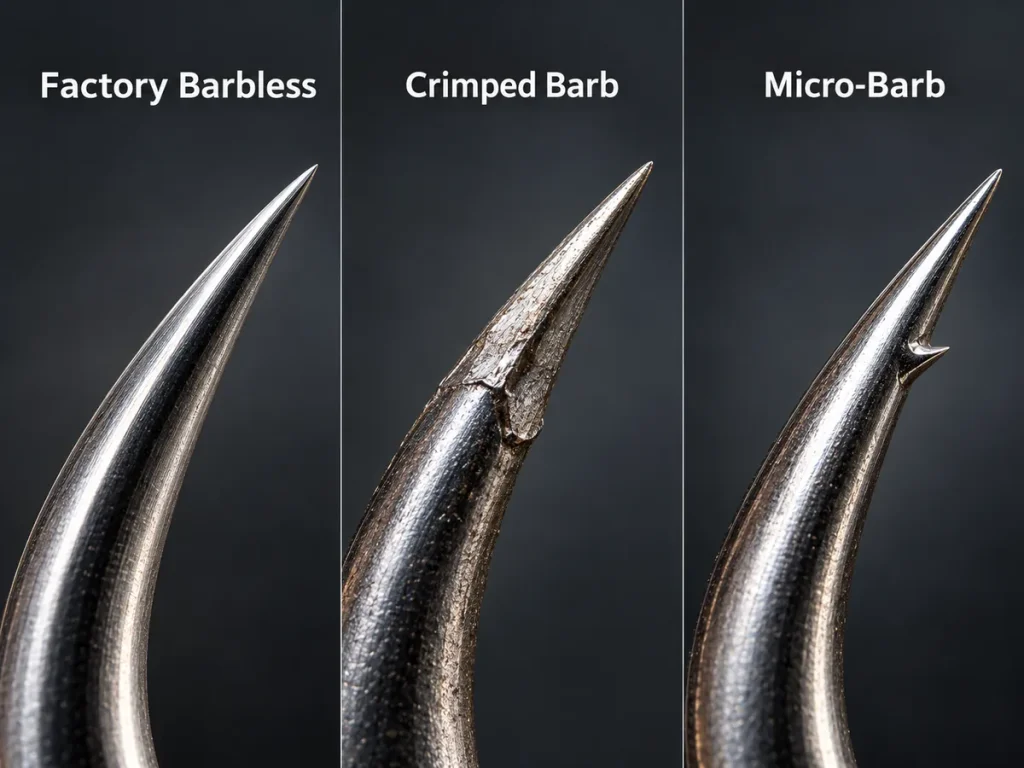
| Barb state | How it is produced | What it does on withdrawal |
| Factory barbless | Formed or ground without a barb | Minimal resistance, continuous taper |
| Crimped barb | Barb pressed flat after forming | Uneven resistance, hardened remnant |
| Micro-barb | Small projection left in place | Partial resistance, some holding |
How Do Barbless Hooks Perform When Fishing?
Removal becomes faster and withdrawal resistance largely disappears. Penetration changes little when the point is formed barbless. Retention when line tension drops gets worse, and published catch-efficiency comparisons are mixed rather than uniformly favourable, so the trade-off has to be managed rather than argued away.
None of this is a property of the barb alone. Performance comes from point geometry, wire diameter, hookset style and the tension kept on the fish, and two barbless hooks in one size range can behave quite differently. The survival gap is also narrower than the marketing implies: a meta-analysis of resident salmonid comparisons put mean hooking mortality at 4.5 percent for barbed hooks and 4.2 percent for barbless, with one of eleven comparisons significant. A separate guide answers Do Fish Feel Pain When Hooked and settles the physiology.
Hook Penetration and Point Geometry
The barb sits behind the tip, but its projection can still affect the force needed for the hook to pass through tissue. Final penetration resistance depends on point sharpness, taper, wire diameter and barb geometry, which is why a crimped remnant standing proud of the taper raises entry force. Forging aims at the same effect from the other side: the flats interrupt the taper only when the point is pulled back, so the intent is retention without entry cost. That intent needs verifying with penetration force and pull-out tests on the finished point.
Fish Retention and Line Tension
A barb can help resist withdrawal when line tension drops, and that is precisely the resistance a barbless point does not have. Without it, a barbless hook leans on secure hook placement, consistent tension and a controlled landing, and slack line cannot be named the main cause of loss without evidence from that fishery. Keeping the rod loaded, avoiding slack at the net and choosing a gap that suits the bait all matter more than the barb state. Catch per unit effort across hook types has generally differed little and not significantly, with mean values in one cyprinid study ranging from 14.4 for circle hooks to 17.2 for barbed J hooks, so a blanket claim that barbless costs catch rate is unsupported.
Bait Holding and Hook Removal
Across 1,066 fish and eight cyprinid species, removal efficiency reached 63.7 percent with barbless J hooks against 45.6 percent with circle hooks, and barbed J hooks took longest to clear, as reported in the study of hook type and reflex impairment in cyprinid angling. Shorter removal time means less handling and less air exposure. Bait holding is the counterweight: soft baits slide on a barbless point, so bait stops, shank barbs or a shorter bait past the bend do work the point no longer does.
Which Barbless Hook Design Fits Your Fishing Style?
Match the pattern to the presentation first, then choose the barb state within that pattern, because barb configuration is the last variable rather than the first.
A barbless version of the wrong pattern is still the wrong pattern.
Freshwater and Competition Fishing
Competition and match fishing reward fast penetration and low visibility, which points to small sizes and a short shank, with wire diameter set by fish size rather than discipline. A pattern such as Shin Kanto Sure Hooks, offered from size 0.1 to 10 in heavy wire with a chemically sharpened needle point, shows how a competition hook can be barbless while keeping the stiffness that small sizes otherwise lose.
Carp Fishing and Wide-Gap Hooks
Carp and other large freshwater species need gap clearance for bulky baits and a wire section that will not open under load. A wide gap pattern like Koi Sure Hooks, built from size 12 to 23 in heavy wire, illustrates the trade: the wider the gap, the thicker the wire for the same strength, and the more point geometry has to compensate at entry.
Natural Bait and Saltwater Fishing
Natural bait and saltwater work push toward heavier wire, corrosion resistance and bait retention on the shank. Here the barbless decision costs most, because bait grip leans on the barb. The compromise is a barbless point combined with a bait stop or a snell that pins the bait at the bend.
| Fishing application | Pattern family | Specifications that matter |
| Competition freshwater | Fine wire, short shank | Point sharpness, wire stiffness, size consistency |
| Carp and big freshwater | Wide gap, heavy wire | Gap width, tensile, point strength |
| Natural bait and saltwater | Bait holder or octopus | Bait retention, coating, corrosion resistance |
| Lure and treble replacement | Single inline replacement | Gap width, shank length, one-point compliance |
Factory-Made vs. Crimped Barbless Hooks
Factory-made and crimped barbless hooks should be treated as distinct manufacturing specifications. Some fishing regulations accept a properly flattened barb, so the buyer has to verify the requirement of each intended market rather than assume the two are interchangeable.
The difference shows up in how the point enters, how long it stays sharp, and whether the batch is uniform. A crimped hook is only as consistent as the hand that flattened it, which suits a field modification better than a volume order.
Point Shape and Manufacturing Differences
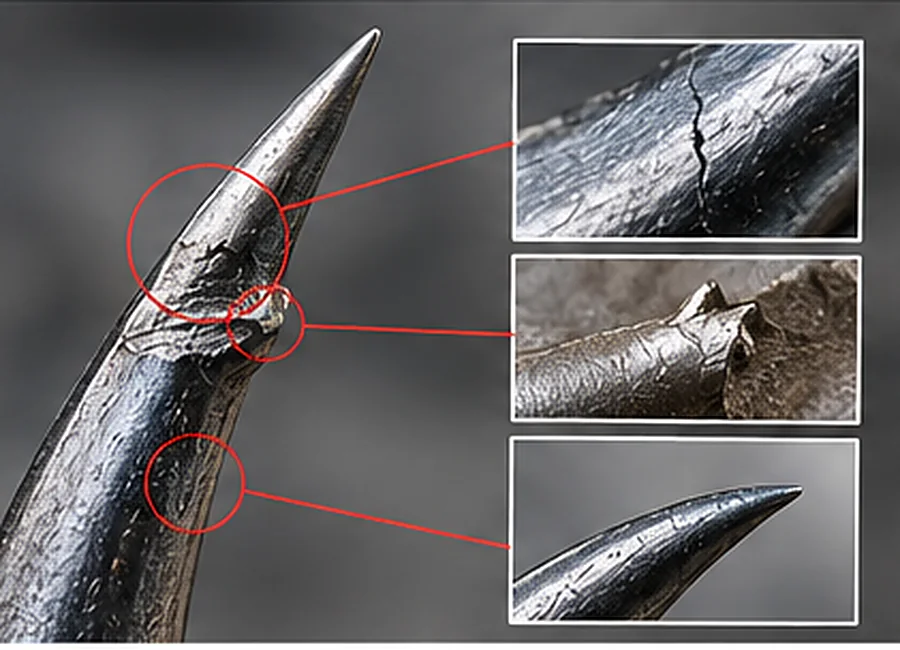
Pressing a barb flat work-hardens the local section and can leave a step where the metal folded, and that step changes penetration feel. Grinding removes the barb and the material around it, which preserves the profile only if point length and taper are re-specified. Forging can form the intended barbless geometry during manufacturing and reduce the need for post-production barb removal, but final point strength, alignment and penetration still have to be verified by testing.
What Can Go Wrong When Flattening a Barb
A crimped point fails in a small number of predictable ways, all visible before the hook reaches water:
- The barb cracks rather than folds, leaving a jagged remnant that tears on entry.
- The flattened edge stands proud of the taper and raises penetration force.
- The point bends off axis, so the hook no longer tracks straight under load.
- The wire is flattened locally, reducing strength where the bend loads it.
How to Inspect a Finished Barbless Point
Inspection should be short, repeatable and free of contact with the point. Examine the tip under magnification for cracks, raised edges or remaining projections, use a non-contact measurement where the drawing allows it, and verify penetration with a controlled test fixture rather than by hand. Appearance checks and penetration tests answer different questions and should be recorded separately. The manufacturing controls behind point geometry are set out in the reference on Fishing Hook Point Technology, and the same checks translate into goods-in criteria.
How to Choose Barbless Fishing Hooks for Your Market
The target species and presentation set the lower limit on wire and gap, and the regulation sets the upper limit on gap, so the specification has to be written between the two.
Markets differ less in wanting barbless hooks than in how tightly they define the hook around it.
Wire Diameter, Gap Width, and Point Style
Thinner wire penetrates more easily and deforms sooner. A wider gap clears bigger baits and needs thicker wire for the same tensile. A long needle point enters cleanly but turns more easily on hard mouths, where a shorter or triangular point holds up better. Set species and bait first, then wire, then gap, and check the result against any regulatory ceiling before sampling.
Coating and Corrosion Resistance
Coatings add measurable thickness, and on a chemically sharpened point that thickness can blunt the feature the buyer is paying for. Specify a thickness limit at the point rather than only on the shank, require salt spray results on finished hooks rather than on wire, and confirm that post-plating handling does not re-dull the tip.
Barbless Fishing Regulations Buyers Should Know
Regulation is now specific enough to be a specification input. In the Pacific region of Canada, a Fisheries and Oceans Canada fishery notice effective 1 September 2026 prohibits hooks with more than one point and any single hook measuring more than 22 mm from point to shank when fishing for salmon in tidal waters, alongside the standing barbless requirement in tidal and non-tidal waters of British Columbia. A gap ceiling turns a size decision into a compliance decision, and a single-point rule removes treble configurations from a whole market segment overnight. Wording varies by jurisdiction, so read barbless against local enforcement practice before committing a range.
What Wholesale Buyers Should Check Before Ordering
Write barbless as a measurable condition on the drawing, then agree an inspection method and an acceptance criterion, because a word alone cannot be rejected at goods-in.
The sequence that works is drawing, sample, measurement method, then acceptance criterion, because buyers who skip to the sample end up approving a hook they cannot describe.
Product Drawings and Sample Approval
The drawing should state the barb state as a geometry callout rather than a word: maximum remnant height at the point, point length from tip to bend, tolerance on point alignment. Sample approval then checks against the drawing instead of an opinion.
Quality-Control Checks for Barbless Points
Agree the sampling plan, the instrument and the person responsible. Magnification and non-contact measurement cover remnant and raised edge, a straight edge covers alignment, and a test fixture on a defined medium covers penetration and pull-out. Record results per batch, because drift across shipments is the useful signal rather than a single pass.

OEM Customization and Packaging
Custom work lands on point geometry, wire, coating and packaging rather than the barb, which has to stay absent. Confirm that private label artwork does not describe a micro-barb product as barbless, since that wording creates a compliance problem after delivery.
| Specification | Inspection method | Acceptance criteria |
| Barb state | Magnification plus non-contact check | No remnant or raised edge above agreed height |
| Point alignment | Straight edge against hook axis | Within agreed offset tolerance |
| Penetration behaviour | Test fixture on defined medium | Within agreed force band per size |
| Gap width | Caliper from point to shank | Within size tolerance and market ceiling |
Frequently Asked Questions
Each of these turns on a definition rather than a preference.
Do Barbless Hooks Lose More Fish?
Barbless hooks may increase the risk of losing a hooked fish in some fishing conditions, but results vary by species, hook design and angling technique. Maintaining steady line tension reduces accidental withdrawal, and a well placed point kept under load behaves much like its barbed equivalent.
Are Micro-Barbed Hooks Considered Barbless?
Not in any strict sense, because a micro-barb is a projection and does resist withdrawal. Whether a market accepts it depends on the wording of the rule and on enforcement, so the safe position for a supplier is to treat it as a separate category and label it explicitly.
Are Factory-Made Barbless Hooks Better Than Crimped Hooks?
For volume supply, yes, because the point is uniform across the run and inspectable against a drawing. Crimping remains useful for an angler modifying hooks already in the box.
Can Barbless Fishing Hooks Be Customized for Bulk Orders?
Yes, and customization normally covers wire diameter, gap width, shank length, point style, coating and packaging, with the barb state fixed as absent. What has to be agreed up front is the point tolerance, since that feature drifts most between runs and is what a market check looks at first.