Whether a fish suffers when it takes a hook is one of the oldest arguments in angling, and it now sits behind commercial decisions. Welfare guidelines, retail sourcing requirements, and gear regulations increasingly specify which hooks may be used. For anyone specifying fishing hooks, from a general Freshwater Hooks range to a specialist pattern, the practical question is narrower than the philosophical one: which design reduces injury and handling time.
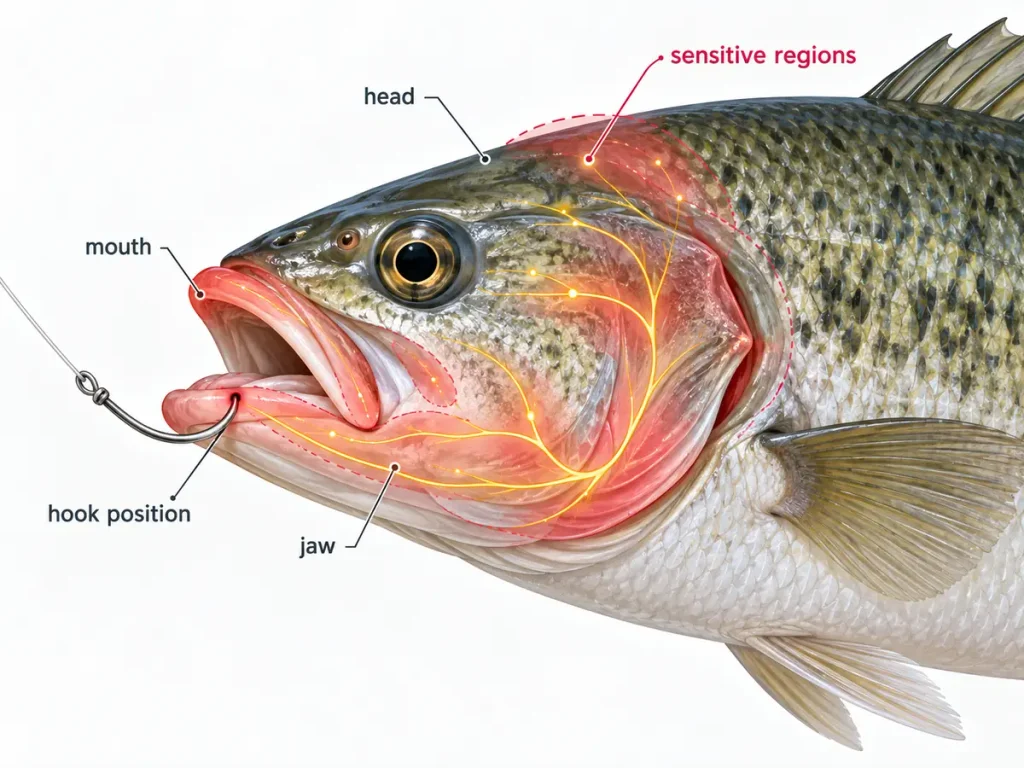
The short answer is that fish detect the tissue damage a hook causes and respond to it, but whether they experience it as pain in the human sense remains scientifically unresolved. Nociceptors, the nerve endings that detect damaging mechanical, thermal, and chemical stimuli, are concentrated on the head, lips, and mouth. A hooked fish also shows behavioural changes lasting far longer than a reflex. What no study has settled is whether those responses come with a subjective experience of suffering. The uncertainty is therefore the working assumption: reduce tissue damage and handling time, and the question matters less.
The sections below cover the physiology, the evidence, and the design decisions that change the outcome.
How a Hooked Fish Responds Physiologically
A hooked fish mounts two responses. Nociception is the detection of tissue-damaging stimuli by nerve endings on the head, lips, and mouth, producing reflex withdrawal. The stress response is whole-body: stress hormones rise, oxygen demand increases, and lactic acid accumulates in muscle. The first is well documented, the second can take hours to resolve, and neither settles whether the fish experiences pain.
Nociceptors in the Mouth and Head
Recordings from the trigeminal nerve of rainbow trout found receptors on the head responding to mechanical pressure, to temperatures above 40 degrees Celsius, and to acetic acid. Of those, 58 responded to at least one stimulus, 22 qualified as nociceptors, and 18 also responded to chemicals, making them polymodal. Those receptors cluster on the face and head, so a hook in the lip involves different tissue from one that reaches the throat or gut.
The Stress Response After a Hookset
Hooking and playing a fish activates the stress axis. Cortisol rises, ventilation and heart rate increase, and oxygen consumption stays elevated well after release. Recovery scales with fight duration and water temperature, and warm water holds less oxygen, slowing recovery. The load is additive rather than resettable, which is why accumulated stress accounts for much of release mortality.
What the Scientific Evidence Shows
The evidence supports two things at once. Fish have the machinery to detect a hook wound, and they behave differently afterwards in ways that outlast a reflex. The evidence does not establish that they experience a subjective state of suffering. The disagreement is less about the data than about what would count as proof.
The Evidence That Fish Experience Pain
Behaviour changed beyond the moment of stimulation. Trout given noxious substances on the lips displayed anomalous behaviour, including a rocking motion also seen in stressed mammals, and rubbed their lips against the tank floor. They took roughly three times longer than controls to resume feeding, and their gill beat rate rose. Those effects persisted rather than resolving in seconds, which a simple reflex arc would not produce. The original study is available through the Royal Society paper on fish nociceptors.
Why Some Researchers Disagree
The sceptical position is not that fish fail to respond, but that the response has been misread. A detailed review argues that fish lack the neural tissue associated with the subjective experience of pain in mammals, in particular a cerebral cortex, and that each commonly cited line of evidence has a non-pain explanation. Behavioural responses to tissue damage are not necessarily evidence of pain. Physiological stress is not pain. Most pointedly, pain is not required to reduce injury, so the survival value of the response cannot be used to infer that it is felt. The full argument is set out in the review of reasons to doubt pain in fish.
What Scientists Can and Cannot Conclude
The experiments that dominate the field deliver a controlled noxious stimulus, such as acid injected into the lip. A hook in a jaw during a fight is a different event: tearing, sustained tension, exhaustion, and often air exposure. The laboratory findings establish that fish can detect tissue damage, but they do not measure what being hooked feels like. What can be concluded is that the capacity to detect damaging stimuli exists and that hook location determines which tissue is damaged. What cannot be concluded is whether a felt experience is attached, which is why the question remains open two decades on, and why the dimensions catalogued in the Fishing Hook Size Chart are better treated as a specification than a footnote.
| Study type | What was observed | What it supports | What it cannot show |
| Electrophysiology on the trout head | Receptors responding to pressure, heat above 40 degrees Celsius, and acid | Fish detect damaging stimuli, concentrated on the head and mouth | Whether detection comes with a felt experience |
| Behavioural trials after noxious stimulation | Anomalous behaviour, lip rubbing, feeding resumed about three times later | Responses outlast a simple withdrawal reflex | Whether the fish suffers, as distinct from responding |
| Analgesic administration | Drug treatment altered the response to the stimulus | The pathway is not a fixed reflex arc | Whether the change reflects relief or reduced sensation |
| Brain anatomy review | No cortex comparable to that of mammals | Behavioural and physiological responses are not proof of pain | Whether a differently organised brain produces an equivalent experience |
| Comparative hooking studies | Hooking location predicts survival far more strongly than hook pattern | Physical damage and its location drive measurable outcomes | Anything about the fish’s subjective state |
Do Fish Heal After Being Hooked?
Often yes, and mouth wounds generally resolve better than gut wounds, because the jaw is well supplied with blood and repairs comparatively well. The outcome depends on where the hook lodged, how much tissue it tore, whether it was removed or left in place, and how the fish was handled. No single recovery timeline applies across species.
How Hook Wounds Heal
Healing runs faster in vascularised tissue such as the jaw than in the gut wall. A hook in the throat, stomach, or gut is a different problem, because the tissue is thinner and surrounds organs that cannot tolerate puncture.
Two mechanisms resolve a hook that is not removed. Corrodible steel loses material and loosens slowly, because an embedded hook is partly shielded from oxygen and water by the inflammatory response that walls it off, while stainless steel resists corrosion and can remain far longer. Encapsulation covers the hook with inert calcified tissue, which is containment rather than healing through. Radiographic studies report retention ranging from a few days in some species to years in others, shifting with hook size, position, material, and water temperature, so any single figure presented as a general rule should be treated with suspicion.
Cutting the Line Versus Removing the Hook
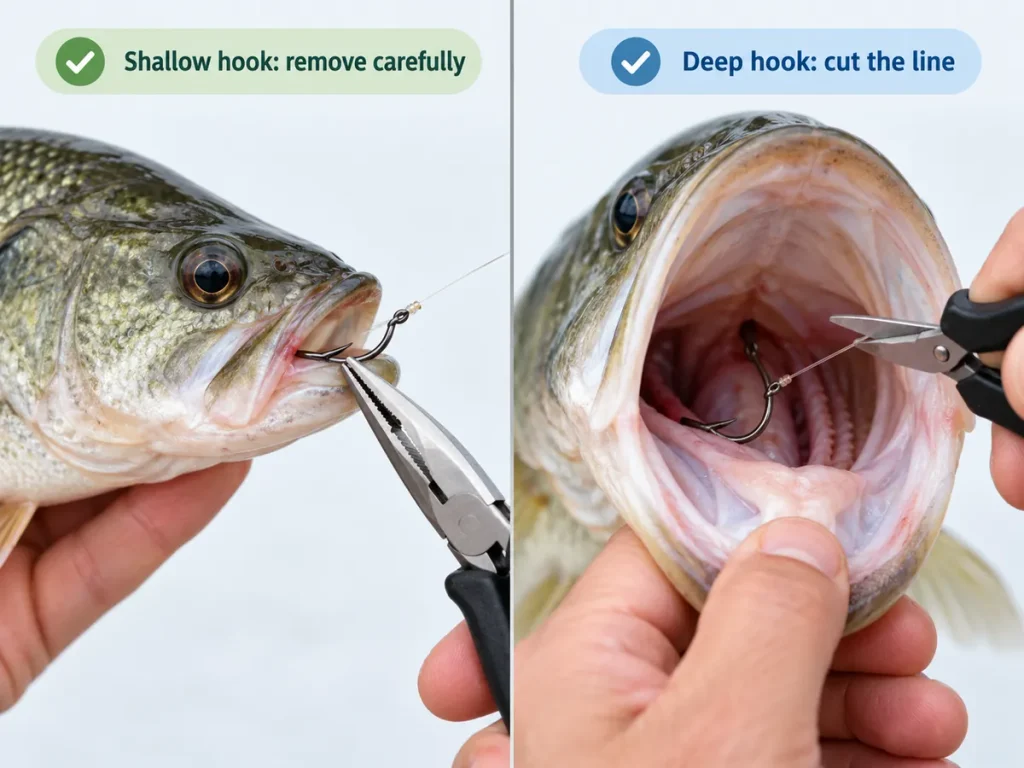
The two cases call for opposite actions. The approach recommended in NOAA Fisheries guidance on catch and release best practices is to remove a hook only when it can be backed out the way it entered, and otherwise to cut the line as close to the hook as possible. One comparison found that several deep-hooked fish died after the hook was pulled out, while none died when the line was cut, as documented in state fisheries research on deep-hook release mortality. The risk concentrates on Bait Hooks fished with natural bait, because a fish taking bait tends to swallow rather than strike.
- Lip or corner of the jaw: removal takes seconds and the wound closes quickly.
- Inside the mouth: use a dehooker while the fish is still in the water.
- Throat, gullet, or gills: cut the line close to the hook, because bleeding here carries the highest mortality.
- Stomach or gut: cut the line and release, because perforation is the outcome to avoid.
Does Hook Design Change How Much Damage a Fish Takes?
Yes, but through specific physical mechanisms rather than any single attribute that makes one hook kinder than another. Point geometry changes how much force is needed to penetrate and how much tissue is cut. Barb configuration changes how much tissue is torn during removal. Circle hook geometry changes where the hook lodges. What none of these change is whether the fish experiences pain, and no configuration of fishing hooks has been shown to remove the damage that hooking causes.
Hook Point Geometry and Penetration
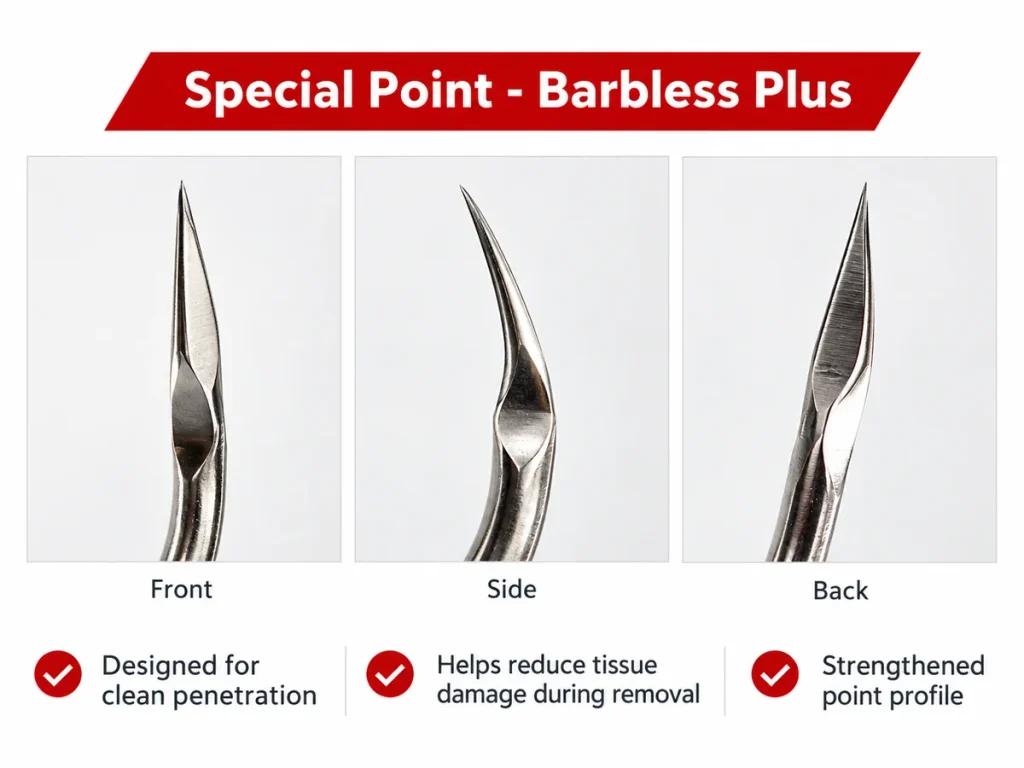
Point design is the most consequential and least measured variable. Needle points concentrate force into a narrow tip, while cutting points slice as they enter, which helps on hard-mouthed species. Sharpness is measurable and it matters: a point requiring more force to set is more likely to tear than penetrate cleanly. This is why penetration force and point retention testing belong in a serious specification for fishing hooks, described further in the reference on Fishing Hook Point Technology. The step from a given point style to a welfare outcome has not been quantified, so that link is a manufacturing inference from tissue mechanics rather than a demonstrated result.
Barbed vs. Barbless Hooks: Removal and Injury
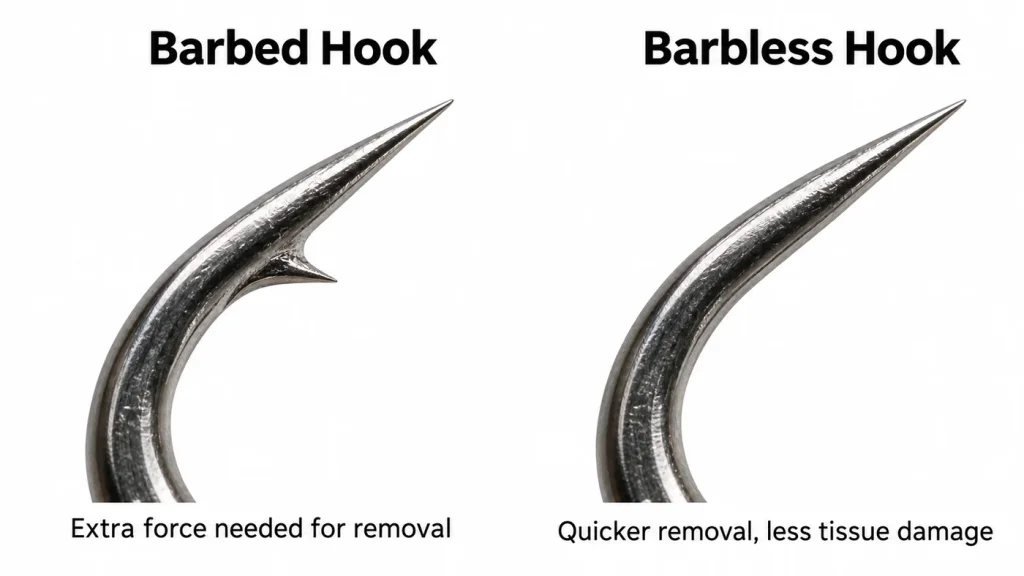
A barb prevents a hook from backing out by requiring extra force to withdraw, and the tissue displaced during withdrawal is the tissue the barb passes through. Barbless hooks and crimped barbs come out quickly, which reduces tissue damage and shortens handling or air exposure. Catch-rate comparisons have found the two broadly similar, though barbless demands maintained line tension. Barbless nevertheless addresses removal, not hooking location, so it does nothing to prevent a swallowed hook, and in deeply hooked fish shedding rates did not differ between the two designs.
Circle Hooks vs. J Hooks: Where Fish Get Hooked
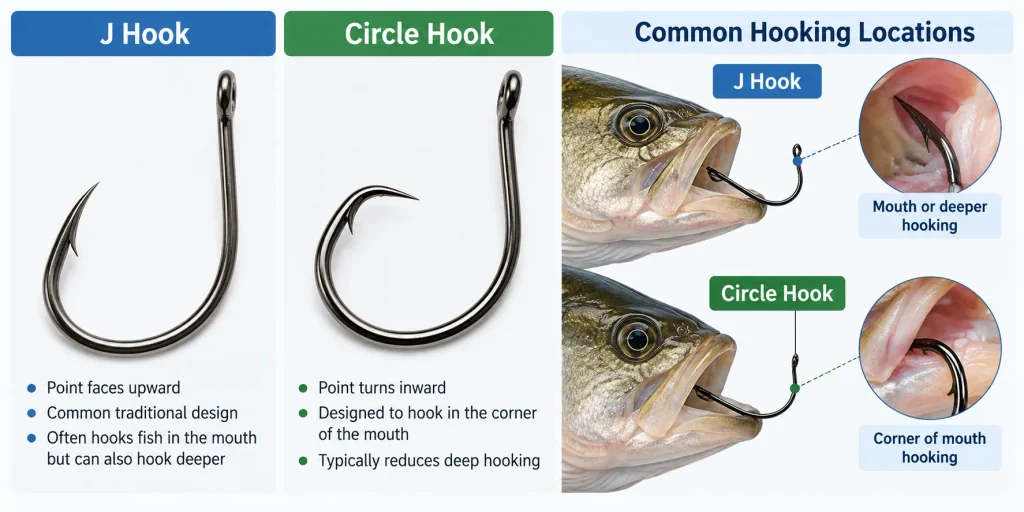
Circle hooks turn the point back toward the shank, so the hook rotates and lodges in the jaw or the corner of the mouth rather than the throat. Comparative work reports lower deep-hooking rates for non-offset Circle Hooks, in one species 1 percent against 4 to 9 percent for conventional patterns, and a fourfold reduction in deep hooking in a striped bass fishery, with the great majority of tuna and billfish hooked in the jaw.
| Hook design feature | Physical mechanism affected | Evidence strength | Practical effect |
| Point geometry and sharpness | Penetration force and tissue displaced | Sharpness effects are measured; point style to welfare outcome is a manufacturing inference | A blunt point tears rather than parts tissue and takes longer to set |
| Barb configuration | Resistance to withdrawal and tissue displaced on removal | Supported by comparative studies | Barbless reduces tissue damage and handling time but needs maintained tension |
| Circle compared with J geometry | Position in which the hook lodges | Supported by comparative studies | Non-offset circle hooks reduce deep hooking and gut injury |
| Offset compared with non-offset | Rotation of the hook inside the mouth | Supported by comparative studies | Offset points are associated with increased gut hooking |
| Hook size relative to bait | How far the bait is taken before the hook engages | Supported by comparative studies | Oversized hooks reduce deep hooking but can lower hook-up rates |
| Wire diameter and material | Penetration force, bending behaviour, corrosion rate | Supported by measurement and observed retention | Thin wire penetrates easily but deforms; corrodible steel loosens sooner than stainless |
Is Catch and Release Cruel?
Judging the practice in the abstract is not useful, because outcomes vary enormously with execution. A fish hooked in the jaw, landed quickly, kept in or over the water, and released within seconds has a high probability of surviving. A fish hooked deep in the gut, played to exhaustion, held out of the water, and handled with dry hands has a much lower one. The intention behind the release changes neither outcome.
When Release Works Well
Holding studies on angled and released fish commonly report survival between roughly 70 and 100 percent, and the variable that explains most of the spread is where the hook lodged. Fish hooked in the lip or mouth have approached full survival, while those hooked in the throat or gut dropped to around 64 percent in one comparison.
Practices That Decide the Outcome
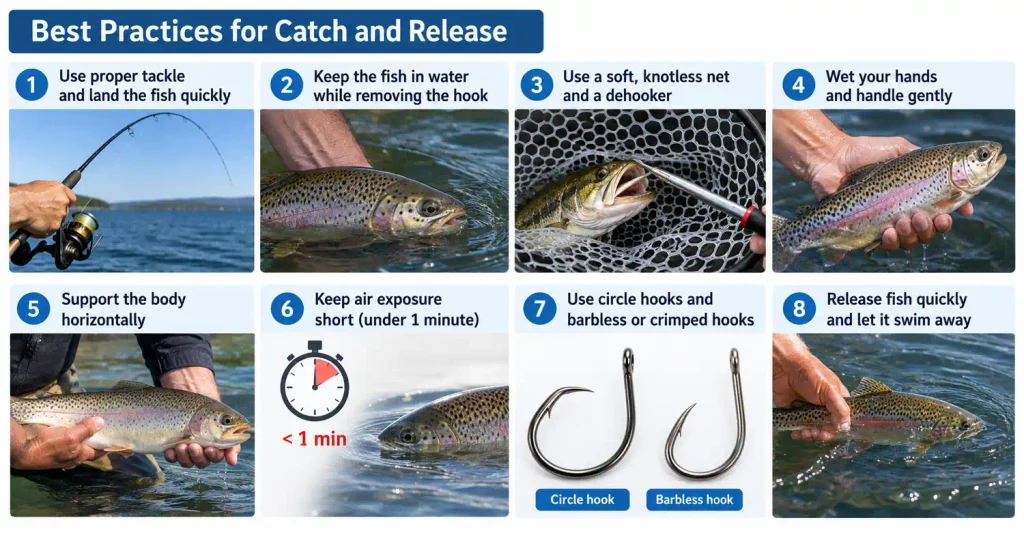
None of these measures depends on resolving the scientific debate:
- Use tackle heavy enough to land the target species quickly, and keep the fight short.
- Keep the fish in the water or directly over it while the hook is removed, using a soft knotless net and a dehooker.
- Wet your hands before any contact, never use a dry towel or glove, and avoid the gills and the eyes.
- Support the body along its length if the fish must be lifted, and never suspend it by the jaw.
- Keep air exposure well under one minute, and prefer no exposure at all.
- Use circle hooks with natural bait, and barbless or crimped hooks where regulations call for them.
- Use corrodible rather than stainless steel hooks when a hook may be left in a fish.
- Release fish caught from more than about 30 feet quickly, using a descending device where barotrauma is likely.
How to Choose Fish Hooks That Reduce Injury
Choose on four measurable attributes: where the hook tends to lodge, how much tissue it displaces, how easily it can be removed, and how quickly it disappears if it cannot be removed. Those four attributes are what separate fishing hooks that reduce injury from those that merely catch fish.
Hook Features That Matter for Fish Welfare
The welfare-relevant attributes are dimensional or material properties, so they can be specified, inspected, and verified rather than debated. Hooking location is set by hook geometry, in particular the relationship between the point, the shank, and the offset. Tissue displacement during removal is set by barb height and shape. Time in hand depends on how quickly the hook releases.
What Wholesale Buyers Should Verify
For buyers sourcing fishing hooks into markets with welfare requirements or gear regulations, the specification sheet is where the commercial risk sits. A pattern described as non-offset needs a dimensional drawing confirming it, because the term has a precise geometric meaning. An order described as barbless needs confirmation that the configuration is available across the entire size range, not only the larger sizes. Material needs to be certified, because corrodible and stainless hooks that look identical in a photograph behave very differently in use. Buyers comparing patterns across these dimensions can review the range covered under Fishing Hooks by Category.
| Specification field | Why it matters for injury and removal | What to ask the supplier |
| Point style and sharpness consistency | Sets penetration force and tissue displaced on entry | How is point sharpness tested, and how much batch variation is accepted |
| Barb height and barbless availability | Sets removal difficulty and tissue displaced during withdrawal | Is a barbless or crimpable version available in every size |
| Offset configuration | Non-offset geometry is associated with reduced gut hooking | Can the pattern be supplied non-offset, with a drawing confirming the geometry |
| Size range and gap dimensions | Determines where the hook engages relative to the bait | Are gap and overall length held within stated tolerances across all sizes |
| Wire diameter and material grade | Affects penetration force, bending behaviour, and corrosion rate | Is the grade certified as corrodible or stainless, and what is the diameter tolerance |
| Coating, finish, and batch documentation | Affects corrosion behaviour, point durability, and warranty exposure | What is the coating specification, and what documentation accompanies each shipment |
Frequently Asked Questions
These are the questions readers ask most often that the sections above do not settle directly.
Can Fish Experience Emotions as Well as Pain?
The most cited experiment placed 72 zebrafish in a tank with a temperature gradient and confined half of them in a net briefly. The stressed fish spent more time in warmer water, with an estimated body temperature rise of 2 to 4 degrees Celsius, which the authors called emotional fever and presented as removing a key argument against fish consciousness. The result has since been contested: a published comment argued that individual fish could not be identified, that the modelling rested on a small fraction of the observation time, and that the shift was not statistically distinguishable, as set out in the published critique of the emotional fever interpretation. Follow-up attempts failed to replicate it. Zebrafish also become anxious in response to the fear behaviour of other fish, a response that depends on oxytocin, the same molecule involved in mammalian empathy, which indicates emotional contagion rather than proof of a subjective state.
Are Circle Hooks or Barbless Hooks Legally Required Anywhere?
There is no global requirement, and the rules that exist are specific to particular fisheries, so check the regulations for the water being fished. In the United States Atlantic, federal regulations require non-offset circle hooks when participating in a billfish tournament using natural bait, and when recreationally fishing for sharks, except with flies or artificial lures. Also in the United States Atlantic, a coastwide rule requires non-offset inline circle hooks when fishing for striped bass with natural bait in any Atlantic coastal state. In British Columbia, Canada, a barbed hook may be used for most finfish, but barbless hooks are required for salmon, sea-run trout, and in the tidal waters of the Fraser River, as set out in Canadian federal recreational fishing regulations for the Pacific region. Buyers supplying regulated markets should treat gear specification as a compliance item, particularly for Saltwater Hooks sold into restricted fisheries.
Does the Hook Matter More Than How Long the Fight Lasts?
Both matter, and they act at different points in the sequence. Hooking location is the strongest single predictor of survival in the comparative studies, and hook geometry determines hooking location, which makes design a first-order factor. Fight duration, air exposure, and handling then determine how much additional load is added on top of the wound, and that load is what converts a survivable injury into a fatal one.