Most hook selection advice starts with a number, which is usually where it goes wrong. Two hooks printed with the same size can be entirely different tools, and a fish responds to how a hook behaves inside its mouth rather than to what the packet says. A catalogue of Fishing Hooks by Category reflects that reality better than a numeric index, because the shape and the wire carry more of the decision than the number does.
The reliable way to choose fishing hooks for a different fish species is to apply four filters in sequence: how the fish opens and uses its mouth, what bait you are presenting and how thick it is, what the habitat will do to your hook during the fight, and which hook family delivers that combination. Hook size is the last filter and should be treated as a starting range rather than an answer. When all four filters point to the same hook family, that is the hook to tie on.
The table below gives the quickest starting point for each species group, and the sections that follow explain how to confirm that choice and when to move away from it.
| Fish group | Common hook family | Typical presentation |
| Trout and char | Fine-wire single bait hooks | Small natural baits and flies |
| Panfish, crappie and bluegill | Light-wire Aberdeen and bait hooks | Worms and small minnows |
| Bass, perch and walleye | Wide-gap worm hooks | Soft plastics and weedless rigs |
| Carp and other stillwater species | Short-shank bottom-bait hooks | Hair rigs and bottom baits |
| Catfish | Circle and wide-gap hooks | Cut bait and live bait |
| Snapper and inshore reef species | Circle hooks | Natural bait on the bottom |
| Tuna and large pelagic species | Heavy-duty circle and jigging hooks | Live bait and vertical jigging |
These are starting points built around common fishing methods, not fixed rules.
Why a Hook Size Number Cannot Match a Hook to a Fish
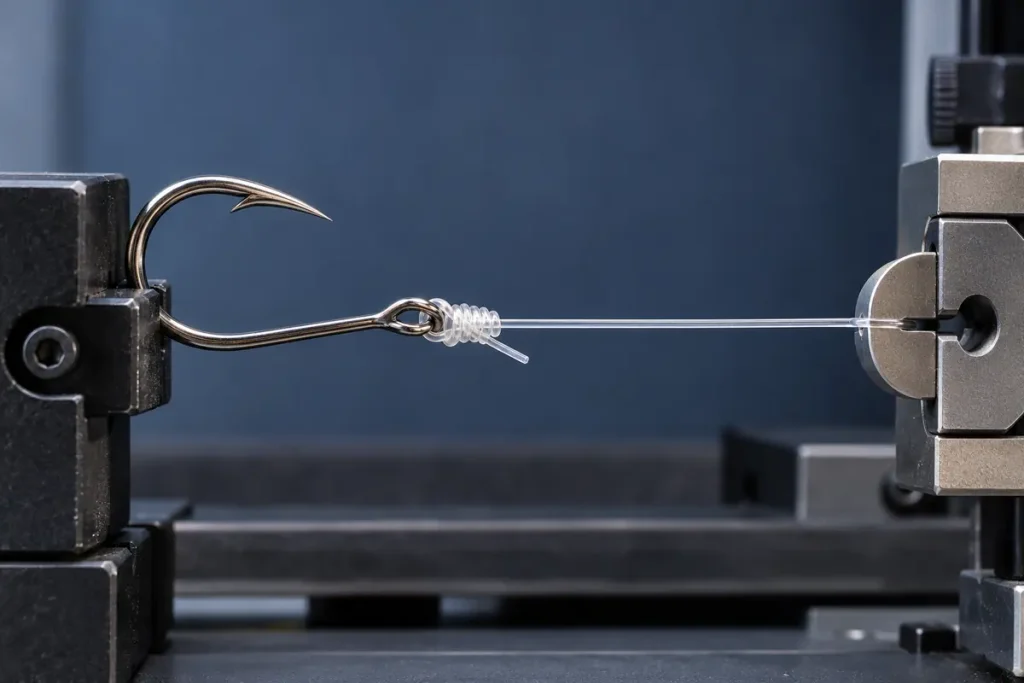
A hook size number is a relative specification label rather than a measurement, so it cannot tell you whether a hook suits a particular species. It does not express the gap, the wire diameter, the shank length or the strength of the hook, and the same number from two different makers can differ in all of them. Matching a hook to a fish requires the shape and the construction of the hook, not the digit on the label.
Hook numbering survives because it is convenient for ordering stock, not because it describes anything an angler can measure. Each maker interprets a given number slightly differently. The reference article on the fish hook at Wikipedia states plainly that no international standard exists and that sizing varies between manufacturers.
What the Number on the Packet Actually Describes
A hook size is nominally associated with the gap, the distance between the point and the shank, but only nominally. Two hooks with the same number can still differ in shank length, wire gauge, bend geometry and point design. Gap is the dimension worth comparing directly.
Where a Size Chart Stops Being Useful
A size chart is useful for one job: finding a plausible starting range so you do not begin with a hook that is wildly wrong for the bait. It stops being useful once you need to know whether a wide-gap worm hook or a short-shank circle hook belongs on your leader. A complete Fishing Hook Size Chart answers the range question, and this article answers the shape question.
Start With How the Fish Eats, Not What It Is Called
Choosing a hook begins with a small set of observable traits: how wide the fish can open its mouth, how it takes food into it, and how large a single item of prey is relative to the hook you intend to bury. Species names are a shortcut to those traits rather than a substitute for them. Read the traits and the species list falls into place.
A species name is only a label for a feeding problem. A fish that engulfs prey whole needs a hook that can be taken along with the bait and then rotate into position, while a fish that grazes small items needs a hook light enough that the bait still looks like food. The same species shifts between these behaviours with the season, the available food and its own growth stage, so read the groups below as common behaviours rather than permanent categories.
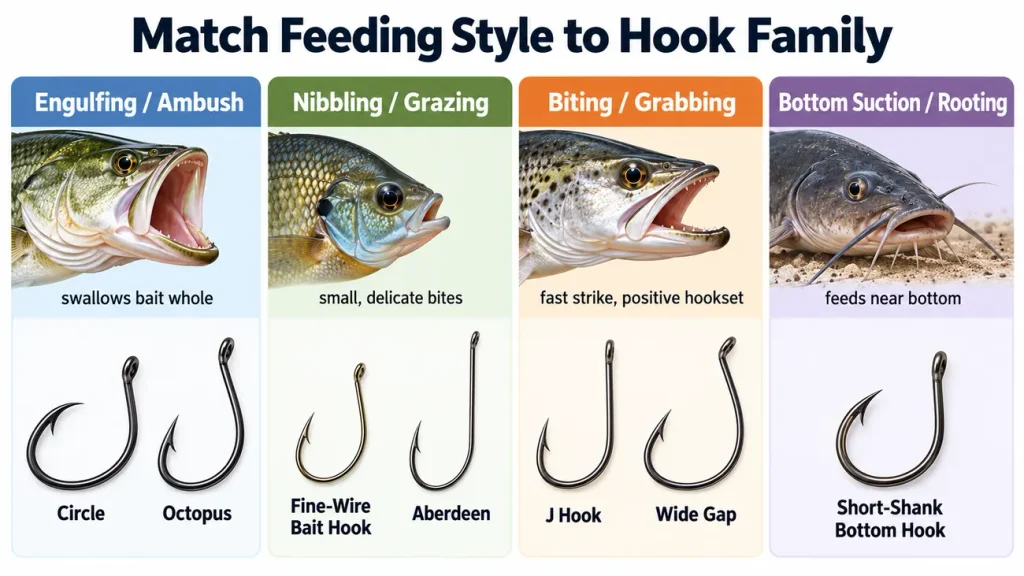
| Feeding and mouth trait | What it demands from a hook | Hook family that fits |
| Opens wide and engulfs bait whole | A hook that rotates to the jaw corner on a tightening line | Circle and octopus patterns |
| Bites and grabs, then runs | Fast penetration and a positive hookset | J-hook, wide-gap and worm patterns |
| Nibbles and mouths slowly | Fine wire that the bait can still carry naturally | Fine-wire Aberdeen and light bait patterns |
| Vacuums food from the bottom | A short shank that keeps the point clear of the substrate | Short-shank bottom-bait patterns |
| Crushes hard-shelled prey | Strength and a point that survives bone and shell | Heavy-wire and forged patterns |
Engulfing and Ambush Feeders
Species that ambush prey and swallow it whole, including most catfish, larger bass and reef predators, hand the angler a rare advantage because the fish does much of the hooking itself. A circle or octopus pattern suits them.
Grazing and Nibbling Feeders
Fish that take small items one at a time, such as panfish, many trout and the smaller stillwater species, punish a hook that is too heavy or too large. Fine wire and a narrow gap let the bait sink and move naturally.
Suction and Bottom Feeders
Fish that feed by suction or by rooting through the substrate, carp and many bottom-dwelling species among them, need a hook that sits just above the bottom with a short shank that is not levered away from the mouth.
Match the Hook Family to the Bait and Presentation
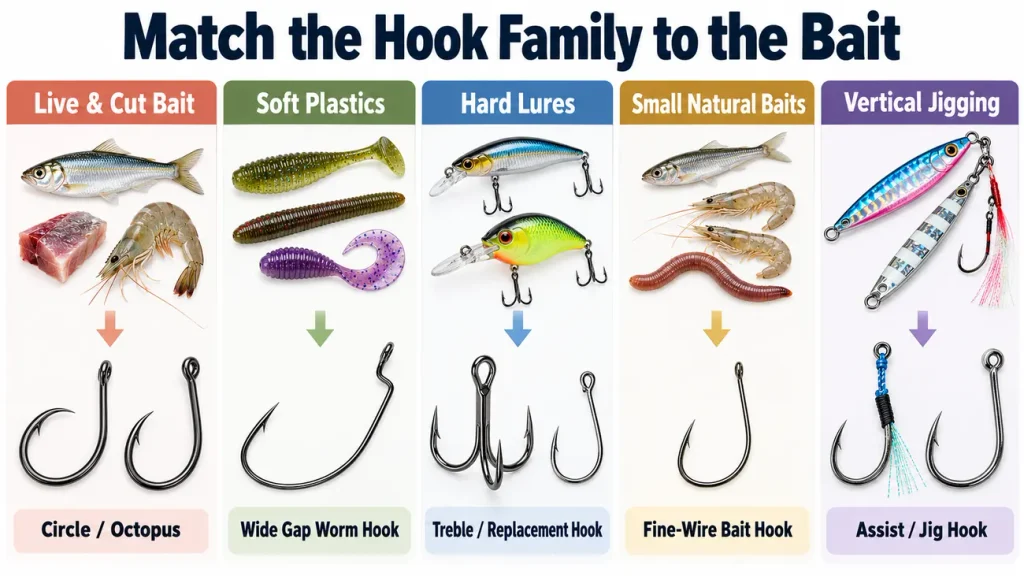
Bait decides more of the hook choice than species reputation does. A hook must provide enough gap to clear the bait on the strike and enough shank to keep the bait in place, and it must be light or heavy enough not to distort the way the bait behaves. Get the bait fit right and most species questions answer themselves.
The reasoning is mechanical. A bulky bait needs a wider gap so the point can travel through it on the hookset, while a slim bait works better with a compact hook that hides the hardware. Wire gauge settles the trade between strength and presentation: heavier wire resists straightening but stiffens a light bait, while fine wire presents naturally but opens under load.
Live and Cut Bait
Live and cut bait reward patterns with a short shank and a wide gap, because the bait is bulky and often soft. Circle and octopus patterns are the usual starting point, and a Bait Fishing Hooks range built around those shapes is where most anglers should begin.
Soft Plastics and Weedless Presentations
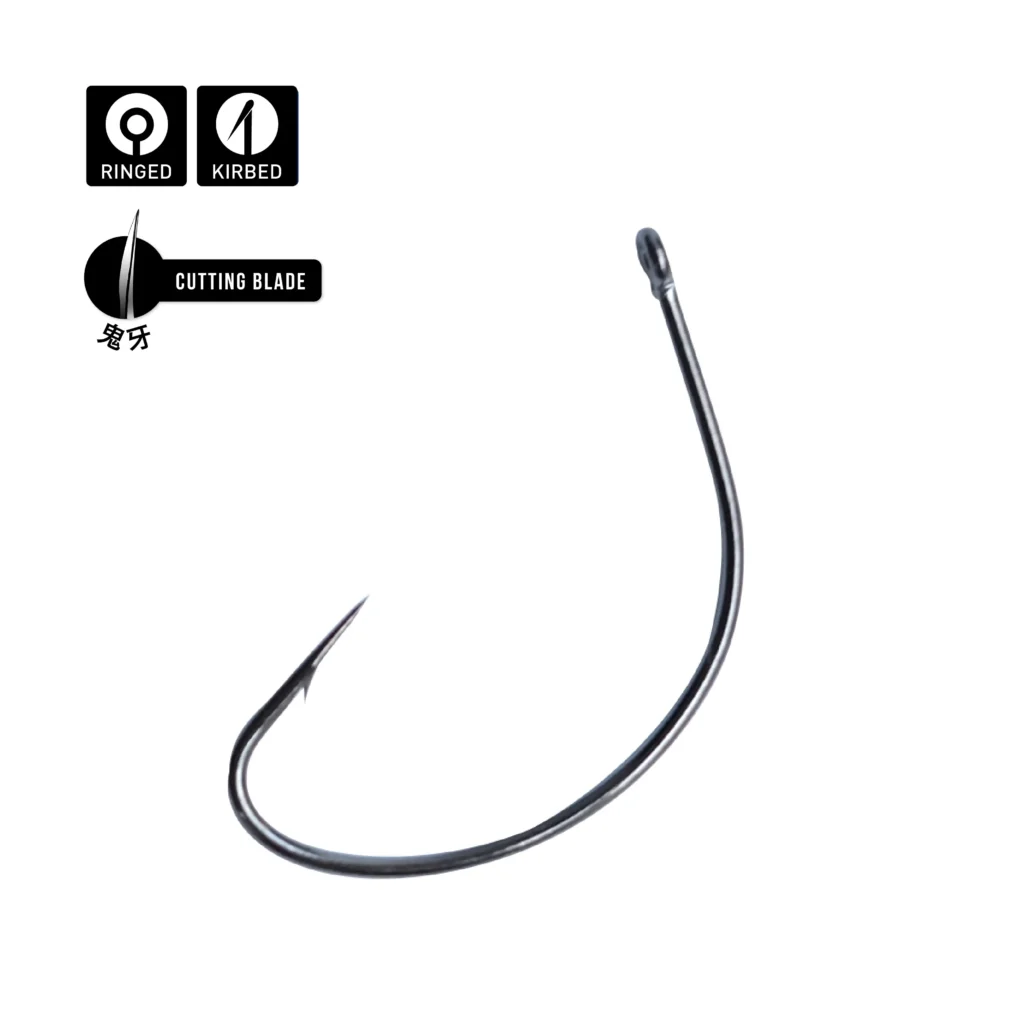
Soft plastic lures are where gap width matters most, because the hook has to travel through the lure before it reaches anything solid. A wide-gap worm pattern with an offset or in-line point is the standard answer, and a hidden point reduces snagging in cover.
Hard Lures and Hook Replacement
Hard-bodied lures usually arrive rigged with three points on a single shank, which raises the rate of contact on a reaction strike but also snags cover and damages fish meant to be released. Replacing a treble changes the balance of the lure.
Small Natural Baits and Fine Presentation
Worms, grubs, insects and small morsels demand fine wire and a narrow gap. The job of the hook here is to be almost invisible: a light pattern with a small barb holds a delicate bait without splitting it.
Vertical Jigging and Assist Hooks
Vertical work presents a different problem, because the hook is attached to the jigging hardware rather than to a bait on a leader. Jig Hooks and assist-style patterns are built so the point rides clear of the lure and faces into the fish as it strikes from below.
Read the Habitat Before You Read the Label
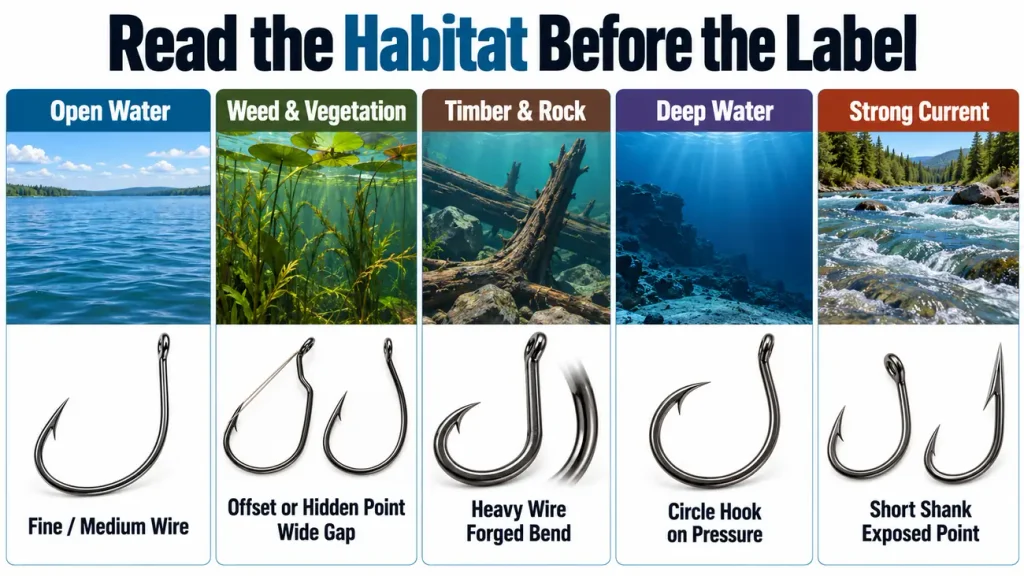
Habitat decides how strong a hook has to be rather than how large it has to be. Cover, snag risk, depth and current determine whether you need heavy wire, a forged bend, an offset point or a hook that bends free of structure. A hook matched to a species in open water can be the wrong hook entirely twenty metres away in timber.
Two anglers fishing the same species on the same day may need different hooks because they are fishing different water. In open water the priority is presentation and speed of penetration, while in cover the priority is surviving the fight.
| Habitat and cover | What commonly fails | Construction to choose |
| Open water and clear bottom | Over-heavy wire that stiffens the bait | Fine to medium wire, standard bend |
| Weed and vegetation | Exposed points that gather weed | Offset or hidden point, wide gap |
| Timber and rock | Straightened hooks and lost fish | Heavy wire with a forged bend |
| Deep water on a long line | Poor hookset purchase at distance | Circle patterns that hook on pressure |
| Strong current | Bait lifting off the bottom | Short shank with a well exposed point |
Freshwater Fish Groups and the Hook Families That Suit Them
Freshwater species separate by mouth structure and feeding style, and each group points to a different family of fishing hooks. Small stream fish and panfish reward fine wire and narrow gaps, bass and their relatives reward wide gaps and hidden points, and carp and catfish reward short shanks matched to stronger wire.
The groups below are described by hook family rather than by size band, because the band depends on the bait far more than on the fish. Our Freshwater Hooks range is organised along the same lines.
Trout, Char and Small Stream Species
Fine-wire single bait hooks are the starting point, and a narrow gap with a small barb lets small baits be presented without distortion. Step up to a heavier pattern only in fast water, for large fish, or when the line class demands it.
Panfish, Crappie and Bluegill
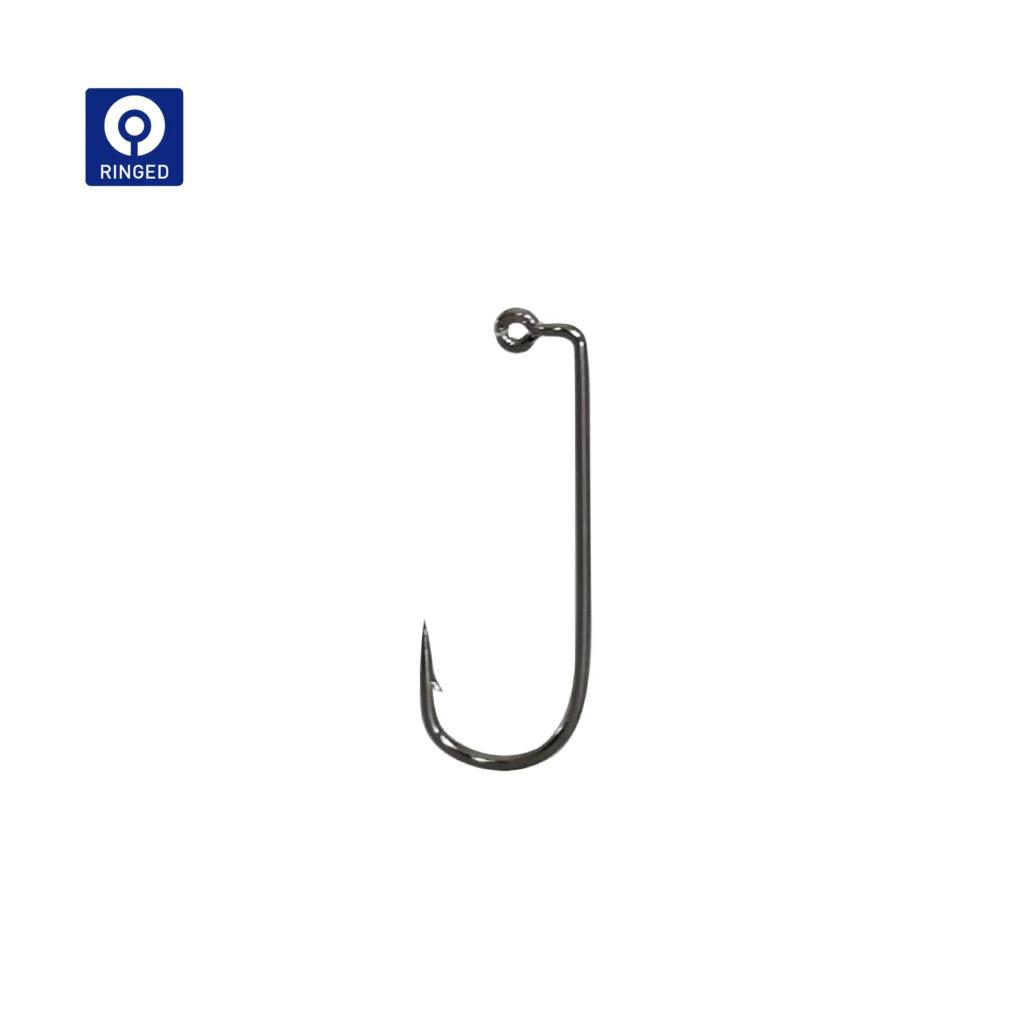
Light-wire patterns with a longer shank suit this group, and the Aberdeen shape is the classic answer because the long shank keeps the point clear of a small bait while the light wire releases from snags.
Bass, Perch and Walleye
Wide-gap worm patterns are the default, because these fish are usually targeted with soft plastics rigged along the shank. A wide gap with an offset point lets the lure be fished weedless without blunting penetration.
Carp and Other Stillwater Species
Short-shank bottom-bait patterns perform best, because the bait is presented on or near the bottom and the hook needs the point clear with a shank short enough that it is not levered out of a soft mouth.
Catfish and Other Bottom Feeders
Circle and wide-gap patterns are the usual choice, and circle hooks suit this group because these fish take the bait and move off with it, the exact situation in which a circle pattern rotates into the corner of the jaw.
Saltwater Fish Groups and the Hook Families That Suit Them
Saltwater species add two variables to the freshwater picture: harder mouths and stronger fish. Hard, bony mouths reward point geometry that bites into the tissue, while greater strength rewards heavier wire, forging and a corrosion-resistant finish matched to the time the hook will spend in salt water.
Species, habitat and bait remain the same three filters, but the margin for error narrows, because a hook that performs acceptably in fresh water will often open, blunt or corrode in salt water. Our Saltwater Hooks range is built around the heavier wire gauges the environment requires.
Inshore and Estuary Species
Circle patterns dominate here because these fish are frequently taken on natural bait, often in areas where catch and release is common, and the circle design reduces deep hooking. Match the hook to the bait rather than to the fish.
Reef and Structure Species
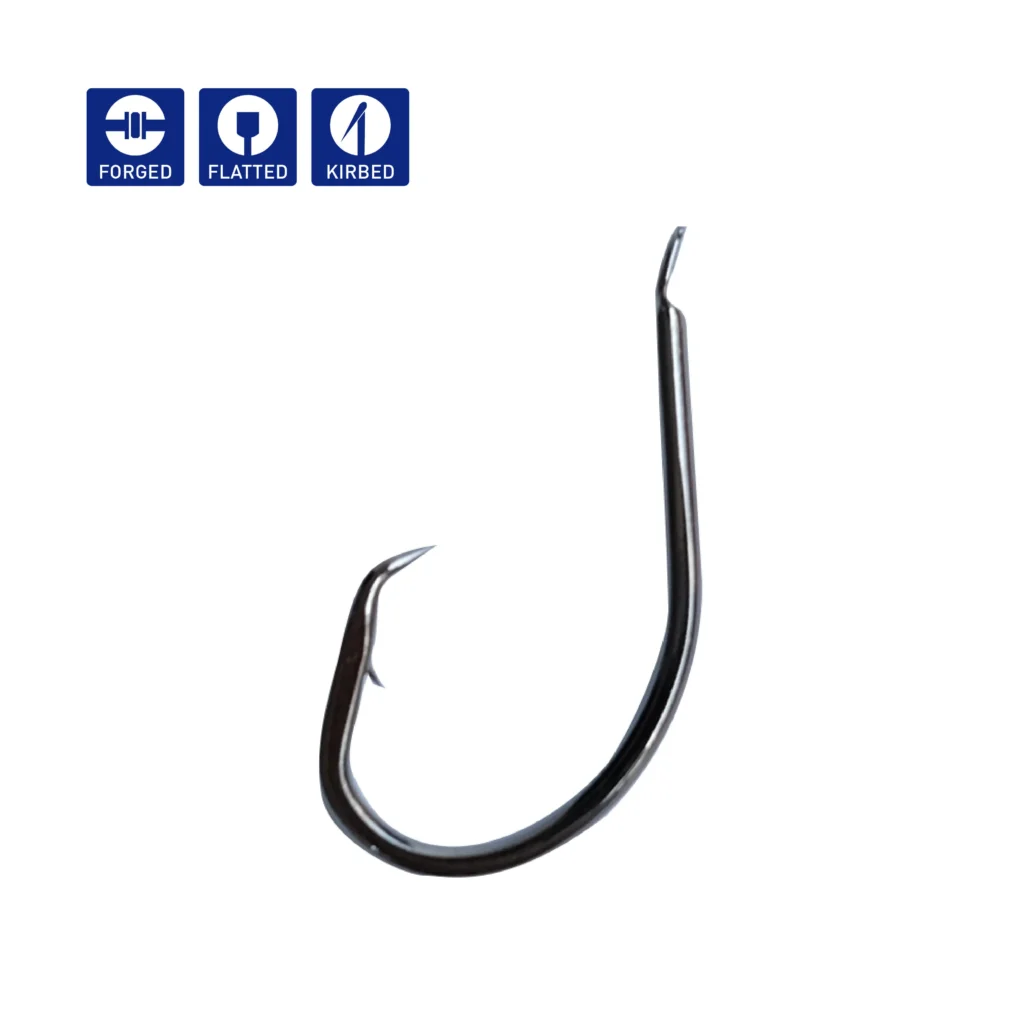
Over reef and rubble the priority shifts to strength, because a fish that reaches cover will break a light hook or straighten it. Heavy-wire circle and bait patterns with a forged bend are the starting point.
Large Pelagic and Hard-Mouthed Species
Large ocean-going fish combine hard mouths with serious power, which is where heavy-duty circle patterns and heavy-wire jigging patterns earn their place. Over a long fight the load is continuous, so wire diameter and bend geometry matter as much as the point.
When to Choose Circle Hooks and Barbless Hooks
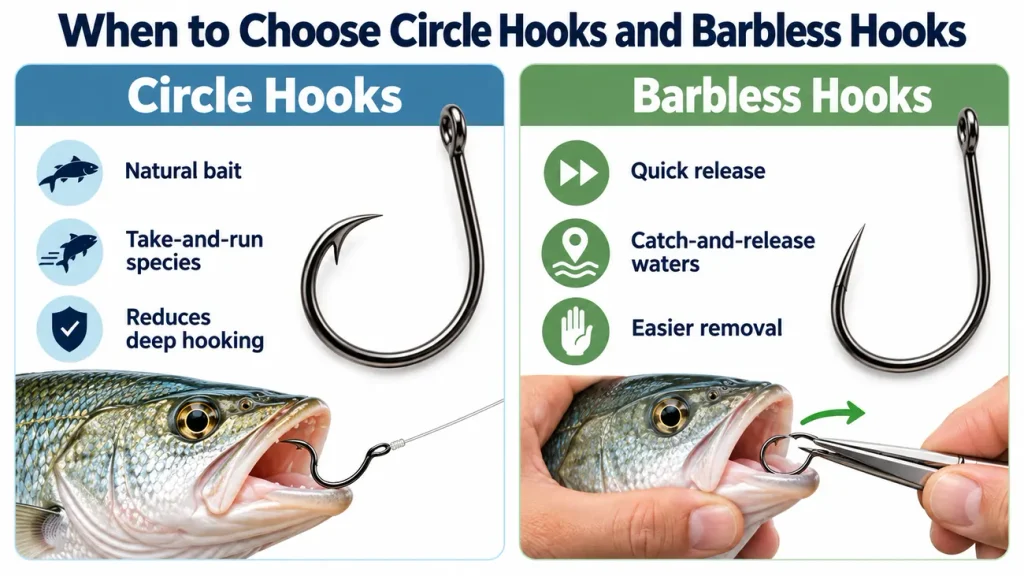
Circle hooks and barbless hooks are chosen for two different reasons, and both are worth understanding before treating them as simply weaker versions of an ordinary hook. Circle hooks suit fish that take bait and run, and they reduce deep hooking; barbless hooks make release faster and reduce some of the injury that handling causes.
Regulation is the usual reason anglers buy a first circle hook, but the design reason came first.
Where Circle Hooks Are Required by Fishing Regulations
Circle hook requirements almost never depend on the species alone. They depend on the combination of target species, area, bait type and the specific fishery rule, which is why the same fish may be fished with a circle hook in one jurisdiction and an ordinary hook in another. Non-offset, non-stainless steel circle hooks are required for snapper and grouper taken on natural bait in certain areas.
How Barbless Hooks Can Reduce Release Injuries
Barbless hooks do not make hooking less effective, because research by NOAA Fisheries found that barbless circle hooks work as well as barbed hooks. What they change is removal: a barbless hook comes out faster or sheds itself, which shortens handling time and reduces the damage removal causes. The agency lists them among the gear choices that improve survival in catch-and-release fishing.
Point Geometry, Penetration and Hookset by Mouth Type
Point design has to suit the tissue it will pass through. Soft, papery mouths reward a fine needle point and steady pressure, while firm or bony mouths reward a point that cuts and a firmer hookset. The hookset itself should follow the hook family and the mouth in front of you, not a habit carried over from another species.
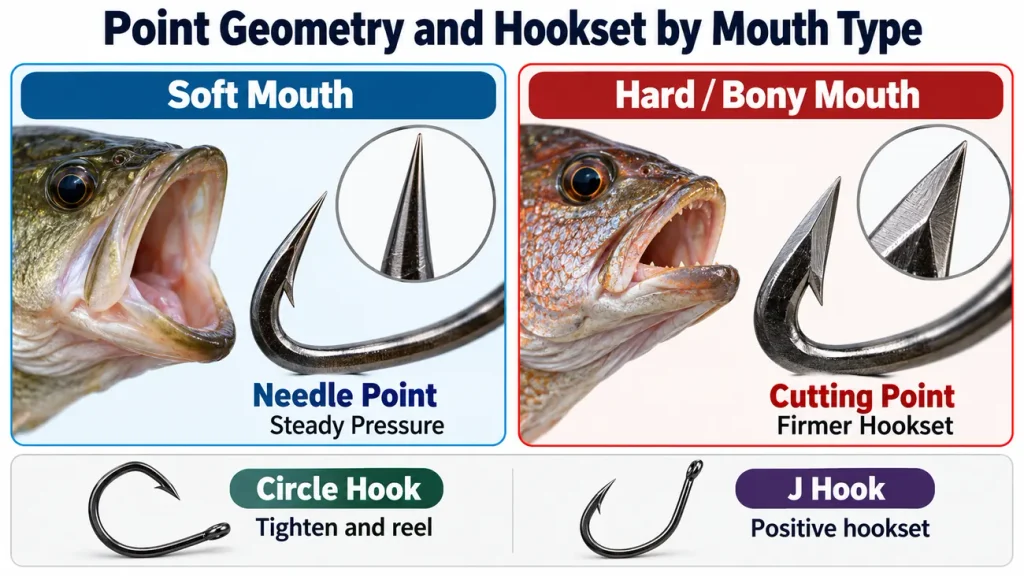
A needle point penetrates soft tissue with very little force, which is why it suits species with delicate mouths. A cutting or triangular point opens tougher tissue more reliably and holds that advantage on fish that crush hard-shelled prey. A circle pattern sets on a tightening line, while a J-hook or wide-gap pattern depends on the angler driving the point home. Manufacturers publish the point geometry of their fishing hooks as part of the specification, and Fishing Hook Point Technology explains how the designs are produced.
Common Mistakes When Matching Hooks to Species
Most mismatches come from four habits: choosing by species name alone, scaling the hook to the fish rather than to the bait, treating a size chart as a specification, and ignoring the habitat. Any one of them will cost fish, and in practice they usually appear together.
- Choosing a hook because a species list says so, without checking the bait and the habitat.
- Sizing the hook to the fish rather than to the bait, which leaves too little gap for what you present.
- Reading a size chart as a measurement, when dimensions vary between makers and patterns.
- Carrying a hookset habit from one species to another, especially between circle and J patterns.
- Ignoring wire gauge until a fish straightens the hook in cover.
- Refusing to change pattern after changing bait, the most common cause of a sudden drop in hook-ups.
Frequently Asked Questions
These four questions come up most often once the species and bait filters have been applied.
Can the Same Fishing Hook Be Used for Different Fish Species?
Yes, and most anglers do exactly that. A wide-gap worm pattern covers bass, perch, walleye and a long list of relatives because the bait and the presentation are similar, and a circle pattern covers a wide range of species taken on natural bait. What does not transfer is a hook built for a species whose mouth differs fundamentally, such as a fine-wire small-bait hook paired with a powerful fish in heavy cover.
Should You Choose Hook Type Based on Fish Size or Bait Size?
Choose by bait size first, then adjust for fish size. Bait size determines the gap and shank you need, because the hook has to clear the bait on the strike. Fish size then determines wire gauge and strength, because a larger fish exerts a longer, heavier load. When the two disagree, start from the bait and step up in strength rather than down in gap.
Are Circle Hooks Better Than J Hooks for All Fish?
No. Circle hooks suit fish that take bait and swim off with it, and they reduce deep hooking, which is why they are favoured for bait fishing and for release. J-hooks and their wide-gap relatives give a faster, more positive hookset and suit lure fishing, soft plastics and situations where the fish mouths the bait without committing.
What Hook Size Should I Start With for a Particular Species?
Start with a range rather than a number, and take that range from a size chart that also tells you which bait size it was built around. Then compare the gap of the pattern you intend to buy. The number on the packet is a starting point, not a specification.