A fish hook size number is the first value anyone reads on a packet, and the one most likely to mislead. Sellers print it, buyers order by it, and anglers compare it across tackle boxes, yet the same number can describe very different hardware. A supplier’s range of bait hooks is normally organised by pattern and size together, the first hint that the two cannot be read apart.
This fish hook size guide treats the number as a classification label, not a measurement. It tells you where a hook sits inside one maker’s range, so it can be compared within a series but not converted by arithmetic across numbering systems, patterns or suppliers. Where a maker publishes a correspondence table, it covers one named model. Only a measured dimension settles what a hook is.
The sections below cover how the two numbering families work, what a published size range covers, and which measurements to request before you order.
Why Fish Hook Size Depends on the Hook Pattern
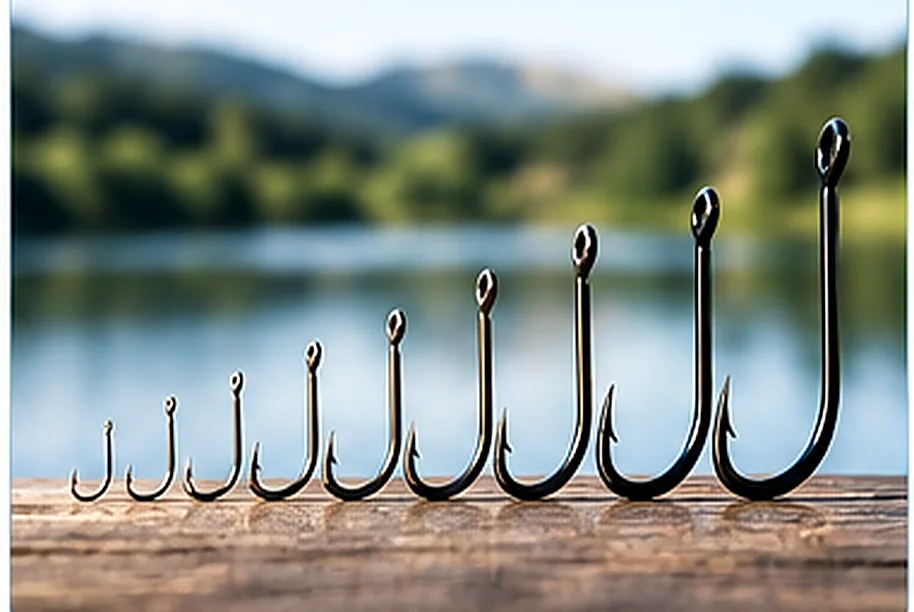
A fish hook size number only makes sense next to the pattern it belongs to. Two hooks stamped with the same number but built on different patterns are different pieces of hardware, and no arithmetic converts one into the other. Compare patterns first, and compare numbers only within a pattern.
The numbering convention predates any standard that governs it. There is no international standard for hook sizes, but within one maker’s range the numbers stay consistent, and that consistency makes reordering possible. The convention grew out of the English needle and tackle trade: the reference entry for Redditch records the town as a centre for that industry from the 1800s.
The Same Number Can Mean Different Things Across Patterns
Pattern is the set of decisions about wire, bend, gap and point a series is built around. A short-shank bait pattern and a wide-gap pattern can both print size 5, and they will differ in overall length, gap, wire diameter and point position. This is the most common route to a wrong order: comparing only the number treats two different hooks as interchangeable, and the mistake surfaces as a gap too narrow for the bait.
Why Loose Number Ranges Are Not Specifications
A range tells you which numbers a series is made in; it says nothing about the hook that will arrive. It carries no tolerance, wire class or point geometry. A range is useful for narrowing a search, which is what a general fishing hook size chart does and what a dimensional specification replaces.
| Specification | What It Identifies | Why Buyers Should Check It |
| Nominal size number | Position in one maker’s range | Confirms the same series |
| Pattern or series name | Wire, bend, gap and point design | Same number, different hook |
| Wire class | Bending resistance under load | Survival under load |
| Point type | How the point enters and holds | Affects hookset and edge life |
| Published size range | Numbers the series is made in | Prevents ordering a size not made |
How Japanese Hook Sizes Differ Across Product Series
Japanese pattern series number their hooks in one family, running from a small decimal such as 0.1 upward through whole numbers, with no change of direction and no aught step. The same printed number in two different series still describes two different hooks, so the series name carries as much weight as the number itself.
Western numbering splits into two families and reverses direction at size 1. A Japanese series has no pivot: the scale continues, and fractions cover the small end where a whole step would be too coarse. Nothing in the printed number reveals where the series is anchored: the anchor is the pattern.
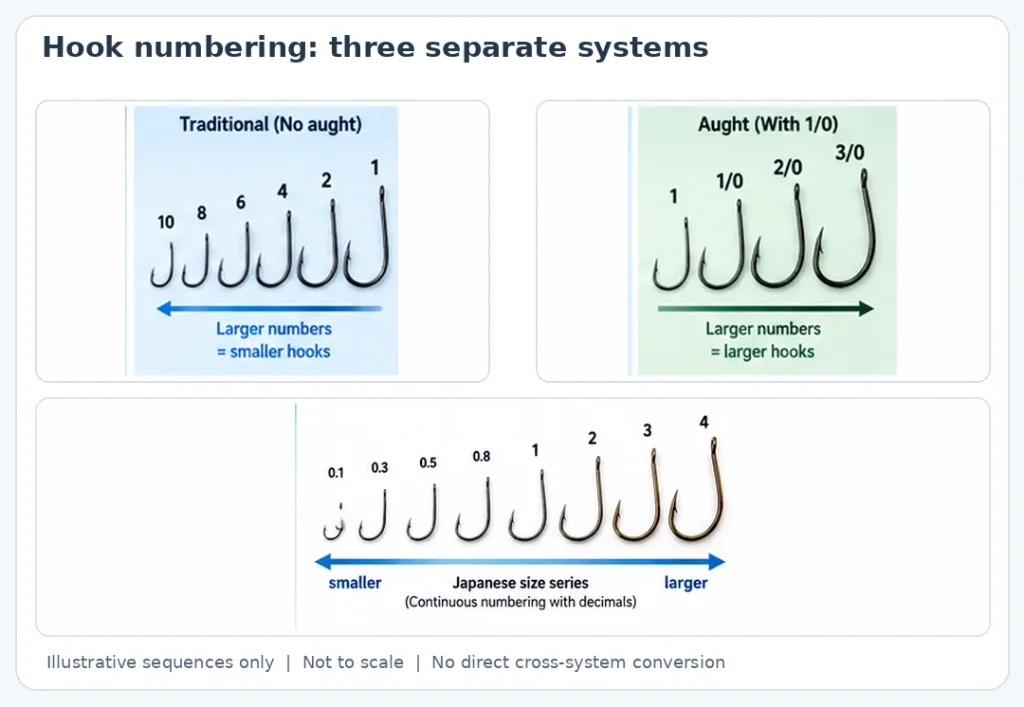
Whole Numbers and Decimal Sizes in Japanese Series
Decimal steps appear where gradation matters. Small-bait series in the Freshwater Hooks range and competition series commonly offer 0.1, 0.3, 0.5 and 0.8 alongside whole numbers, and a step from 0.5 to 1 is a real change in gap, not a rounding difference. Western numbering has no such fractional step, so no arithmetic expresses a Japanese 0.5 in Western terms.
When a Range Looks Wrong but Is Actually Correct
Published ranges are written by the maker, and the two ends are not always written small to large. A series may be listed largest-first, so the ends can look reversed beside another series. Read the range as a set of available numbers rather than a direction. The convention is shared across a family rather than standardised between series: iseama hooks and the fine-wire stream patterns both mix whole numbers and decimals, and neither number transfers to the other.
Fish Hook Size Reference by Pattern
The table below collects the published size range, wire class and published application for each pattern series supplied here. Use it to find which numbers a series is made in, then request the dimensional drawing for the sizes you intend to order.
How to Read a Manufacturer’s Size Range
Every row is transcribed from the corresponding product listing, and each pattern name links to it, so range, wire class and application can be checked at source. Ranges are reproduced as published, and each listing notes that custom sizes can be made. A range is a span, not a stocking promise: do not assume every number between the two ends is available. Ring eye and forged variants appear as separate rows.
Published Size Range Versus Actual Millimetre Dimensions
The gap between a nominal range and a real dimension is where most ordering errors begin. A range of 1 to 15 covers fifteen nominal positions; it does not give the gap of size 5 in millimetres. Two series can share an overlapping range and still produce different sizes at the same number. That is why an application column beats a size column when matching a hook to a task.
| Pattern Listing | Product or Variant | Published Size Range | Wire Class | Published Application |
| Chinu Hooks | Standard | #12 – #0.1 | Standard/heavy | Saltwater bait |
| Chinu Ring Hooks | Ring eye | #16 – #0.5 | Standard/heavy | Saltwater bait |
| Chinu Forged Hooks | Forged shank | #0.8 – #8 | Heavy | Saltwater bait |
| Iseama Hooks | Standard | #17 – #1 | Heavy | Saltwater big fish |
| Iseama Ring Hooks | Ring eye | #18 – #5 | Heavy | Saltwater big fish |
| Maruseigo Hooks | Standard | #24 – #3 | Standard/heavy | Natural bait |
| Maruseigo X Hooks | Cutting blade point | #24 – #18 | Heavy | Natural bait |
| Sode Hooks | Standard | #0.8 – #17 | Fine/standard | Freshwater float |
| Keiryu Hooks | Standard | #1 – #15 | Fine | Stream and river |
| Sara Hooks | Standard | #1 – #8 | Fine | Stream and river |
| Ayu Hooks | Standard | #4 – #7 | Fine | Freshwater river |
| Umitanago Hooks | Standard | #1 – #15 | Fine | Freshwater bait |
| Izumejina Hooks | Standard | #1 – #16 | Standard | Crucian and bait |
| Shin Kanto Sure Hooks | Barbless competition | #0.1 – #10 | Heavy | Competition |
| Big Koi Hooks | Big fish | #18 – #22 | Extra heavy | Big fish |
| Koi Sure Hooks | Wide gap barbless | #12 – #23 | Heavy | Big fish |
| Circle Hooks | Standard | #10 – #20 | Heavy | Live bait |
| Wide Gap Hooks | Standard | #12 – #3/0 | Heavy | Saltwater big fish |
Wire class tracks the environment, not the number. The heavier patterns sit within the saltwater hooks range, while the fine-wire stream series share several numbers with them at a far lighter construction.
Which Hook Measurements Matter Before Ordering?
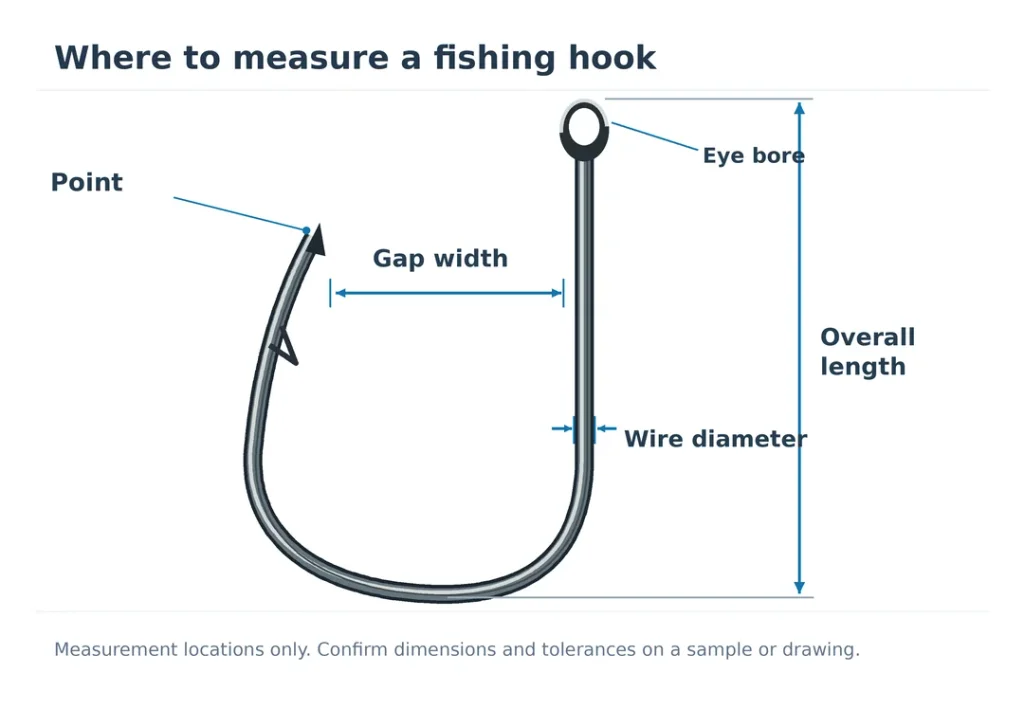
Four dimensions decide whether a hook does its job: gap width, overall length, wire diameter and point geometry. Ask for all four in millimetres, with shank length and eye bore, then check them on a sample, not the label. A supplier who will not publish them is asking you to buy from a size number alone.
Units matter here. The inch that range columns get converted into is defined rather than measured: the length reference published by NIST records the yard from which the inch derives as exactly equivalent to 0.9144 metre, putting the inch at exactly 25.4 millimetres, which is why millimetres keep drawings comparable between factories.
Measuring Gap and Overall Length on a Sample
Gap width is the distance from point to shank, and it sets the clearance a hook has around its bait. Measure the finished hook with a caliper, point to nearest shank surface, and record it for every size: gap is not derived from the nominal number and moves between patterns even when the number does not. Against an approved sample, that record is the fastest acceptance test available.
Checking Wire Diameter, Eye Bore and Point Geometry
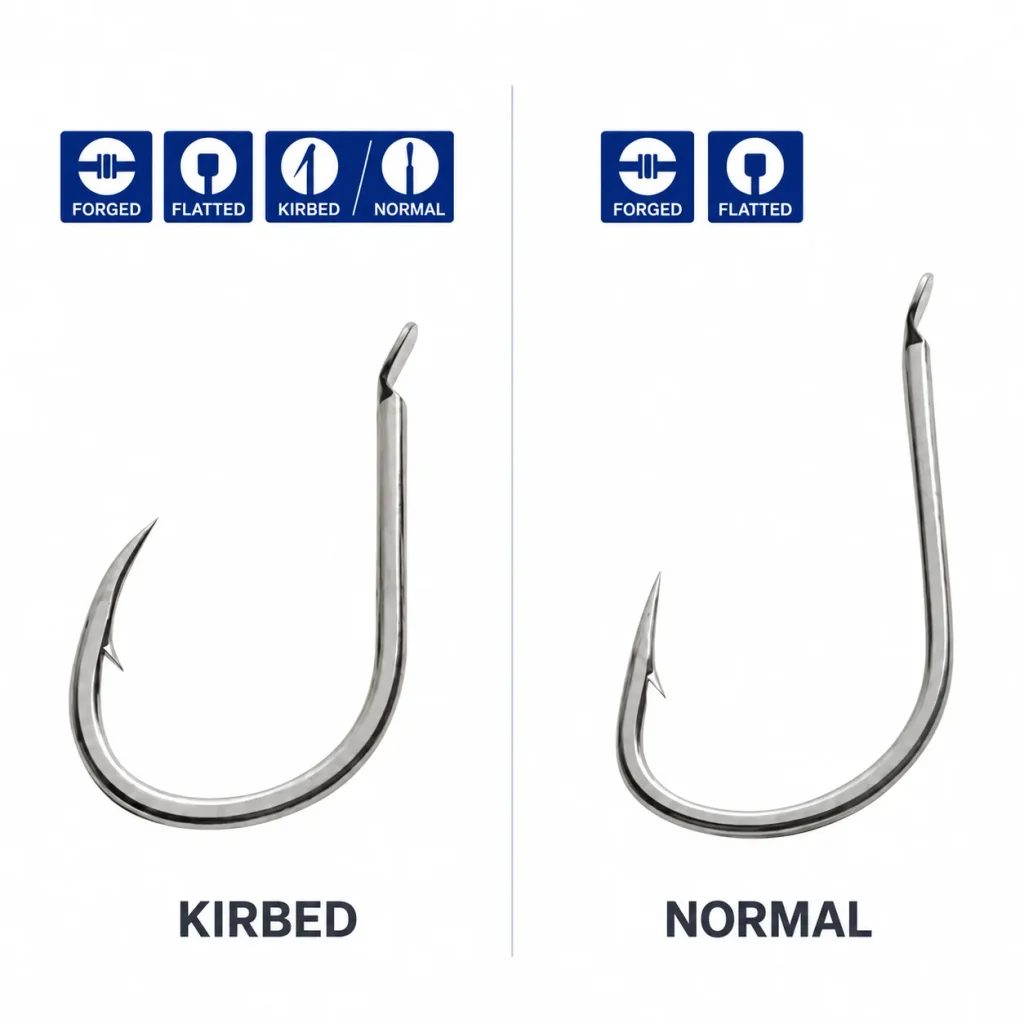
Wire diameter is measured across the wire rather than at a bend, where it has been drawn thinner, and that reading tells you whether the nominal wire class was shipped. Eye bore has to clear the line or ring it carries. Point geometry is confirmed from the drawing, because a needle point and a cutting point can share a size and a gap while behaving differently.
| Dimension | How to Measure | What to Agree | Risk If Unchecked |
| Gap width | Point to shank, by caliper | Value plus tolerance | Bait clearance tight |
| Overall length | Eye to outside of bend | A range per size | Will not fit a lure |
| Shank length | Eye to start of bend | A range per size | Bait sits wrong |
| Wire diameter | Across the wire, off a bend | Wire class and tolerance | Light wire opens under load |
| Eye bore | Eye inner diameter | Minimum bore | Ring will not pass |
| Point geometry | From the drawing and sample | Needle or cutting | Same size behaves differently |
Common Fish Hook Size Ordering Mistakes
Most hook size errors are ordering errors rather than fishing errors. They come from carrying a number across a boundary it does not cross: between numbering families, between suppliers, or from a competitor’s chart onto a purchasing list. The cost is a batch that does not fit the job it was bought for.
Mixing the Two Numbering Families
The traditional family and the aught family run in opposite directions, and the boundary sits between size 1 and 1/0. Reading a number without knowing its family produces confident errors in both directions: a size 1 hook is far larger than a size 10, while a 1/0 hook is larger again than the size 1. A series printed from 12 to 3/0 shows both families on one label.
Using a Competitor’s Size Chart as an Exact Conversion
A chart from another maker describes that maker’s range, not yours. A maker can publish a correspondence table for one named model, listing a Western size beside an Asian size, and that table is dependable for that model: it does not extend to another pattern, another maker or an unlisted size step. The honest rule is narrower than a blanket refusal and narrower than arithmetic. Where a chart calls a Japanese series approximately equal to a Western size, treat approximately as load-bearing and confirm the gap.
Buying the Same Number From a Different Supplier
Consistency inside one supplier’s range is what makes a number reorderable, and that does not survive a move to another supplier. A size 6 from one source and a size 6 from another may differ in wire, bend and gap, and the difference shows only when the order arrives. A sample set costs far less than replacing a batch.
How to Compare Fish Hook Sizes From a Supplier
Compare suppliers the way you would compare any other component: ask for a drawing, measure a sample, and check that the numbers hold across batches. A size that cannot be repeated is not a specification, and repeating the first order is the only real test.
What to Request From the Manufacturer
A request that gets a usable answer names dimensions, not size numbers. Ask for these in millimetres:
- A dimensional drawing per size, showing gap, length, shank and wire diameter.
- The tolerance on each dimension.
- The full pattern name and the wire class.
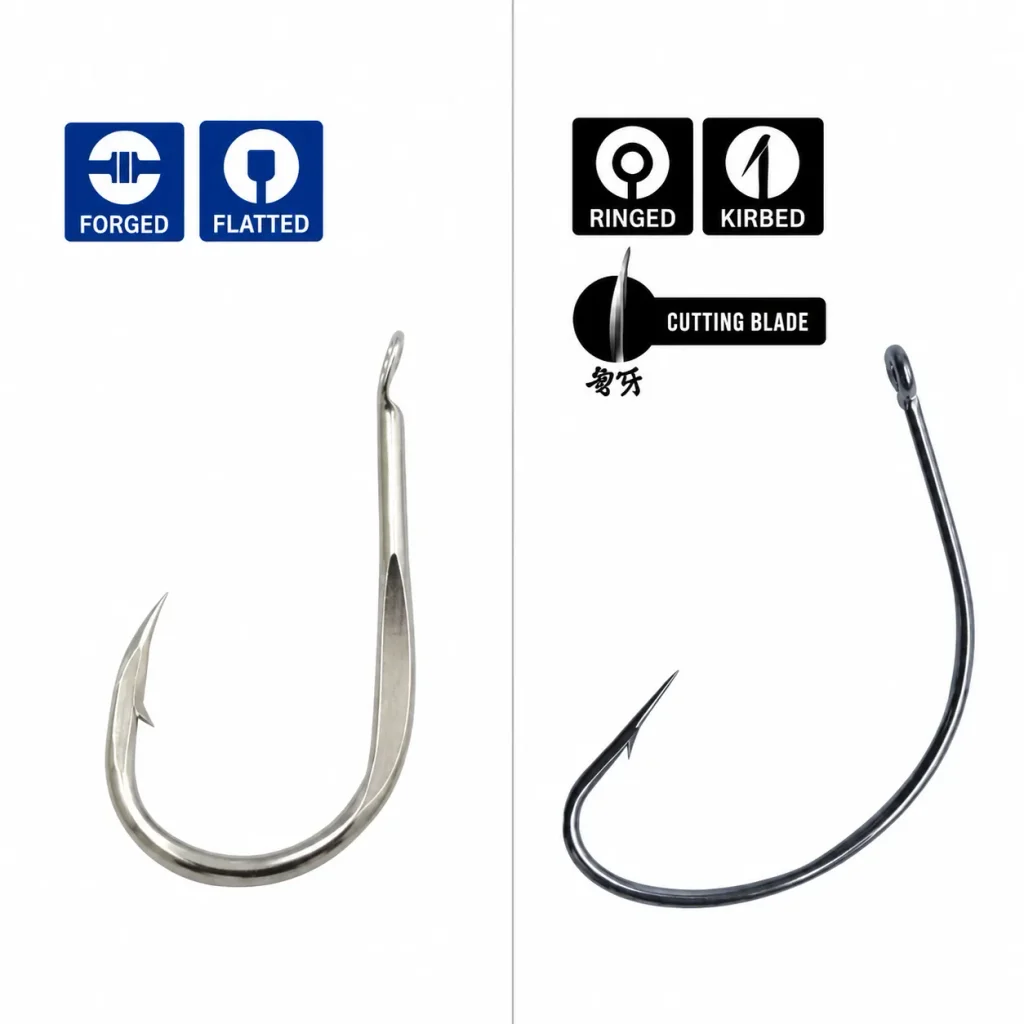
- The point geometry, and whether it is forged or cut.
- Eye bore and eye position.
- The size range the line is made in, and whether decimal sizes exist.
How to Verify Consistency Across Batches
Measure the second batch against the first rather than against the drawing alone. Sampling a handful of hooks per size and recording the gap catches drifts a specification sheet will not show, because the drawing describes intent while samples describe what shipped. That record is the fastest way to change a specification, because a fishing hook manufacturing contact can act on measured numbers where a general sales inbox cannot.
More Fish Hook Size Questions
How do I match a supplier’s hook to the model I already use?
The identifier that settles the question is the sample in your hand rather than the number on the packet. Send the supplier a physical hook, state the nominal size and the pattern you believe it belongs to, and ask them to name the model they would supply with its published range, wire class and gap in millimetres. A bare size number will be matched by almost any supplier, and not always to the same hook.
One step difference, how much does it matter?
It depends where you are on the scale: the steps are uneven. Near the small end of a Japanese series, one decimal step changes the gap by a small but real amount. Near the large end of an aught range, one step can add several millimetres of gap. Compare the measured gap between steps rather than assuming the intervals are equal.
What should a repeat order contain to stay consistent?
A repeat order should carry more than a size number. Write the pattern name, the nominal size, the wire class, the point type and the eye configuration into it, and attach the measured gap from the approved sample as the reference every batch is checked against. With those values on the order, the second batch is a verification exercise rather than a new guess.
Final Fish Hook Size Checklist
Fish hook size is a classification label, and treating it as more produces ordering errors. The working rules are short. Read the pattern before the number. Keep the two numbering families separate. Do not convert between makers, and treat a correspondence table as valid for one model. Treat a range as a list of available numbers rather than a dimension or a stock promise. Ask for gap, length and wire diameter in millimetres, and check them on a sample. Compare a second batch against the first rather than against the drawing alone. With those habits in place, the number on the packet does the job it was designed for: placing a hook inside a range you already understand.