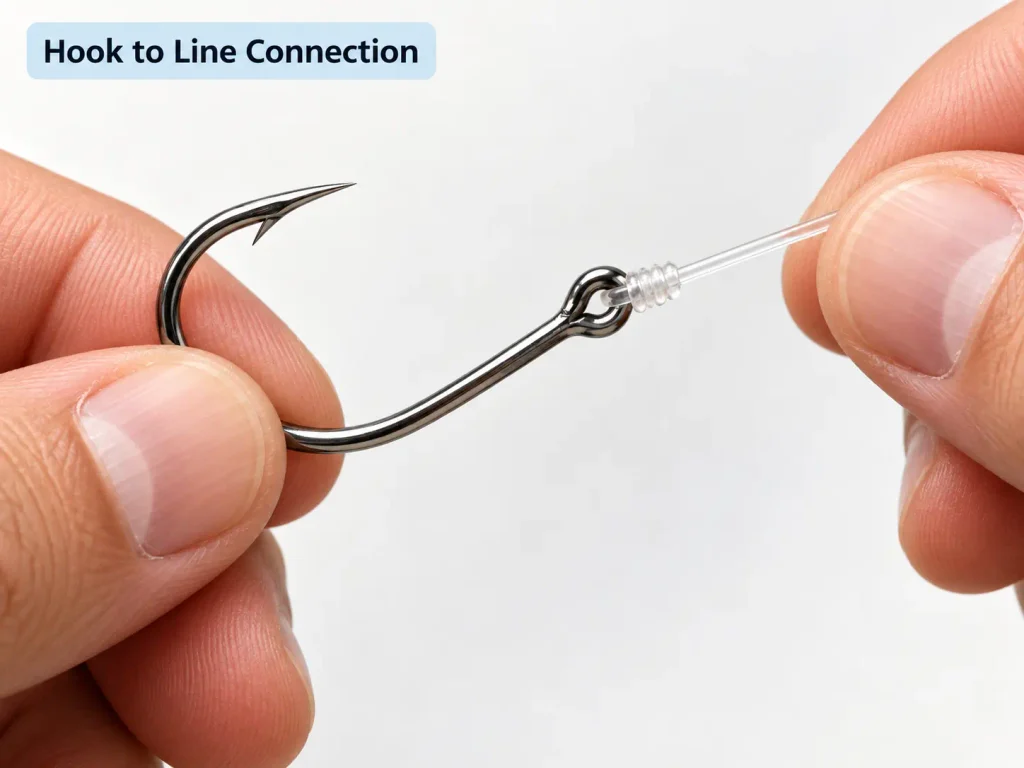
Every spool of line leaves the factory rated on a bare strand, pulled until it parts with no knot in it. The moment that strand is finished with a knot, the rating stops being the number that matters: the connection becomes the weakest point in the system, and most break-offs at the hook happen inside a few centimetres of wrapped line. The loss bites hardest on heavy patterns such as Saltwater Hooks, where hook, leader and knot all work close to their limit at once.
No single knot is the strongest for every fishing hook connection, because every published result is conditioned on the line it was tied in. Monofilament rewards the Palomar and the uni, heavy fluorocarbon moves the top of the table to the San Diego Jam or a snell, and on braid the winners differ between tests. The honest answer is a short list tied to line and hook, and lighter tackle used with Freshwater Hooks reorders it again.
What follows compares the main knots by measured and published strength, then shows what changes when the line or the hook changes.
What Knot Strength Actually Measures
Knot strength is a ratio, not a rating. The figure that matters is the load at which the knotted connection failed, divided by the breaking load of the same line without a knot, and which denominator you use moves the percentage more than the knot does. Published figures only agree when the line, the conditions and the arithmetic behind them are the same.
Retention Is a Ratio, and the Denominator Matters
The strict calculation divides the knotted breaking load by the measured unknotted breaking load of the same line. The looser version, common at the tackle counter, divides by the line’s rated strength instead, and the two denominators are rarely the same number.
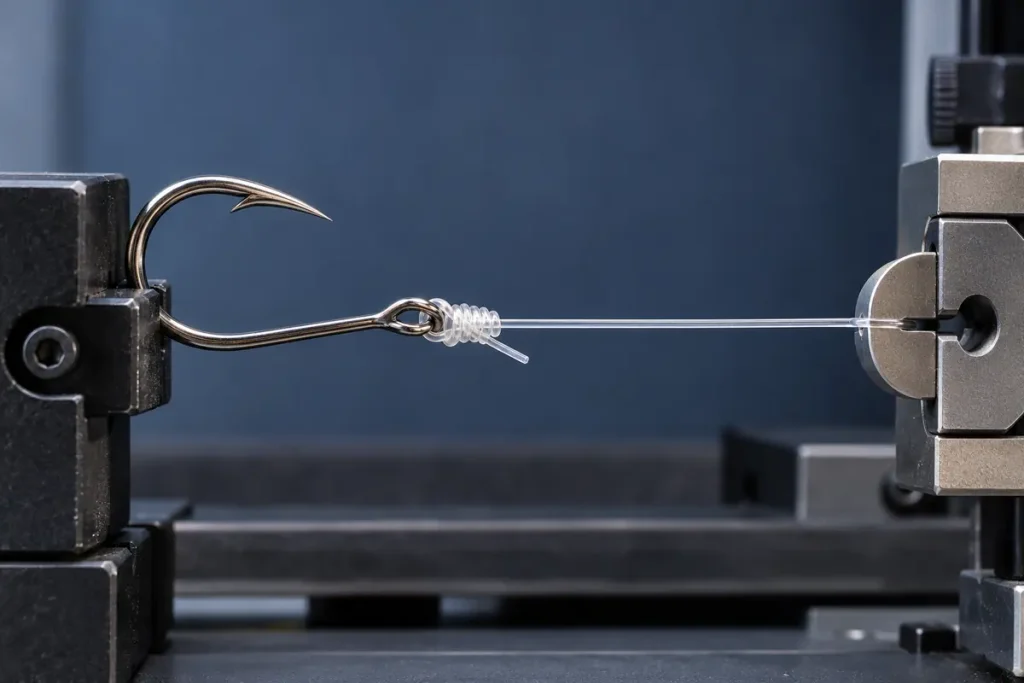
One published reader challenge makes the gap visible. Before testing any knots, its organisers measured the bare lines on the calibration-grade tension tester used for world-record line verification: a nominal twenty pound monofilament broke at 27.04 pounds, and a braided line of the same rating broke at 41.45 pounds. A connection failing at twenty pounds is a 100 percent knot against the rating, a 74 percent knot against the mono’s measured strength, and a 48 percent knot against the braid’s. One failure, three honest answers.
The simple example often quoted, a ten pound line finished with a connection that retains ninety percent leaving about nine pounds usable, is arithmetic against the rated figure, and it holds only as a hypothetical: rated and measured strength part company as soon as the line is real.
Why Published Figures Differ Between Sources
Two honest tests can quote the same knot ten points apart. The line is never the same, because diameter and construction move the result. The conditions move it too: that challenge tested its monofilament dry, and dry mono breaks higher than soaked mono, so every percentage sits above what the same knots would score wet. Sample size matters as well; the challenge averaged three breaks per knot, where a single-pull test can report an outlier as a finding.
How Connections Actually Fail
A connection fails one of two ways: the line parts, or the knot slips until nothing holds it. Both happen, and which dominates depends on the knot, the material and how carefully it was formed, so no single failure mode holds for fishing line generally.
One controlled study shows how far slippage can go when it dominates: it tied six hundred and forty knotted loops in 0.55 mm nylon monofilament, pulled every one to failure, and more than seventy percent failed by slipping or coming completely undone rather than by breaking a controlled knot-security study. The study was designed for surgical training, so its percentages describe that material at that diameter, not fishing knots generally. The mechanism it measured, coils giving way before the line does, is the one every angler meets at the hook.
The Strongest Fishing Hook Knots Compared
On the published comparisons, the Palomar, the uni, the San Diego Jam and the snell occupy the top of the hook-end table under different conditions, while the clinch family sits lower and loses most on braid. No position in that list is unconditional: change the material, the diameter or the hook, and the order moves.
How the Comparison Was Assembled
Four things decide where a knot belongs: how much load it passes into the line rather than its own coils, whether it grips that material when the load arrives suddenly, whether it can be formed on the hook in front of you, and what a mistake costs. The table keeps to those conditions, because percentages from different tests cannot be averaged into one honest ranking.
| Knot | Where It Wins | Where It Loses |
| Palomar | mono and braid, where the eye passes a doubled line | small eyes, stiff heavy leaders, bulky lures |
| Uni | mono, at the top of published tests | needs extra wraps to hold slick braid |
| San Diego Jam | heavy and stiff fluorocarbon | wrap count must be right or it jams short |
| Snell | eyeless hooks and shank-driven patterns | needs the shank, not the eye |
| Improved Clinch | light monofilament | slips on braided line |
| Clinch | light-tackle mono | too few effective wraps on heavier line |
| Non-slip loop | hooks that must swing free | bulk at the eye on tiny hooks |
| Davy | small hooks and fine leaders | light loads only |
Why the Palomar Knot Retains So Much
The Palomar is the odd one in any table it enters, because it is not a wrap-and-jam knot at all. The line is doubled, passed through the eye, tied into a loose overhand knot, and the hook is passed back through the loop so both strands bear on the eye. Two strands share the load, the path through the eye stays close to straight, and there are no coils that must hold by friction alone, so a well-tied Palomar breaks the line before it creeps.
It stops winning in three situations: an eye too small to pass a doubled line, a leader too stiff to double cleanly, and a lure or hook too bulky to pass through the finished loop.
The Tests Disagree, and That Is the Finding
The challenge quoted above tested twenty nine mono knots and thirty braid knots, three breaks each. Its mono entries ran from one hundred percent of measured line strength down to about seventy two, most in the eighties; its braid entries ran from thirty one to eighty seven. The best braid entry was not a standard Palomar but a doubled-loop variant at 79.08 percent, and a plain five-turn uni took second among the mono entries at 99.26 percent one published reader challenge.
The same publisher’s earlier challenge was topped by different, doubled-line constructions, and the gap between rounds is itself the finding: a ranking belongs to the line, the diameter and the hands that tied it, not to the knot alone. That is why any list of the ten best fishing knots only means something with its conditions attached, and why the next section is organised by line rather than by rank.
Best Fishing Hook Knot for Mono, Fluoro, and Braid
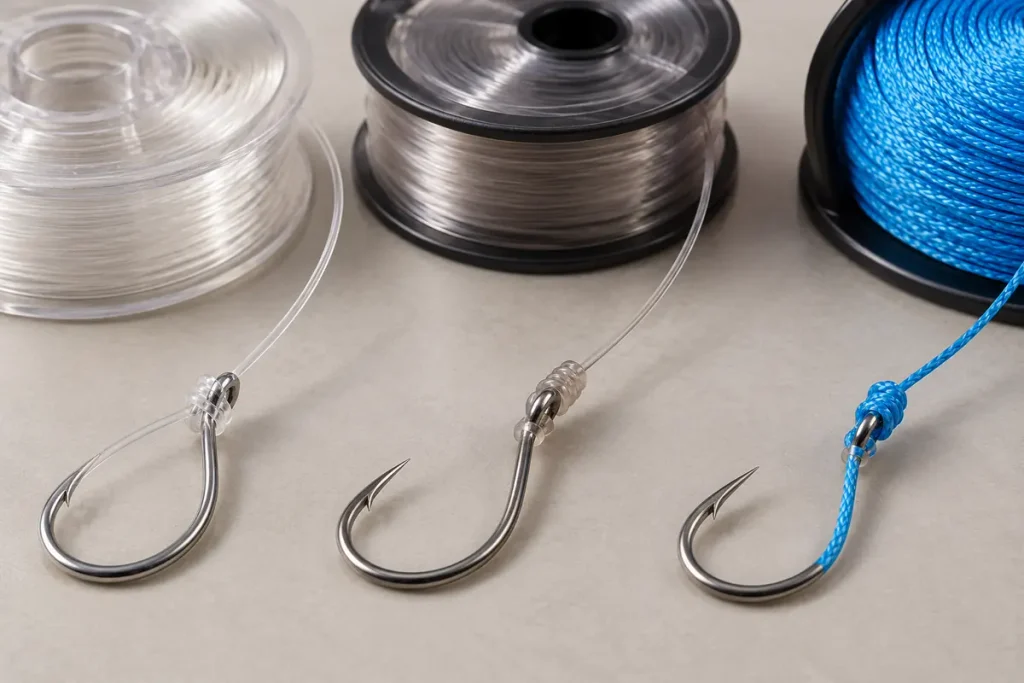
For monofilament, the Palomar and the uni are the default answers, with the improved clinch acceptable on light line. For fluorocarbon, the San Diego Jam and the snell move to the front, because the material punishes doubled loops and dry tightening. For braided line, the published winners split between doubled-loop Palomar variants and multi-wrap uni constructions, so the choice follows the test closest to your diameter.
| Line | First Choice | Strong Alternative | Why the Choice Shifts |
| Monofilament | Palomar | Uni, improved clinch on light line | stretch lets coils seat, so friction knots hold |
| Fluorocarbon | San Diego Jam | Snell | stiff and heat-sensitive, so doubling and dry draws cost strength |
| Braided main line | Doubled-loop Palomar or multi-wrap uni | Uni with added wraps | slick fibre gives friction knots little to bite |
| Heavy fluorocarbon leader | San Diego Jam | Snell | diameter and stiffness rule out doubling |
| Wire leader | Mechanical termination | shank wrap | wire is closed with sleeves or twists, not friction |
Reading the Matrix
The matrix tracks one variable: what the material does to the knot. Monofilament stretches and seats its own coils, which is why nearly every knot family works on it. Fluorocarbon is the stiffer material and the most heat-sensitive, so the knots that suit it avoid doubling the line and can be drawn down slowly and wet. Braided line is stronger for its diameter but slicker, so friction knots need more wraps and a longer tag end, or a doubled Palomar loop to share the load.
The Exceptions That Matter
The matrix has edges. Braid results split between tests, so the diameter you actually fish decides which published winner to follow. Very heavy fluorocarbon stops being about knot choice and becomes about whether the leader can be doubled neatly at all. And the hook can overrule the material, which is the next section.
When Hook Design Changes the Best Knot
The hook can reorder the table before the line does. Eye size decides whether a doubled line can pass at all, shank geometry decides what the hook tolerates, and an eyeless shank replaces the eye connection entirely, so the strongest knot for one hook can be the wrong one for its neighbour.
Small Eyes Rule Out Doubled-Line Knots
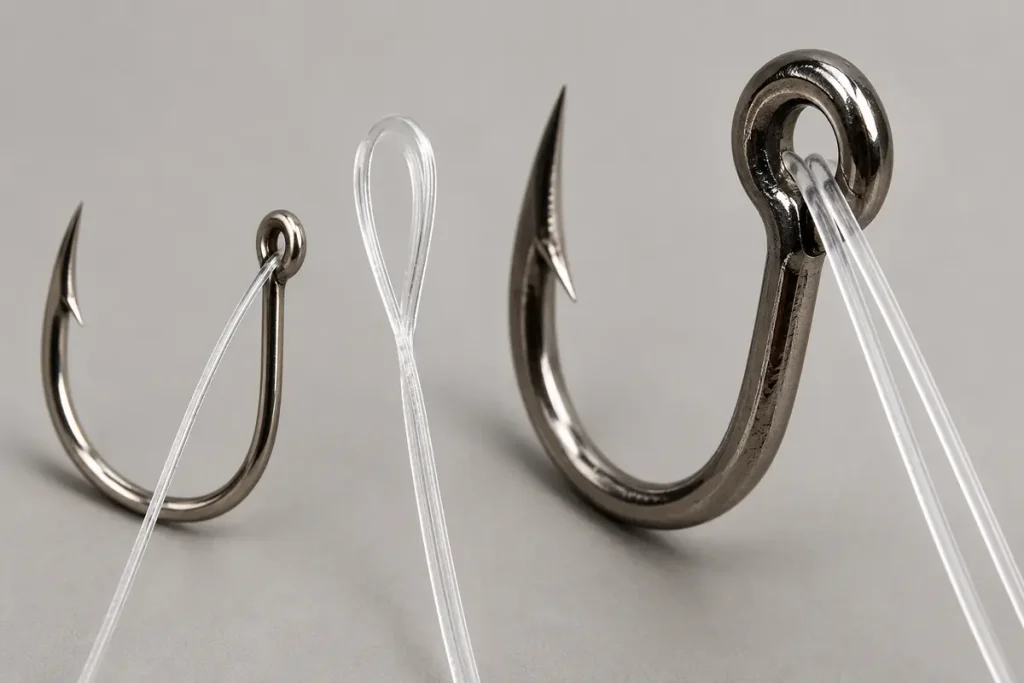
Eye diameter is measured against the line, not in isolation. A doubled Palomar loop needs an eye that passes two strands plus the hook wire, and on fine-wire hooks it will not go. The single-strand knots, the uni, the jam family and the clinch family, become the practical answers there, and their penalties on light mono are small.
Stiff Leaders Rule Out the Loop Altogether
A stiff, heavy leader resists being doubled and drawn, and a knot forced onto it forms uneven coils that never seat. The San Diego Jam exists for this case: it is tied single-strand and jams against itself rather than relying on the leader bending. Past the diameter where even that becomes clumsy, very heavy leaders are closed with sleeves or twists, and those are matched systems of sleeve, tool and line, not a shortcut around knot strength.
Eyeless Hooks Change Where the Load Lands
Eyeless hooks carry no connection at the eye at all. The snell laces the line around the shank itself, so the load travels straight down the hook instead of pivoting at the eye, and it holds a fixed hook angle that eyed connections cannot. Shank-driven patterns such as Octopus Hooks are its natural home.
What Makes a Strong Knot Underperform?
Most underperformance is construction, not choice. A well-chosen knot tied with too few wraps, dried out mid-draw or seated in stages will score well below its published range, and nothing about the finished connection looks wrong until it moves under load. Every percentage assumes the knot was built to spec.
Wrap Count Is a Control Variable, Not a Rule of Thumb
Wrap count is a controlled quantity in every strength test, which is why it belongs in a comparison rather than a tutorial. Thinner line needs more wraps because each wrap adds less contact area, thicker line needs fewer because the coils crowd, and braided line needs more of everything because its fibre is inherently slick, with very low friction between strand and strand. A count right for one diameter is wrong for the next size up. The step-by-step patterns are shown in How to Tie Hook to Fishing Line.
Three habits move the score more than any knot change:
- Lubricate before the draw, every time, most critically on fluorocarbon, where friction heat damages the line where it is already most stressed.
- Draw down in one steady motion. Tightening in stages seats coils unevenly, and the first coil to take the full load fails.
- Seat the knot against the eye and confirm it under a controlled pull before the first cast.
Why Leader-to-Leader Knots Need a Separate Comparison
A hook-end ranking does not transfer to the join where a braided main line meets a leader. A join answers to two lines at once and to the rod guides it has to pass, so it is ranked by profile and diameter match as much as by raw strength.
| Join | Built For | Profile Through the Guides |
| FG | braid to leader, wrapped along the leader | slimmest, which is why it leads |
| Alberto | compact joins across a diameter mismatch | slim and short |
| Double Uni | any pairing, quickest to learn | bulky, can rattle in the guides |
Where measured numbers exist, the spread is wide: one published braid-to-leader challenge scored the FG at 73.4 percent on light braid with an improved variant at 80.9, and the field ran from one hundred percent down to about seventeen a published braid-to-leader challenge. A join that retains ninety percent and passes the guides cleanly is worth more than one that retains ninety-five and does not.
Diameter Match Picks the Join
Diameter match decides the join as much as strength does. Similar diameters suit joins where the two lines bite each other evenly, and a wide mismatch between thin braid and heavy leader favours joins that wrap the thinner line along the thicker one. The arrangement matters most where a thin, strong main line meets a heavy leader, the standard setup on Jig Hooks.
Frequently Asked Questions
These three questions come up whenever knot strength is compared, and none of them is settled by the tables alone.
Can a knot be stronger than the line it is tied in?
Against the single strand, a plain knot cannot be, because the ratio is a fraction of what the line already carries. The apparent exceptions are constructions in doubled line, measured breaking at over one hundred percent of the single-strand figure because two strands share the load. Against the doubled line they sit near one hundred, not above it, so the doubled line did the work, not the knot.
Do these percentages apply to the hook as well as the line?
No. A retention figure describes the line and the knot together, tested in isolation. The hook is a separate variable with its own wire diameter, material and point condition, and a connection retaining ninety-five percent of a strong line can still be let down by a fishing hook that has spent a season in salt water. Checking the hook belongs in the same routine as checking the knot.
Does aged or salt-exposed line change which knot to use?
It changes the number, not the choice. Sunlight, abrasion and salt lower the load the line can carry, and a strong knot in weakened line still fails at the weakened figure. Cut back the working stretch and re-tie after hard use rather than compensating with a different knot. Where a programme needs hooks supplied to match a specific leader and connection system, OEM Fishing Tackle Manufacturing covers how that specification is set.